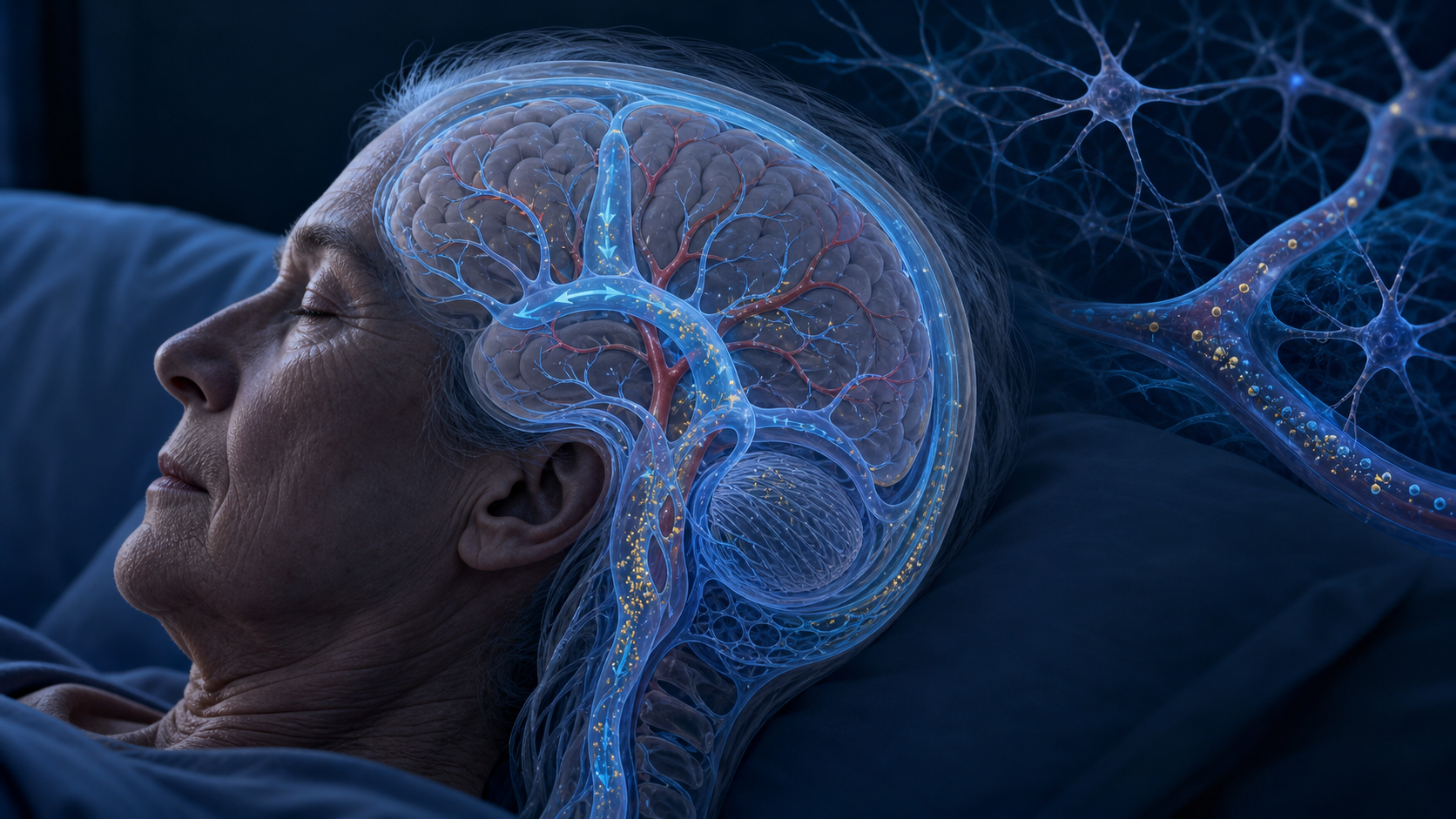
Glymphatic Clearance and Brain Aging: Sleep, Waste Removal, and Evidence
The glymphatic system may help clear brain metabolites during sleep. Learn how it works, how aging may alter it, and what current evidence can and cannot prove.
Table of Contents
DISCLAIMER
This article is for informational purposes only and does not constitute medical advice. The statements in this article have not been evaluated by the FDA. The information presented is based on published research and should not be used as a substitute for professional medical guidance. Consult your physician before starting any supplement or health protocol.
The brain produces metabolic by-products while its cells signal, repair, and maintain themselves. Unlike most tissues, it does not contain conventional lymphatic vessels throughout its interior. That raised a basic question: how does the brain move dissolved waste and proteins away from the spaces around its cells?
The glymphatic system is one influential answer. First described in animal research, the model proposes that cerebrospinal fluid enters along spaces surrounding arteries, exchanges with interstitial fluid, and carries solutes toward routes beside veins and out through meningeal lymphatic and other drainage pathways.
The idea has transformed sleep research, but popular descriptions often race ahead of evidence. The brain does not become chemically spotless every night, and no supplement or sleeping position has been proven to “flush toxins” on command.
How Glymphatic Flow Is Thought to Work
Cerebrospinal fluid surrounds the brain and spinal cord. In the glymphatic model, some of this fluid moves along perivascular spaces that accompany penetrating blood vessels. Exchange with the interstitial space allows dissolved molecules to move toward exit pathways.
Astrocytes—support cells whose endfeet wrap around vessels—are central to the model. Their membranes contain aquaporin-4 water channels. Animal experiments suggest the organization of these channels influences fluid movement and solute clearance, although the exact contribution remains debated.
Movement is likely driven by several forces rather than a single pump. Arterial pulsation, breathing, body movement, pressure gradients, and slow vascular oscillations may all contribute. Meningeal lymphatic vessels then provide one route connecting fluid around the brain with lymph nodes in the neck.
Scientists still debate how much transport occurs through bulk flow versus diffusion, how pathways differ across brain regions, and how well rodent findings translate to humans. “Glymphatic” is a useful framework, not a final map of every clearance mechanism.
Why Sleep Changes Brain Fluid Dynamics
The landmark 2013 study “Sleep Drives Metabolite Clearance from the Adult Brain” reported that interstitial space expanded in sleeping or anesthetized mice and that solute clearance increased compared with wakefulness. This helped create the widely repeated claim that sleep allows the brain to take out its trash.
Human research is harder because investigators cannot use the same invasive tracers or measurements in healthy volunteers. MRI, electroencephalography, and fluid biomarkers provide indirect windows. Studies have observed coordinated slow-wave activity, blood-volume changes, and cerebrospinal-fluid oscillations during non-REM sleep.
These findings make biological sense: deep non-REM sleep features large, synchronized neural slow waves and distinctive vascular activity. Yet the relationship between a wearable’s “deep sleep minutes” and actual solute clearance is unknown. Consumer devices infer stages from motion, heart rate, and sometimes temperature; they do not see cerebrospinal fluid moving.
Sleep also supports memory, immune regulation, metabolic control, and cardiovascular recovery. Even if the glymphatic model evolves, adequate sleep remains important for many independent reasons.
What Aging May Do to Clearance Pathways
Animal studies suggest that glymphatic transport can become less efficient with age. Possible contributors include reduced arterial pulsatility, changes in aquaporin-4 organization, sleep fragmentation, inflammation, and alterations in meningeal lymphatic drainage.
Vascular health is deeply connected. Perivascular spaces depend on the shape and motion of blood vessels. Hypertension, small-vessel disease, and arterial stiffening may change the forces that drive fluid exchange. This creates a plausible bridge among vascular aging, sleep, and neurodegeneration.
Researchers are especially interested in amyloid-beta and tau because their accumulation is associated with Alzheimer’s disease. Laboratory studies show that sleep and clearance pathways influence these proteins. However, it would be incorrect to claim that sleeping more guarantees prevention or that poor glymphatic flow is the sole cause of dementia.
Neurodegenerative disease can itself disrupt sleep, blood vessels, astrocytes, and fluid pathways. Cause and consequence may form a cycle. Long-term human studies are needed to determine which measurements predict disease and whether changing flow meaningfully changes outcomes.
Can Technology Measure or Improve Glymphatic Function?
Researchers use dynamic contrast MRI, diffusion imaging, phase-contrast MRI, PET tracers, and analysis of enlarged perivascular spaces. Each technique measures a different aspect and has limitations. Contrast introduced into cerebrospinal fluid is invasive and generally reserved for specific research or clinical contexts.
Noninvasive MRI methods are advancing, but there is no universally accepted clinical “glymphatic score.” Enlarged perivascular spaces on a scan can have multiple meanings and should be interpreted by qualified clinicians rather than converted into a DIY clearance diagnosis.
Intervention research includes sleep enhancement, exercise, vascular risk management, and in laboratory settings, manipulation of lymphatic or aquaporin pathways. Some animal work suggests body position affects clearance, but evidence is not strong enough to prescribe one sleep posture as a brain-detox technique for humans.
The safest practical approach is less exotic: protect sleep opportunity, keep a regular schedule, exercise, manage blood pressure and metabolic risks, and seek evaluation for suspected sleep apnea. Apnea repeatedly fragments sleep and lowers oxygen, creating reasons for concern beyond glymphatic theory.
The Bottom Line
The glymphatic system has given neuroscience a compelling way to study how sleep, blood vessels, glial cells, and brain fluid interact. Evidence strongly supports dynamic clearance pathways and sleep-dependent changes, while important details remain unsettled.
Treat headlines about “washing the brain” as metaphors. No wearable can directly measure the process, and no consumer product has proved it can rejuvenate brain clearance. The durable message is simpler: sleep and vascular health are foundational to brain aging, even as scientists continue to refine the plumbing diagram.
This article is for educational purposes and is not medical advice.
Frequently Asked Questions
What is the glymphatic system?
Does deep sleep clean the brain?
Can a consumer device measure glymphatic clearance?
Sources
Stay Updated on Longevity Science
Weekly research digests. No spam, unsubscribe anytime.
Related Articles

3D Bioprinting for Aging: Can We Print Replacement Organs and Tissues?
Explore how 3D bioprinting may address age-related organ failure by creating functional replacement tissues. Review current capabilities and future prospects.
12 min read
AI Diagnostics for Aging: Detecting Early Signs of Biological Decline
Learn how AI-powered diagnostic tools detect early aging markers from medical images, blood tests, and wearable data to enable proactive longevity interventions.
12 min read
AI Drug Discovery for Longevity: What Research Is Coming
How artificial intelligence is accelerating longevity drug discovery, from target identification to clinical trial design, and what it means for aging research.
13 min read