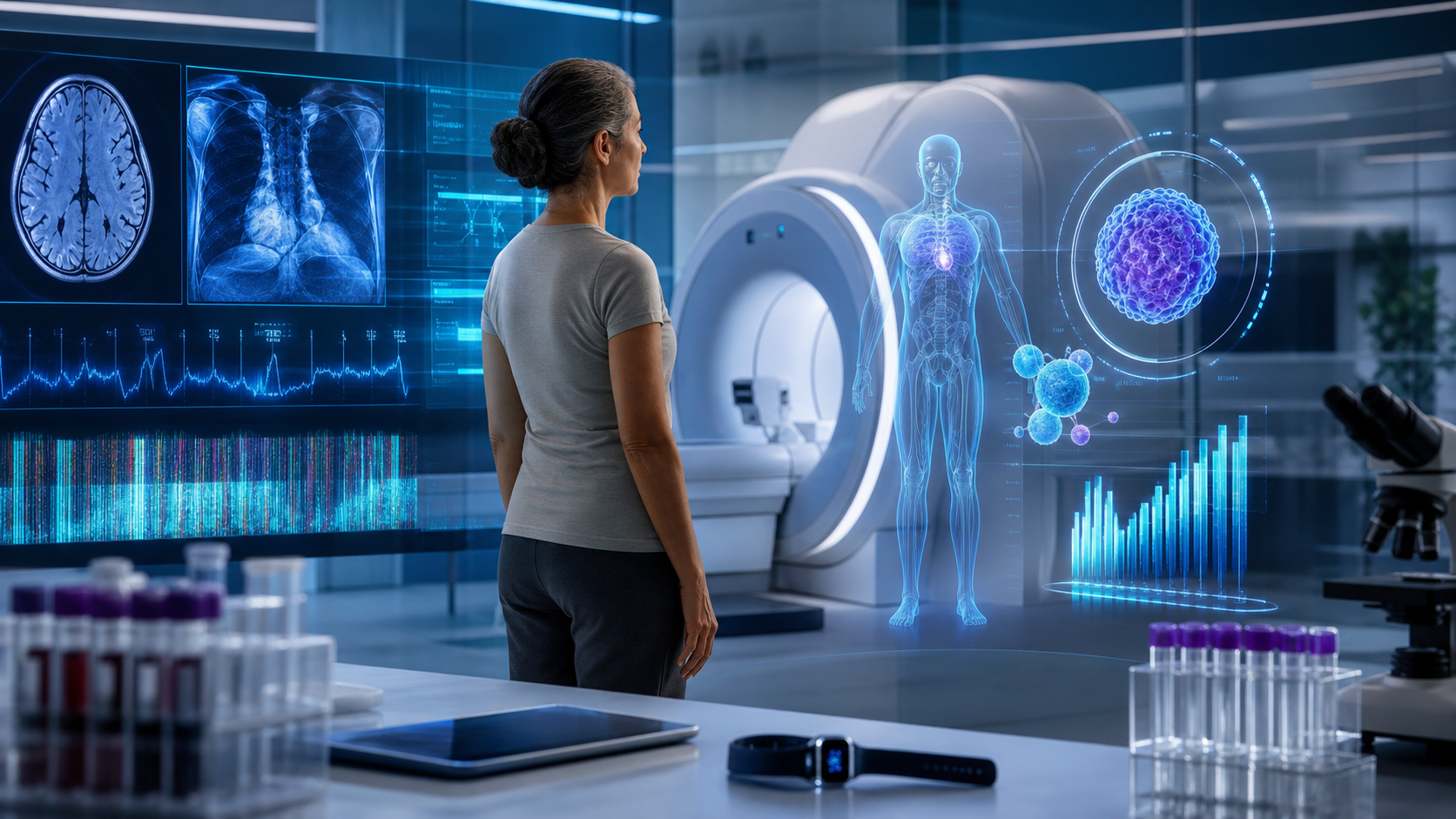
AI Diagnostics for Aging: Detecting Early Signs of Biological Decline
Learn how AI-powered diagnostic tools detect early aging markers from medical images, blood tests, and wearable data to enable proactive longevity interventions.
Table of Contents
DISCLAIMER
This article is for informational purposes only and does not constitute medical advice. The statements in this article have not been evaluated by the FDA. The information presented is based on published research and should not be used as a substitute for professional medical guidance. Consult your physician before starting any supplement or health protocol.
Artificial intelligence is transforming how we detect, measure, and potentially intervene in the aging process. Where traditional aging assessment relies on a few standard biomarkers and subjective clinical evaluation, AI systems can analyze thousands of data points simultaneously, identifying patterns of aging too subtle or complex for human clinicians to detect. From retinal photographs that reveal cardiovascular age to voice recordings that detect early neurodegeneration, AI is opening entirely new windows into biological aging.
The convergence of AI with aging science has produced tools that may fundamentally change how we approach healthy aging: shifting from reactive treatment of age-related diseases after they manifest to proactive detection and intervention at the earliest molecular and physiological stages of decline (Zhavoronkov et al., 2021; PMID: 33358279).
AI-Powered Biological Age Assessment
Deep Learning from Medical Images
Deep learning algorithms have demonstrated remarkable ability to estimate biological age from various types of medical images.
Retinal Age: AI models trained on retinal photographs can predict chronological age with impressive accuracy and, more importantly, identify individuals whose “retinal age” exceeds their chronological age. This retinal age gap has been associated with increased risk of mortality and cardiovascular disease. The retina is the only place where blood vessels can be directly visualized non-invasively, making it a uniquely informative window into vascular aging.
Brain Age: Deep learning models analyzing brain MRI scans can estimate brain age and detect accelerated brain aging. The brain age gap (difference between predicted and chronological age) has been associated with cognitive decline, neurodegenerative disease, and mortality. These models can identify patterns of brain atrophy and white matter change too subtle for visual assessment.
Facial Age: AI facial age estimation, while seemingly superficial, has been shown to correlate with health outcomes. Individuals who appear older than their chronological age tend to have increased mortality risk. AI systems can assess facial aging more consistently and objectively than human observers.
Chest X-ray Age: Deep learning models trained on chest X-rays can estimate biological age based on cardiac size, lung appearance, and skeletal features. Chest X-ray age has been associated with cardiovascular disease and mortality risk.
Blood Biomarker Analysis
AI algorithms can analyze standard blood test results to generate biological age estimates (Pyrkov et al., 2021; PMID: 34255799). By applying machine learning to combinations of routine biomarkers (complete blood count, metabolic panel, lipid panel, inflammatory markers), these tools can identify aging patterns that are not apparent from any single biomarker.
Several companies have developed AI-powered biological age calculators based on blood work. These tools may democratize biological age assessment, as the underlying blood tests are inexpensive and widely available.
Multi-Modal Integration
The most sophisticated AI aging assessment tools integrate data from multiple sources: blood biomarkers, medical images, genomic data, wearable device data, and clinical measurements. By combining these diverse data streams, AI models can generate comprehensive aging profiles that capture different dimensions of the aging process.
AI for Early Disease Detection in Aging
Cancer Screening
AI is improving early cancer detection through enhanced medical image analysis (identifying subtle abnormalities in mammograms, CT scans, and pathology slides), liquid biopsy analysis (detecting circulating tumor DNA fragments with greater sensitivity), and multi-cancer early detection tests that combine AI with proteomic or genomic blood markers.
Neurodegenerative Disease
AI models can detect early signs of Alzheimer’s disease and Parkinson’s disease years before clinical diagnosis. Approaches include speech and language analysis (detecting subtle cognitive changes reflected in word choice, grammar, and fluency), gait and movement analysis using smartphone or wearable sensors, and analysis of retinal changes associated with neurodegenerative pathology.
Cardiovascular Risk
AI can improve cardiovascular risk prediction beyond traditional risk calculators by integrating genetic, proteomic, imaging, and lifestyle data. Deep learning models analyzing coronary calcium CT scans or echocardiograms can detect subclinical cardiovascular aging with greater accuracy than traditional methods (Lu et al., 2019; PMID: 30669119).
AI-Driven Intervention Optimization
Beyond diagnosis, AI is being applied to optimize anti-aging interventions.
Personalized Supplement and Drug Recommendations
AI models that integrate individual health data, genetic information, and treatment response patterns may enable more personalized longevity recommendations. While still in early stages, companies are developing platforms that suggest supplement stacks, dietary modifications, and exercise prescriptions tailored to individual aging profiles.
Clinical Trial Design
AI is accelerating longevity clinical trials by identifying optimal patient populations, predicting treatment responses, and designing adaptive trial protocols. These capabilities may significantly reduce the time and cost of bringing anti-aging therapies to market.
Drug Repurposing
AI analysis of existing drug databases and molecular interaction networks has identified potential anti-aging applications for drugs developed for other purposes. This drug repurposing approach can dramatically shorten development timelines.
Privacy and Ethical Considerations
The use of AI in aging assessment raises important privacy and ethical concerns. The health data used to train and operate AI aging models is highly personal and sensitive. Algorithmic bias may lead to less accurate aging assessment for underrepresented populations. The psychological impact of receiving a biological age significantly older than chronological age requires careful consideration. And the potential for insurance or employment discrimination based on AI-assessed biological age must be addressed through policy.
Frequently Asked Questions
How accurate are AI biological age estimates? Current AI biological age models typically predict chronological age within 2-5 years and can identify individuals aging faster or slower than average. However, there is no gold standard for “true” biological age, making accuracy assessment challenging. The most clinically useful AI aging models are those that predict health outcomes (mortality, disease risk) rather than simply matching chronological age.
Can I get an AI-powered aging assessment today? Yes, several services offer AI-powered biological age assessment. Some use standard blood test results that can be obtained from any laboratory. Others offer more comprehensive assessments including genetic analysis, retinal imaging, or multi-modal data integration. These services range from free online tools using basic inputs to premium services costing several hundred dollars for comprehensive analysis. Results should be interpreted as one piece of information within a broader health picture.
Will AI replace doctors in aging medicine? AI is more likely to augment than replace physicians in aging medicine. AI excels at pattern recognition across large datasets, identifying subtle changes, and processing multiple data streams simultaneously. However, clinical judgment, patient communication, treatment decision-making in complex cases, and the human aspects of healthcare will continue to require physician expertise. The most effective approach will likely be AI-physician collaboration, where AI handles data analysis and pattern detection while physicians provide clinical interpretation, patient counseling, and treatment decisions.
Sources
Stay Updated on Longevity Science
Weekly research digests. No spam, unsubscribe anytime.
Related Articles
3D Bioprinting for Aging: Can We Print Replacement Organs and Tissues?
Explore how 3D bioprinting may address age-related organ failure by creating functional replacement tissues. Review current capabilities and future prospects.
12 min read
AI Drug Discovery for Longevity: What Research Is Coming
How artificial intelligence is accelerating longevity drug discovery, from target identification to clinical trial design, and what it means for aging research.
13 min read
AI-Powered Longevity Drug Discovery: Machine Learning Meets Anti-Aging
Explore how AI is transforming longevity drug discovery in 2026, from target identification to clinical trial design and geroprotector screening.
8 min read