3D Bioprinting for Aging: Can We Print Replacement Organs and Tissues?
Explore how 3D bioprinting may address age-related organ failure by creating functional replacement tissues. Review current capabilities and future prospects.
Table of Contents
DISCLAIMER
This article is for informational purposes only and does not constitute medical advice. The statements in this article have not been evaluated by the FDA. The information presented is based on published research and should not be used as a substitute for professional medical guidance. Consult your physician before starting any supplement or health protocol.
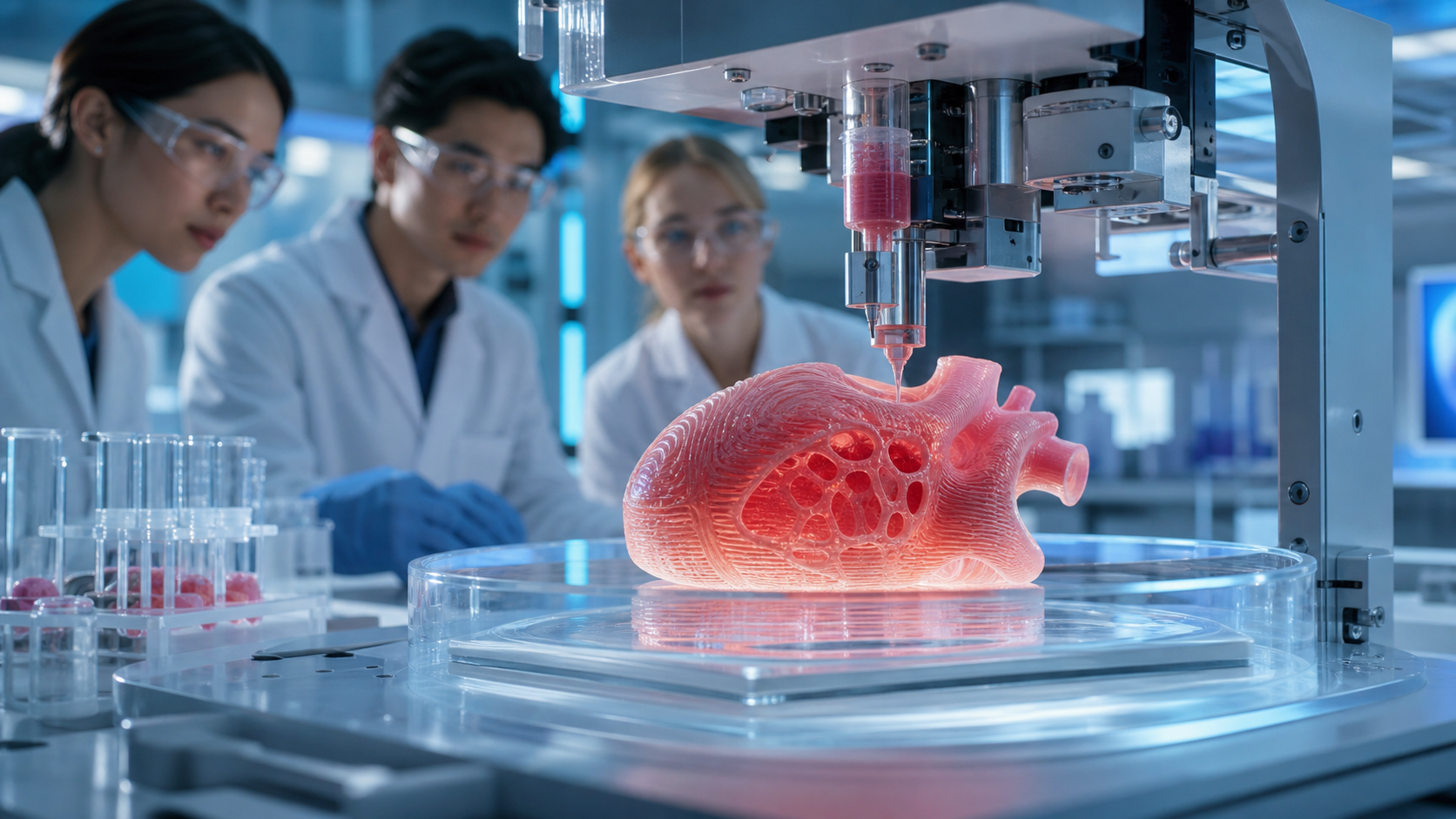
As the global population ages, the gap between the demand for organ transplants and the available supply grows ever wider. In the United States alone, more than 100,000 people await organ transplants, with a new name added to the waitlist every 10 minutes. Age-related organ failure, from hearts and kidneys to livers and lungs, is a primary driver of mortality in older adults. 3D bioprinting, the layer-by-layer construction of living tissues using cells and biomaterials, offers a transformative vision: the ability to manufacture replacement organs on demand, potentially eliminating transplant waiting lists and providing aging individuals with functional tissue replacements when their own organs fail.
While fully functional, transplantable whole organs remain a future goal, the field has made remarkable progress in printing simpler tissues and tissue components that are already finding clinical and research applications (Murphy & Atala, 2014; PMID: 24651372).
How 3D Bioprinting Works
3D bioprinting adapts additive manufacturing technology for biological materials. The process involves three main components.
Bioink: A combination of living cells and a supportive biomaterial (hydrogel, collagen, gelatin, or synthetic polymer) that can be extruded through a print nozzle. The bioink must protect cells during printing while providing structural support and biological cues for tissue maturation.
The Bioprinter: A robotic system that deposits bioink in precise three-dimensional patterns according to a digital blueprint. Major bioprinting approaches include extrusion-based (pushing bioink through a nozzle), inkjet-based (depositing droplets of bioink), laser-assisted (using laser energy to transfer bioink), and stereolithography-based (using light to crosslink photosensitive bioinks).
Post-Printing Maturation: Printed constructs are typically cultured in bioreactors that provide mechanical stimulation, nutrient flow, and growth factors to promote tissue maturation and functional development over days to weeks.
Current Capabilities and Applications
Skin Bioprinting
Skin is one of the most advanced bioprinting applications and highly relevant to aging (Yan et al., 2020; PMID: 32066437). Bioprinted skin grafts containing multiple cell types (keratinocytes, fibroblasts, melanocytes) organized in layers mimicking the epidermis and dermis are in clinical development. For aging applications, bioprinted skin could potentially replace age-damaged skin, deliver anti-aging factors, or serve as research platforms for testing anti-aging cosmetic and pharmaceutical products.
Cartilage
Cartilage bioprinting is advancing rapidly due to cartilage’s relatively simple structure (avascular, single cell type). Age-related joint degeneration (osteoarthritis) affects millions of older adults, and bioprinted cartilage implants could potentially replace damaged joint surfaces. Several groups have demonstrated functional cartilage constructs in animal models.
Bone
Bioprinted bone grafts combining calcium phosphate scaffolds with osteoblasts and growth factors are being developed for age-related bone loss and fracture repair. These constructs can be customized to match the specific geometry of individual defects (Heinrich et al., 2020; PMID: 32753672).
Blood Vessels
Printing functional blood vessels is critical for the viability of any large tissue construct, as cells cannot survive more than 100-200 micrometers from a blood supply. Several groups have successfully printed vascular networks within tissue constructs, a crucial step toward larger organ-scale printing.
Cardiac Tissue
Bioprinted cardiac patches containing cardiomyocytes have demonstrated contractile function in vitro and improved cardiac function when implanted in animal models of heart injury. These patches could potentially be used to repair age-related cardiac damage without requiring full heart transplantation.
Challenges for Organ-Scale Bioprinting
Vascularization
The single greatest challenge in bioprinting functional organs is creating the complex, hierarchical vascular network (from large arteries down to capillaries) needed to sustain thick tissues. Without adequate vascularization, cells in the interior of a printed construct will die from oxygen and nutrient deprivation. Significant progress is being made through sacrificial printing (printing channels that are later dissolved to create hollow vessels), self-assembling vascular networks from endothelial cells, and multi-material printing strategies.
Cell Sourcing
Printing a human-scale organ requires billions of cells. Generating these cells in sufficient quantities while maintaining their function and viability is a major manufacturing challenge. Induced pluripotent stem cells (iPSCs) offer a theoretically unlimited cell source that can be differentiated into any cell type, but the efficiency and consistency of differentiation remain challenges.
Innervation
Most organs require nervous system connections for proper function. Integrating neural elements into bioprinted constructs is still in early stages.
Maturation and Function
Even when the correct cells are placed in the right positions, achieving the functional maturity of native tissue requires extended culture under appropriate conditions. The bioreactor systems needed for organ-scale maturation are still being developed.
Relevance to Aging
Bioprinting intersects with aging in several important ways. It could address age-related organ failure by providing replacement tissues when native organs deteriorate beyond repair. It enables research by creating aged tissue models for studying age-related diseases and testing interventions. Patient-specific constructs printed using the patient’s own cells (or iPSCs derived from them) could avoid immune rejection, particularly important for elderly patients with compromised immune systems. And the combination of bioprinting with rejuvenation technologies, such as printing tissues from epigenetically rejuvenated cells, could theoretically produce young tissue from an old patient’s cells.
Timeline and Expectations
Simple tissues (skin grafts, cartilage patches) are likely to reach clinical use within the next few years. Tissue patches for heart, liver, and kidney repair may become available in the 2030s. Whole organ bioprinting, if achieved, is likely a decade or more away and will require solutions to the vascularization, innervation, and maturation challenges.
Frequently Asked Questions
Can we already 3D print functional organs? Not yet. While researchers have bioprinted miniature organs (organoids) and tissue patches that demonstrate some organ-level functions, fully functional, transplantable human-scale organs have not yet been achieved. The main obstacles are creating adequate blood vessel networks, sourcing billions of cells, and achieving functional maturation. Simpler tissues like skin and cartilage are closer to clinical use.
Could bioprinting make organ transplant waiting lists obsolete? This is the long-term vision. If fully functional organs can be bioprinted from a patient’s own cells, it could eliminate both the supply shortage and the need for immunosuppressive drugs. However, achieving this vision will require significant advances in vascularization technology, cell manufacturing, and post-printing maturation. Realistically, this is a goal for the 2030s and beyond.
How does bioprinting relate to anti-aging research? Bioprinting could extend healthy lifespan by replacing organs that fail with age, creating research platforms for understanding and testing anti-aging interventions, potentially combining with cellular rejuvenation to produce young replacement tissues from aged cells, and enabling personalized medicine approaches for elderly patients. The intersection of bioprinting and rejuvenation biology is particularly exciting, as it suggests the possibility of manufacturing biologically young tissues for aged individuals.
Sources
Stay Updated on Longevity Science
Weekly research digests. No spam, unsubscribe anytime.
Related Articles
AI Diagnostics for Aging: Detecting Early Signs of Biological Decline
Learn how AI-powered diagnostic tools detect early aging markers from medical images, blood tests, and wearable data to enable proactive longevity interventions.
12 min read
AI Drug Discovery for Longevity: What Research Is Coming
How artificial intelligence is accelerating longevity drug discovery, from target identification to clinical trial design, and what it means for aging research.
13 min read
AI-Powered Longevity Drug Discovery: Machine Learning Meets Anti-Aging
Explore how AI is transforming longevity drug discovery in 2026, from target identification to clinical trial design and geroprotector screening.
8 min read