Spirometry and Lung Age: What Breathing Tests Reveal About Healthy Aging
Spirometry and lung age can reveal changes in airflow, but the numbers need context. Learn what FEV1, FVC, trajectories, and research actually show.
Table of Contents
DISCLAIMER
This article is for informational purposes only and does not constitute medical advice. The statements in this article have not been evaluated by the FDA. The information presented is based on published research and should not be used as a substitute for professional medical guidance. Consult your physician before starting any supplement or health protocol.
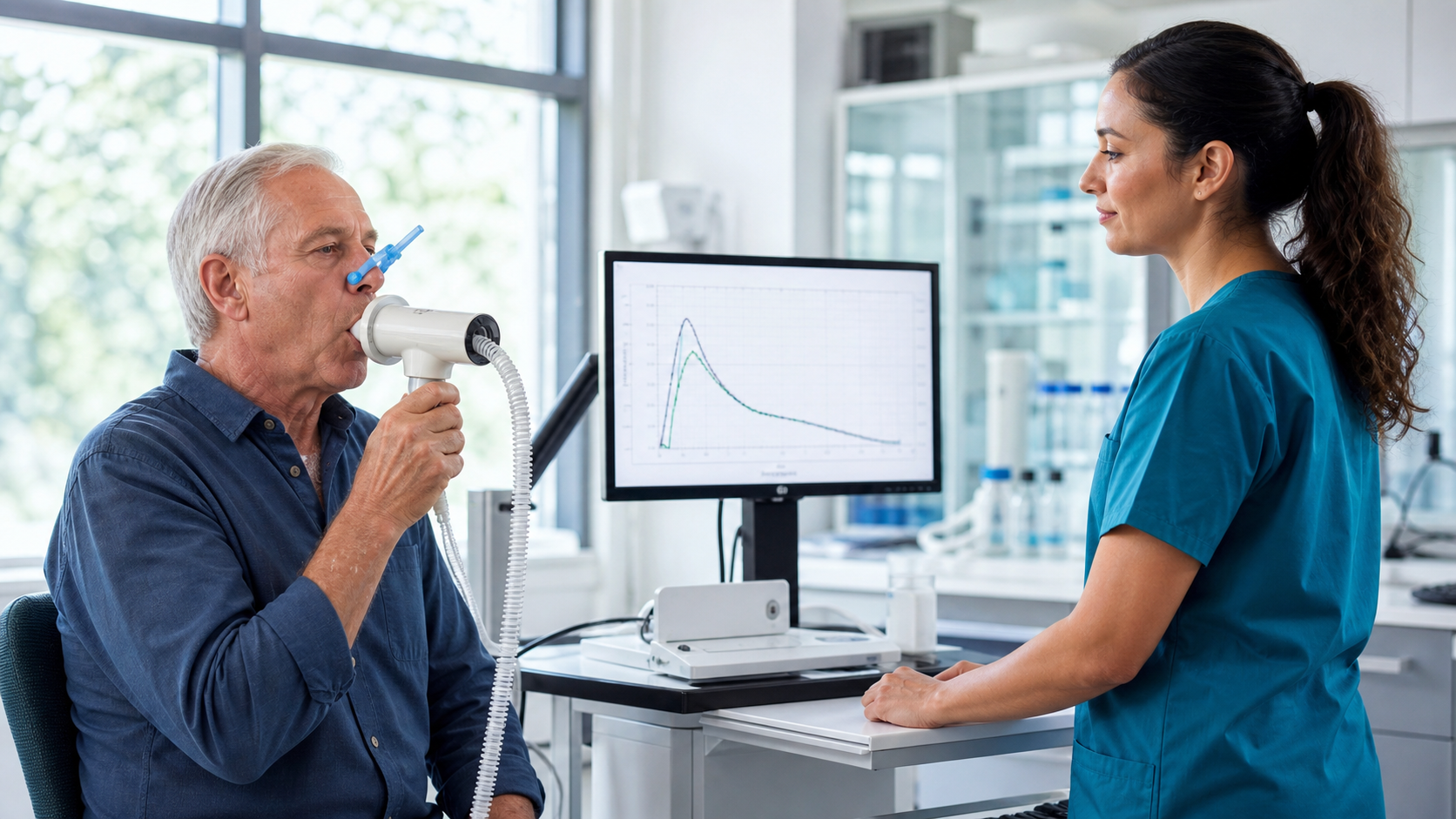
Spirometry and lung age offer a practical window into healthy aging because breathing capacity changes are measurable long before they become obvious in daily life. The test records how much air a person can forcefully exhale and how quickly it leaves the lungs. Those numbers can reflect airway caliber, lung elasticity, respiratory muscle effort, and the quality of the test itself.
The appeal of a “lung age” is simplicity. The limitation is also simplicity: lungs do not age on one universal schedule, and no single breathing number summarizes the entire respiratory system.
What Spirometry Measures
The two best-known values are forced vital capacity, or FVC, and forced expiratory volume in one second, or FEV1. FVC is the amount exhaled after a full inhalation. FEV1 is the amount expelled during the first second. The FEV1/FVC ratio helps identify patterns of airflow obstruction.
Modern interpretation compares a result with reference values that account for variables such as age, height, and sex. The Global Lung Function Initiative has developed equations across wide age ranges, but a reference range is still a statistical comparison—not a verdict about one person.
Test quality matters. The 2019 ATS/ERS spirometry standard emphasizes coaching, repeatable maneuvers, equipment checks, and correct reporting. A poor seal, hesitant start, cough, or early stop can distort results. That is why a home gadget reading and a clinical-quality test should not automatically be treated as equivalent.
What “lung age” adds
Lung age converts an airflow result, often FEV1, into the age of an average reference person with a similar value. It was designed partly to make an abstract measurement more understandable, especially in smoking-cessation conversations.
The translation can motivate attention, but it can also overstate certainty. Different equations may produce different ages. A person may receive an older lung age because of temporary illness, suboptimal effort, longstanding exposure, or true physiological change. The number should be interpreted with the underlying spirometry, symptoms, and clinical history.
How Lung Function Changes Across Adulthood
Lung function typically grows through childhood and adolescence, reaches a plateau in early adulthood, and then gradually declines. Aging can alter chest-wall mechanics, respiratory muscle performance, elastic recoil, airway closure, and gas exchange. The pace is not fixed.
Longitudinal research has challenged the idea that chronic obstructive pulmonary disease follows one pathway. Some adults reach a lower peak lung function and decline at an otherwise ordinary rate. Others begin with normal function and experience a faster decline. This trajectory view matters because late-life lung capacity can reflect both the peak achieved earlier and the losses accumulated later.
Smoking is a major modifiable exposure, but it is not the only one. Air pollution, occupational dusts and fumes, asthma, respiratory infections, socioeconomic conditions, early-life development, and other health conditions may shape the curve. Genetics and measurement variability also contribute.
Lung function is not aerobic fitness
Spirometry and VO2 max answer different questions. Spirometry measures ventilatory flows and volumes. VO2 max reflects the integrated ability of the lungs, heart, blood, and muscles to transport and use oxygen during exercise. A person can have normal spirometry and limited aerobic capacity, or abnormal spirometry with better-than-expected functional fitness.
This distinction prevents a common mistake: treating one respiratory test as a complete longevity score.
What the Research Can—and Cannot—Tell You
Population studies consistently associate lower lung function with less favorable health outcomes, including greater cardiopulmonary risk. Those associations do not mean that an FEV1 number independently causes every outcome. Lung function may reflect cumulative exposures, inflammation, frailty, cardiovascular health, and socioeconomic conditions.
Repeated measurements are more informative than a single value when the goal is to understand change. Even then, technicians and clinicians need to consider biological variation and test quality. Small differences between two tests may be noise rather than meaningful decline.
Spirometry can help investigate persistent breathlessness, chronic cough, wheeze, or suspected airway disease, but symptoms require professional evaluation. Sudden or severe breathing difficulty is not a situation for a consumer longevity metric.
Practical Implications for Healthy Aging
The evidence supports protecting respiratory reserve across the life course. Avoiding tobacco smoke, reducing harmful workplace exposures, following air-quality guidance, staying physically active within personal capacity, and receiving appropriate preventive care may all contribute to respiratory health.
Regular movement does not necessarily increase FEV1 dramatically in a healthy adult, but it can improve cardiovascular fitness, muscle efficiency, and the ability to perform daily tasks with the lung capacity available. Strength work may also help preserve the muscles and posture involved in effective breathing.
If spirometry is repeated, consistency matters: similar equipment, qualified supervision, and attention to testing standards make trends easier to interpret. The result should sit beside symptoms, medical history, exposure history, and other measures—not above them.
The Bottom Line
Spirometry can reveal important changes in airflow and help map a lung-function trajectory, while lung age can make the result easier to grasp. Neither is a standalone biological-age test. The most useful question is not “How old are my lungs?” but “Is this a reliable measurement, how has it changed, and what context explains it?”
Frequently Asked Questions
What does lung age mean on a spirometry test?
Which spirometry number changes with age?
Can one spirometry test show how fast lungs are aging?
Sources
Stay Updated on Longevity Science
Weekly research digests. No spam, unsubscribe anytime.
Related Articles
Arterial Calcification and Vascular Aging: Reading the Risk Signals
Arterial calcification can reveal accumulated vascular risk. Learn what calcium scores mean, why calcification develops, and where testing has limits.
10 min read
Arterial Stiffness and Vascular Age: A Longevity Evidence Guide
Understand arterial stiffness vascular age longevity links, key studies, measurement limits, and evidence-based lifestyle implications for healthy aging.
11 min read
Arterial Stiffness and Vascular Aging: What the Evidence Shows
Explore arterial stiffness vascular aging, how vessels change over time, what pulse wave velocity studies show, and practical ways evidence may inform prevention.
10 min read