Arterial Stiffness and Vascular Age: A Longevity Evidence Guide
Understand arterial stiffness vascular age longevity links, key studies, measurement limits, and evidence-based lifestyle implications for healthy aging.
Table of Contents
DISCLAIMER
This article is for informational purposes only and does not constitute medical advice. The statements in this article have not been evaluated by the FDA. The information presented is based on published research and should not be used as a substitute for professional medical guidance. Consult your physician before starting any supplement or health protocol.
Introduction
Arterial stiffness vascular age longevity research asks a deceptively simple question: do the arteries look and function like those of someone younger, older, or about the same age? In longevity science, that question matters because the vascular system is not only a set of pipes. It is a living, adaptive organ network that helps regulate blood flow, pressure, oxygen delivery, inflammation, and communication between tissues.
As people age, large elastic arteries such as the aorta often become less compliant. Instead of cushioning each heartbeat, a stiffer artery transmits pressure more forcefully into smaller vessels. Over decades, this may contribute to higher systolic blood pressure, wider pulse pressure, greater cardiac workload, and stress on organs with delicate microcirculation, including the brain and kidneys.
“Vascular age” is a shorthand for this functional state. It does not mean a person has one exact vascular birthday. Rather, it is an estimate based on markers that tend to change with age and risk exposure. Pulse wave velocity, especially carotid-femoral pulse wave velocity, is commonly described as a direct noninvasive marker of aortic stiffness. The faster the pressure wave travels, the stiffer the artery is thought to be.
For longevity readers, arterial stiffness is compelling because it bridges conventional cardiovascular risk and biological aging. It is influenced by chronological age, blood pressure, metabolic health, kidney function, inflammation, physical activity, and connective tissue remodeling. It may also help explain why two people with the same chronological age can have very different cardiovascular resilience.
This guide reviews what arterial stiffness means, how it connects to vascular age, what major studies have found, and what practical implications can be drawn without turning an educational marker into a diagnosis or a promise.
The Science
What arterial stiffness measures
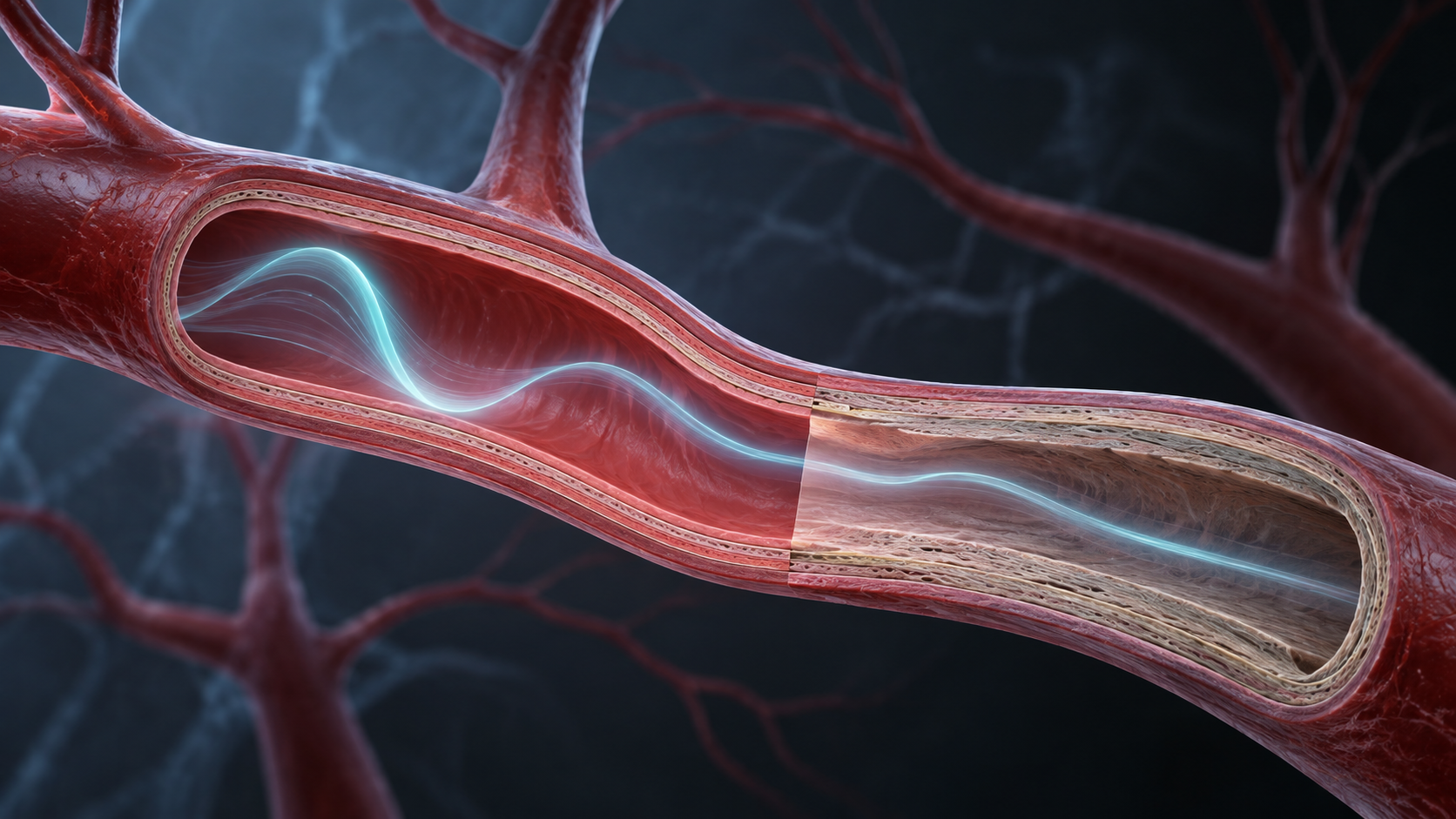
Arteries are designed to stretch and recoil. When the heart contracts, the aorta expands to absorb part of the pressure wave. When the heart relaxes, elastic recoil helps maintain forward blood flow. This buffering function is sometimes called the Windkessel effect.
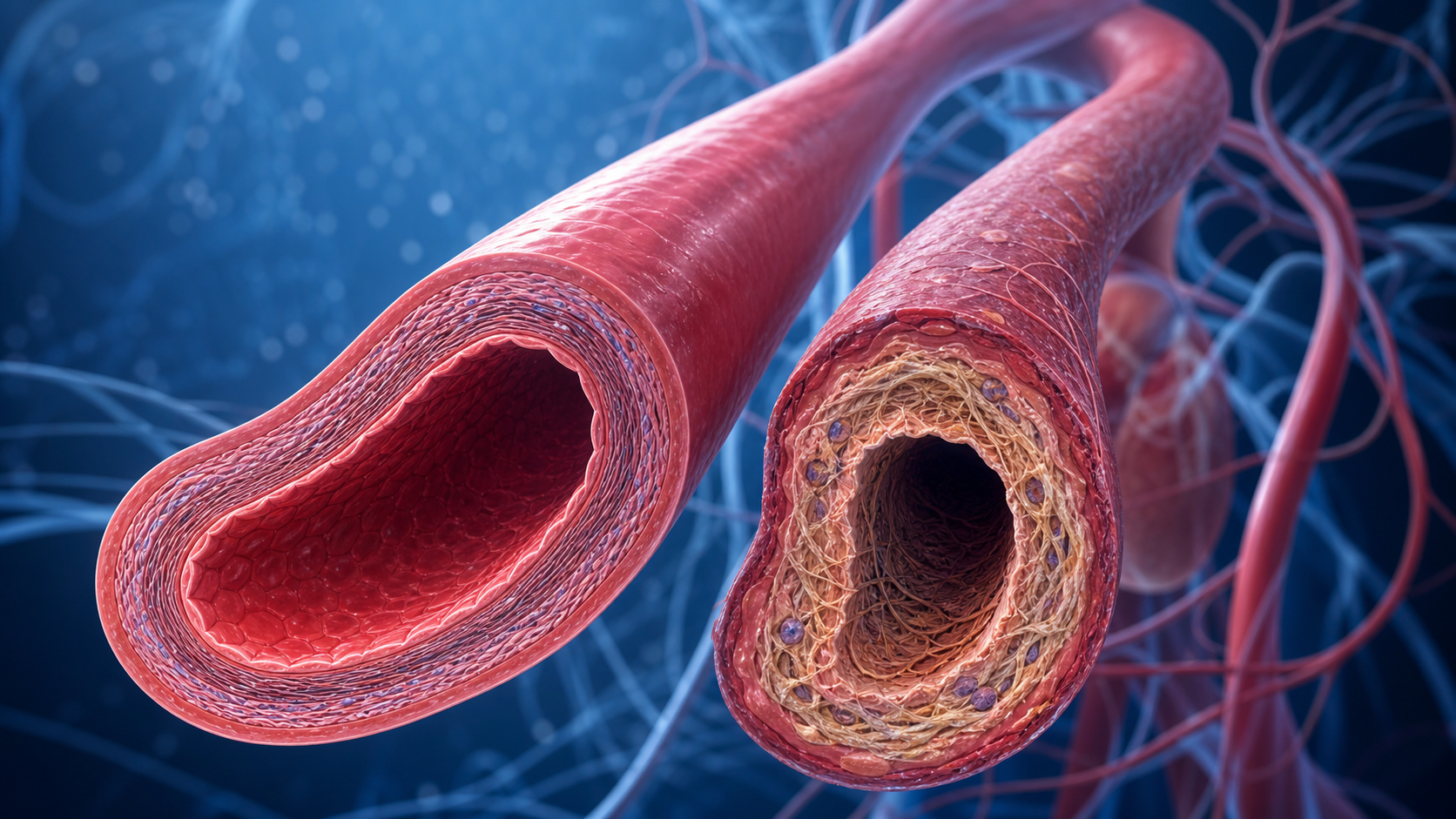
With aging and cumulative risk exposure, the arterial wall may become less elastic. Elastin fibers can fragment, collagen can become more dominant, and advanced glycation end products may cross-link structural proteins. Smooth muscle tone, endothelial function, inflammation, calcification, and extracellular matrix turnover may all contribute to the final stiffness signal.
Pulse wave velocity measures how fast the pressure wave moves through the arterial tree. In general, pressure waves travel faster through stiffer tubes. Carotid-femoral pulse wave velocity is often used as a reference method because it approximates stiffness of the aorta, a central artery with major effects on cardiac load and downstream pressure transmission.
Other methods include brachial-ankle pulse wave velocity, cardio-ankle vascular index, augmentation index, central blood pressure estimates, and imaging-based measures of aortic distensibility. These tools do not measure identical biology. Some are more influenced by current blood pressure, heart rate, body size, or peripheral arterial properties. That is one reason a single result should usually be interpreted cautiously.
Why vascular age is not just chronological age
Chronological age is the number of years lived. Vascular age is an attempt to estimate accumulated vascular wear, repair, and functional reserve. It is shaped by time, but not only by time.
A 55-year-old with long-standing high blood pressure, insulin resistance, low physical activity, and chronic kidney strain may show a stiffer arterial profile than expected for age. Another 55-year-old with favorable cardiometabolic markers may show a lower pulse wave velocity than expected. This does not prove that one person will live longer than the other, but it may indicate different cardiovascular risk patterns.
The Reference Values for Arterial Stiffness Collaboration, published in the European Heart Journal in 2010, pooled data from 16,867 individuals and showed that pulse wave velocity rises with both age and blood pressure category. The age effect appeared stronger when blood pressure was higher, suggesting that vascular aging may be accelerated when mechanical load is chronically elevated.
This interaction is important. Arterial stiffness is both a marker and a possible contributor. Stiffer arteries can raise systolic pressure and pulse pressure; higher pressure can further strain arterial walls. Over time, this may create a feedback loop in which vascular aging and pressure load reinforce each other.
Mechanisms linking stiffness to organ aging
The aorta normally buffers pulsatile energy before blood reaches smaller vessels. When the aorta stiffens, more pulsatile pressure may reach the microcirculation. Organs such as the brain and kidneys have high blood flow and low resistance, making them potentially vulnerable to pressure pulsatility.
Several biological pathways may connect arterial stiffness with age-related outcomes:
Endothelial function: The endothelium helps regulate vessel tone, clotting balance, inflammation, and nitric oxide signaling. Reduced nitric oxide availability and oxidative stress may contribute to less flexible arteries.
Extracellular matrix remodeling: Elastin degradation, collagen accumulation, and protein cross-linking may make large arteries more rigid. This overlaps with broader aging-science interest in extracellular matrix stiffness across tissues.
Inflammation: Chronic low-grade inflammation may influence vascular smooth muscle cells, endothelial cells, and matrix remodeling. This may connect arterial stiffness with the broader concept of inflammaging.
Metabolic stress: Glucose dysregulation and insulin resistance may promote glycation, oxidative stress, and vascular dysfunction. These processes may influence both vascular age and biological aging markers.
Mechanical load: Blood pressure is not merely a number on a cuff. It is a repeated mechanical force. Over millions of heartbeats per year, higher pressure may contribute to structural changes in the arterial wall.
These mechanisms are intertwined, which is why arterial stiffness can be difficult to interpret as a single causal pathway. It may reflect many layers of biology rather than one isolated process.
Key Research Findings
Laurent and colleagues: aortic stiffness predicted mortality in hypertension
A landmark study by Stéphane Laurent, Pierre Boutouyrie, and colleagues was published in Hypertension in 2001. The paper, “Aortic stiffness is an independent predictor of all-cause and cardiovascular mortality in hypertensive patients,” examined whether a direct measure of aortic stiffness could predict mortality in people with essential hypertension.
The study reported that aortic stiffness was independently associated with all-cause and cardiovascular mortality. Importantly, pulse pressure, an indirect marker of stiffening, was not independently associated with mortality in the same way after adjustment. This helped strengthen the case that direct stiffness measurement may capture risk-relevant information beyond standard blood pressure readings.
For longevity interpretation, this does not mean pulse wave velocity determines lifespan by itself. It suggests that in a higher-risk clinical population, aortic stiffness may reflect accumulated vascular damage and cardiovascular strain that are relevant to long-term outcomes.
Vlachopoulos meta-analysis: pulse wave velocity predicted events and death
In 2010, Charalambos Vlachopoulos, Konstantinos Aznaouridis, and Christodoulos Stefanadis published a systematic review and meta-analysis in the Journal of the American College of Cardiology. The analysis included 17 longitudinal studies with 15,877 participants and a mean follow-up of 7.7 years.
The findings were influential because they quantified risk across multiple populations. High versus low aortic pulse wave velocity was associated with higher risk of total cardiovascular events, cardiovascular mortality, and all-cause mortality. The authors also reported that each 1 m/s increase in aortic pulse wave velocity corresponded to higher adjusted risk for these outcomes.
This study is frequently cited because it moved arterial stiffness from a physiological curiosity toward a risk marker with longitudinal evidence. For longevity science, it supports the idea that vascular aging may be one measurable component of healthspan risk, particularly cardiovascular healthspan.
Framingham Heart Study: community-based evidence
Gary Mitchell and colleagues published “Arterial stiffness and cardiovascular events: the Framingham Heart Study” in Circulation in 2010. The study examined 2,232 participants, with a mean age of 63 years, and followed them for first-onset major cardiovascular events.
The study assessed multiple vascular measures, including pulse wave velocity, wave reflection, pressure amplification, and central pulse pressure. During follow-up, higher pulse wave velocity was associated with incident cardiovascular events. In a community-based cohort, this supported the relevance of arterial stiffness outside of narrowly selected high-risk groups.
The Framingham findings matter because many longevity readers are not thinking only about established disease. They are interested in early risk signals, resilience, and prevention-oriented conversations. Community cohort data suggest that arterial stiffness may have value as part of a broader risk picture, although it should not replace validated clinical risk assessment.
Reference values and the challenge of interpretation
The Reference Values for Arterial Stiffness Collaboration, published in the European Heart Journal in 2010, attempted to establish normal and reference values for pulse wave velocity. The collaboration pooled data from multiple European centers and showed clear effects of age and blood pressure category.
This helps explain why raw pulse wave velocity numbers can be misleading without context. A value that appears high for a younger adult may be closer to expected for an older adult with elevated blood pressure. Conversely, a “normal” value may still deserve attention if it is rising quickly or appears alongside other concerning biomarkers.
More recent work has expanded the reference-value discussion. A 2023 systematic review and meta-analysis in The Lancet Healthy Longevity examined global distributions of age- and sex-related arterial stiffness across 167 studies and more than 500,000 participants. The authors found that pulse wave velocity varies by age, sex, country, and measurement method. This reinforces the need for population-aware interpretation.
Estimated pulse wave velocity: useful but imperfect
Estimated pulse wave velocity, often calculated from age and blood pressure, has attracted interest because it can be derived from common clinical variables. A 2022 analysis by Kevin Heffernan, Janet Wilmoth, and Andrew London in Innovation in Aging used Health and Retirement Study data and found that estimated pulse wave velocity was independently associated with mortality among middle-aged and older adults in the United States.
This type of estimate may be useful for population studies and risk modeling, but it is not equivalent to directly measured arterial stiffness. Because age and blood pressure are part of the equation, estimated pulse wave velocity may partly repackage known risk factors. It may still add structure to risk discussions, but its interpretation should be careful.
For individuals, direct measurements and estimated scores answer different questions. Direct pulse wave velocity asks how the vascular system behaves during measurement. Estimated pulse wave velocity asks what stiffness might be expected from age and blood pressure. Both may be informative, but neither should be used as a stand-alone longevity score.
Practical Implications
What arterial stiffness may tell readers
Arterial stiffness may provide a window into vascular aging, especially when tracked over time and interpreted with conventional risk factors. It may help frame questions such as:
Is blood pressure placing excess mechanical load on the arteries?
Does the vascular profile appear older or younger than expected for chronological age?
Are lifestyle, metabolic, and clinical risk factors aligned with vascular resilience?
Is a result consistent across repeated measurements, or could it reflect a temporary state such as stress, caffeine intake, recent exercise, poor sleep, or device variability?
For readers interested in longevity, the most useful interpretation is usually not “my vascular age is X.” It is “what does this marker suggest about cardiovascular resilience, and what other data should be considered?”
How arterial stiffness is measured
Carotid-femoral pulse wave velocity is often described as the reference approach for central arterial stiffness. It measures the travel speed of the pulse wave between the carotid and femoral arteries. In research settings, this can be done with tonometry, cuffs, Doppler, or other validated devices.
Brachial-ankle pulse wave velocity is easier to measure in some settings and is widely used in parts of Asia. It includes both central and peripheral arterial segments, which may make it useful but somewhat different biologically from carotid-femoral measures.
Consumer devices and smart scales may estimate pulse wave velocity using indirect signals. These tools may help with trend awareness, but their readings can depend on proprietary algorithms, measurement position, temperature, hydration, and device validation. They should not be treated as equivalent to clinical vascular testing unless validation data support that use.
Lifestyle patterns associated with healthier vascular aging
Research broadly suggests that the same habits associated with cardiovascular health may also support more favorable vascular aging. These are educational implications, not individualized medical instructions.
Regular physical activity is one of the strongest general signals. Aerobic exercise is often associated with better endothelial function, lower resting blood pressure, and healthier arterial compliance. Resistance exercise may support metabolic health and muscle function, although very high-intensity or poorly programmed training can have complex short-term vascular effects. A balanced, sustainable activity pattern may be more relevant than any single exercise type.
Dietary patterns rich in minimally processed foods, fiber, legumes, vegetables, fruits, nuts, fish, and unsaturated fats tend to align with better cardiometabolic markers. Mediterranean-style dietary patterns have been associated with cardiovascular benefit in multiple lines of research, although arterial stiffness outcomes can vary by study design and population.
Sleep regularity may also matter. Poor sleep, sleep apnea, and circadian disruption are linked with blood pressure dysregulation and metabolic strain. The relationship is likely bidirectional, and readers with persistent sleep-related breathing concerns may benefit from clinician-guided evaluation.
Smoking avoidance is especially relevant for vascular aging. Tobacco exposure is associated with endothelial dysfunction, inflammation, oxidative stress, and higher cardiovascular risk. Even when arterial stiffness is not the primary outcome, the broader cardiovascular evidence makes smoking status central to vascular age discussions.
Stress physiology may influence vascular tone and blood pressure. Chronic stress does not translate neatly into one pulse wave velocity number, but repeated sympathetic activation, poor sleep, and less favorable health behaviors may plausibly affect vascular aging over time.
Biomarkers to view alongside vascular age
Arterial stiffness is more meaningful when placed next to other established markers. These may include blood pressure, ApoB or LDL cholesterol, triglycerides, fasting glucose, hemoglobin A1c, kidney function, high-sensitivity C-reactive protein, waist circumference, cardiorespiratory fitness, and family history.
The key is pattern recognition. A higher pulse wave velocity together with elevated systolic blood pressure, high ApoB, insulin resistance, and low fitness may carry a different implication than a single borderline stiffness reading in an otherwise low-risk profile. Likewise, a favorable vascular age estimate does not cancel out other major risks.
This is where longevity tracking can become more disciplined. Instead of chasing one “age” metric, readers may gain more from building a dashboard of complementary markers: vascular function, metabolic health, inflammation, body composition, fitness, and recovery.
Limitations and Future Research
Arterial stiffness research is strong in some areas and still developing in others. The association between pulse wave velocity and cardiovascular outcomes is well supported, but several limitations remain.
First, measurement methods vary. Carotid-femoral pulse wave velocity, brachial-ankle pulse wave velocity, cardio-ankle vascular index, augmentation index, and consumer-derived estimates do not capture identical signals. Device type, operator technique, body position, cuff placement, and calculation methods can change results.
Second, causality is difficult to isolate. Arterial stiffness may contribute to cardiovascular risk, but it also reflects age, blood pressure, kidney function, glucose metabolism, inflammation, and arterial structure. A change in pulse wave velocity may not always mean a direct change in long-term risk.
Third, reference values are population-dependent. Age, sex, ancestry, geography, body size, and blood pressure all influence distributions. A universal “good” or “bad” vascular age cutoff may oversimplify the biology.
Fourth, many intervention studies use short-term surrogate outcomes. A program may improve blood pressure, endothelial function, or pulse wave velocity over weeks or months, but that does not automatically prove improved longevity. Long-term outcomes require longer follow-up, careful controls, and clinically meaningful endpoints.
Future research may clarify how arterial stiffness interacts with epigenetic clocks, proteomic aging scores, metabolomic profiles, kidney aging, brain aging, and fitness measures. It may also help determine whether repeated pulse wave velocity tracking improves decision-making compared with standard cardiovascular risk assessment alone.
One promising direction is integrating vascular age into multi-marker aging models. A single biological age score can hide system-specific variation. Someone may have favorable immune aging markers but unfavorable vascular stiffness, or strong cardiorespiratory fitness but emerging metabolic risk. System-level aging profiles may become more useful than one composite number.
The Bottom Line
Arterial stiffness is one of the more evidence-supported ways to study vascular aging, and pulse wave velocity has been associated with cardiovascular events and mortality in major longitudinal research. For longevity, vascular age is best understood as a risk-context marker rather than a precise lifespan forecast.
The practical takeaway is measured and conservative: arterial stiffness may help readers think more clearly about cardiovascular resilience, especially when interpreted alongside blood pressure, metabolic markers, fitness, and clinical history. It is a useful signal, not a stand-alone verdict.
Frequently Asked Questions
What is vascular age, and how is it related to arterial stiffness?
Can pulse wave velocity predict longevity?
What can readers do with an arterial stiffness result?
Sources
- Aortic stiffness is an independent predictor of all-cause and cardiovascular mortality in hypertensive patients(2001)
- Prediction of cardiovascular events and all-cause mortality with arterial stiffness: a systematic review and meta-analysis(2010)
- Arterial stiffness and cardiovascular events: the Framingham Heart Study(2010)
- Determinants of pulse wave velocity in healthy people and in the presence of cardiovascular risk factors(2010)
- Recommendations for Improving and Standardizing Vascular Research on Arterial Stiffness(2015)
Stay Updated on Longevity Science
Weekly research digests. No spam, unsubscribe anytime.
Related Articles
Arterial Stiffness and Vascular Aging: What the Evidence Shows
Explore arterial stiffness vascular aging, how vessels change over time, what pulse wave velocity studies show, and practical ways evidence may inform prevention.
10 min read
Autophagy and Aging: Your Body's Cellular Cleanup System
Explore autophagy, your body's cellular cleanup system, and its critical role in aging and longevity. Research suggests modulating autophagy may support cellular health.
12 min read
Capillary Rarefaction and Aging: When Tissues Lose Their Smallest Blood Vessels
Capillary rarefaction can reduce microvascular reserve with age. This review separates human, animal, and cell evidence, plus limits.
15 min read