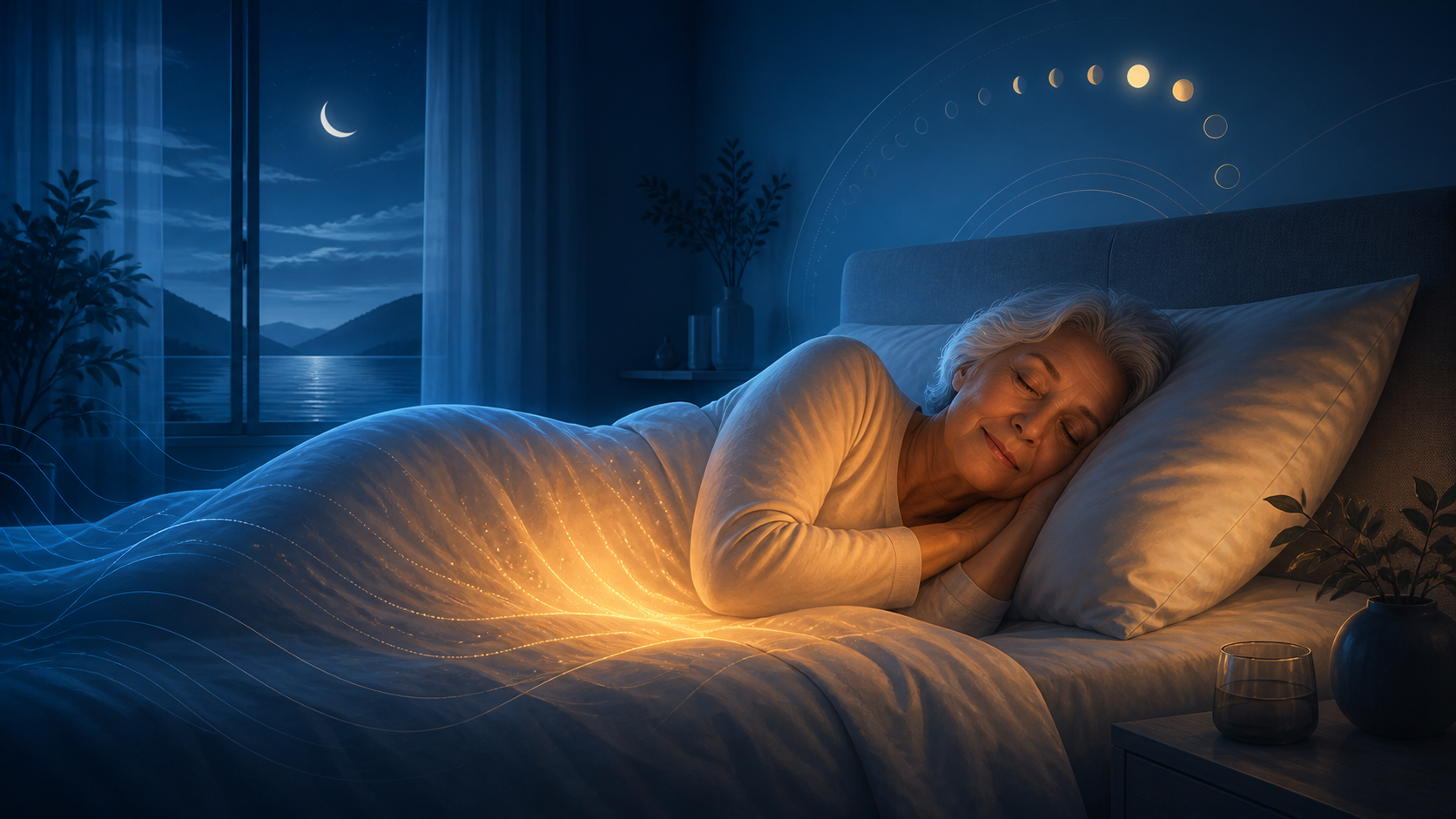
Sleep Temperature Regulation and Healthy Aging: Why Nighttime Cooling Matters
Learn how sleep temperature regulation healthy aging research links nighttime cooling, circadian rhythm, and bedroom choices for deeper, steadier rest.
Table of Contents
DISCLAIMER
This article is for informational purposes only and does not constitute medical advice. The statements in this article have not been evaluated by the FDA. The information presented is based on published research and should not be used as a substitute for professional medical guidance. Consult your physician before starting any supplement or health protocol.
Introduction
Sleep temperature regulation healthy aging research points to a deceptively simple idea: the body often sleeps best when it can cool at night. This does not mean a person needs to feel cold. In many studies, the pattern that appears most relevant is a coordinated shift in heat from the body core toward the skin, followed by heat release into the surrounding environment. That quiet thermal transition may help explain why warm feet, breathable bedding, a slightly cooler room, and consistent evening routines can change how easily sleep begins.
Healthy aging depends on more than total sleep time. Sleep timing, continuity, circadian rhythm strength, slow-wave sleep, autonomic balance, and morning alertness all appear to matter. Temperature touches each of these systems because thermoregulation is deeply connected to the brain circuits that organize sleep and wakefulness. The same internal clock that helps coordinate melatonin timing also helps shape daily body temperature rhythms. In a typical pattern, core body temperature declines in the evening, reaches its low point during the night, and rises again before waking.
With age, that rhythm may become less robust. Some people notice lighter sleep, earlier waking, more nighttime awakenings, or new sensitivity to a bedroom that once felt comfortable. Others may not notice temperature changes clearly, even when those changes influence sleep physiology. For healthy aging, the practical question is not whether a single perfect bedroom temperature exists. It is whether the sleep environment allows the body to perform its normal nighttime cooling work.
The Science
Sleep begins during a thermal transition
Human sleep tends to occur when core body temperature is falling, not when it is rising. This decline is partly circadian, meaning it is governed by the body’s internal timing system, and partly behavioral, shaped by evening light exposure, movement, meals, bathing, clothing, and bedding. The transition into sleep is often accompanied by warmer skin in the hands, feet, and other peripheral regions. That may sound contradictory, but warmer skin can reflect vasodilation, or wider blood vessels near the surface, which allows heat to move away from the core.
Researchers often describe this using the distal-proximal skin temperature gradient. “Distal” refers to areas such as the hands and feet, while “proximal” refers to areas closer to the trunk. When distal skin becomes warmer relative to proximal skin, the body may be in a state that favors heat loss. Studies suggest that this gradient is associated with sleep readiness and shorter sleep onset latency.
This is why comfort is not merely psychological. A person can feel cozy because the skin surface is warm, while the body’s core temperature is still moving downward. In that sense, the ideal sleep setup may be one that warms the skin enough to permit relaxation and peripheral heat loss, while keeping the broader sleep environment cool and breathable enough to avoid heat retention.
The hypothalamus links temperature and sleep
Thermoregulation is coordinated by brain regions that include the preoptic area of the hypothalamus. These circuits receive information from the skin, body core, and circadian clock. They help organize responses such as vasodilation, sweating, heat conservation, and changes in arousal state.
The overlap between sleep-regulating and temperature-regulating systems may help explain why small thermal cues can have measurable effects. A hot room, heavy bedding, or poor ventilation may create a thermal load that increases wakefulness. A room that is too cold may also disrupt sleep if the body has to defend its temperature through vasoconstriction or discomfort. The relevant target is not cold exposure for its own sake; it is a stable thermal zone that permits the normal nighttime decline in core temperature.
Aging can narrow the comfort window
Aging is associated with changes in circadian rhythm, skin blood flow, sweat responses, muscle mass, vascular function, and thermal perception. These changes do not affect everyone equally, but they may narrow the range of sleep conditions that feel comfortable and support stable sleep.
Older adults may also have more variability in medication use, pain, nocturia, cardiometabolic health, and sleep disorders. These factors can interact with temperature. For example, a person who wakes often may repeatedly adjust bedding, expose skin, or become aware of being too warm or too cool. A person with reduced sensitivity to temperature may not adjust the sleep environment until sleep is already fragmented.
From a healthy aging perspective, temperature regulation matters because sleep is one of the body’s major nightly organizing states. During sleep, the brain and body shift through changes in metabolism, cardiovascular tone, immune signaling, hormone patterns, and neural activity. Research does not show that bedroom temperature alone controls aging outcomes, but it does suggest that thermal stability may be one modifiable part of a broader sleep-supportive environment.
Key Research Findings
Skin warming can promote sleep onset
In a controlled human study published in the American Journal of Physiology-Regulatory, Integrative and Comparative Physiology in 2005, Raymann, Swaab, and Van Someren examined how subtle changes in skin and core temperature affected sleep onset. The study manipulated temperature within a comfortable range and found that proximal skin warming was associated with shorter sleep-onset latency.
The finding is important because it suggests that the skin may act as more than a passive thermometer. Thermal information from the skin may influence sleep-regulating systems. The study did not imply that hotter is better. Instead, it supports the idea that mild, comfortable warming of the skin can help create conditions under which the body transitions toward sleep.
For healthy aging, this helps clarify the familiar experience of wanting warm hands or feet at bedtime while still preferring a cool room. The useful signal may be peripheral warmth that allows heat release, not an overheated sleep environment.
Older adults may have reduced awareness of optimal sleep temperature
Raymann and Van Someren published a related study in Sleep in 2008 focused on older adults with and without insomnia complaints. The researchers reported that mild proximal skin warming appeared to facilitate sleep onset in both groups. However, older participants, especially those with insomnia, seemed less able to perceive subtle temperature differences that influenced sleep initiation.
This finding may be highly relevant to aging. If a person cannot easily sense the thermal state that supports sleep, the bedroom can drift into a less favorable range without obvious discomfort. The result may be longer sleep latency or more fragile sleep, even when the person does not identify temperature as the cause.
The study also suggests why practical sleep adjustments should be individualized. Some older adults may benefit from testing lighter bedding, breathable sleepwear, foot warming, fan use, or room temperature adjustments while tracking sleep quality over several nights. The goal is not to force a rigid rule, but to find a repeatable environment that seems to support sleep onset and continuity.
Warm bathing may help older adults release heat before bed
A larger, real-world study by Tai and colleagues, published in the Journal of Clinical Sleep Medicine in 2021, examined hot-water bathing habits in 1,094 older adults with a mean age of 72 years. The study found that bathing 61 to 120 minutes and 121 to 180 minutes before bedtime was associated with shorter sleep onset latency and a higher distal-proximal skin temperature gradient.
The proposed mechanism is physiologically plausible: passive body warming can increase blood flow near the skin, and the subsequent heat loss may align with the body’s natural presleep cooling pattern. The timing appears important. A very hot bath immediately before bed may leave some people feeling too warm, while a bath taken earlier in the evening may allow the warming and cooling sequence to unfold.
This is not medical advice and may not apply to everyone. People with cardiovascular conditions, dizziness, heat intolerance, mobility concerns, or medication-related temperature sensitivity may need individualized guidance from a qualified healthcare professional. Still, the study provides a useful example of how everyday thermal habits may interact with sleep biology in later life.
A dynamic thermal environment may increase slow-wave sleep
In a controlled laboratory study published in Sleep in 2007, Togo and colleagues tested whether slow changes in the thermal environment could influence sleep structure. In healthy young men, a dynamic ambient temperature pattern that lowered and delayed the minimum core body temperature was associated with a longer duration of slow-wave sleep compared with a constant temperature condition.
The study was small and involved younger participants, so it should not be overgeneralized to older adults. Its value is mechanistic. It suggests that the timing and shape of nighttime cooling may matter, not just the number on a thermostat. Slow-wave sleep is often discussed in aging science because it tends to decline with age and is associated with restorative sleep physiology. Research does not prove that manipulating temperature can reverse age-related sleep changes, but it does indicate that thermal conditions can influence sleep architecture in measurable ways.
Practical Implications
Think in terms of heat flow, not just room temperature
A bedroom temperature number can be useful, but it does not capture the full sleep environment. Heat flow depends on room temperature, bedding insulation, mattress materials, sleepwear, humidity, air movement, body size, metabolic rate, and whether a person shares a bed. A room that feels cool at bedtime may become too warm under heavy bedding. A room that feels comfortable in winter may be too humid in summer.
A research-reporting approach would frame the goal as thermal flexibility. The sleep setup should allow the body to release heat as core temperature falls, while preventing cold discomfort that can trigger arousal. Breathable layers, adjustable blankets, and the ability to uncover hands or feet may help some people maintain that balance.
Keep the evening thermal signal consistent
Circadian rhythms tend to respond to repeated cues. A consistent evening routine may help align temperature, light exposure, and sleep timing. Warm bathing 1 to 3 hours before bed, lighter activity in the late evening, dimmer light, and a bedroom that gradually feels cooler may work together as signals that the sleep period is approaching.
The evidence is not strong enough to prescribe a single sequence for everyone. However, studies suggest that the body’s natural presleep pattern involves peripheral warming and core cooling. Practical routines that support this pattern may be worth testing carefully, especially for people who notice difficulty falling asleep.
Avoid overheating from bedding and sleepwear
Overheating is a common, underrecognized sleep disruptor. Heavy comforters, heat-trapping foam, synthetic sleepwear, and poor airflow may increase the thermal burden during the night. Heat exposure in real-life sleep conditions has been associated in reviews with more wakefulness and less slow-wave or REM sleep.
For aging adults, overheating may be especially relevant because thermoregulatory responses can become less efficient. The body may not dissipate heat as smoothly, and awakenings may become more frequent. Lightweight layers that can be adjusted during the night may be more useful than a single heavy blanket.
Do not confuse cooling with cold stress
Nighttime cooling does not mean trying to sleep in an aggressively cold environment. Cold stress can increase sympathetic nervous system activity, cause discomfort, and make sleep less stable. If the body has to work to stay warm, sleep may become fragmented even if the room is technically “cool.”
The practical target is a thermoneutral-feeling environment that permits heat loss. Warm feet, a cool room, breathable bedding, and modest air circulation can coexist. Some people may sleep better with socks because warm distal skin supports heat release; others may prefer uncovered feet. Individual response matters.
Track patterns over several nights
Because sleep varies naturally, a single night is rarely enough to judge a temperature change. A more useful approach is to test one variable at a time for several nights: lighter blanket, slightly cooler room, different sleepwear, a fan, or an earlier bath. Subjective notes can be paired with wearable data if available, but wearable metrics should be interpreted cautiously.
Relevant observations may include time to fall asleep, number of awakenings, early morning waking, night sweats, cold hands or feet, morning grogginess, and perceived sleep depth. If temperature-related symptoms are severe, new, or accompanied by other health changes, clinical input is appropriate.
Limitations and Future Research
The science of sleep temperature regulation is promising, but several limitations remain. Many controlled studies are small, short-term, and conducted under laboratory conditions. Real homes are more complex. Bedding, partners, pets, HVAC systems, humidity, seasonal changes, and personal routines all affect the thermal environment.
Aging research also has heterogeneity. “Older adults” are not a single physiological category. A healthy 66-year-old endurance exerciser, an 82-year-old with limited mobility, and a 70-year-old taking several medications may have very different thermoregulatory responses. Sex hormones, body composition, vascular health, and chronic conditions may all influence nighttime heat balance.
Another limitation is that many studies focus on sleep onset rather than full-night sleep quality or long-term healthy aging outcomes. Falling asleep faster is useful, but it is not the only measure that matters. Future research may need to examine how temperature strategies influence slow-wave sleep, REM sleep, nocturnal blood pressure, glucose regulation, next-day cognition, mood, and biological aging markers over months or years.
There is also a need for better home-based measurement. Wearable temperature sensors, mattress sensors, and environmental monitors may eventually help identify personalized thermal patterns. However, consumer devices vary in accuracy, and data can be misleading without context. The most useful future tools may combine bedroom conditions, skin temperature, sleep staging, heart rate variability, and subjective comfort into practical guidance.
Finally, research should clarify who benefits most. People with insomnia symptoms, hot flashes, circadian rhythm disruption, low physical activity, impaired vascular function, or high bedroom heat exposure may respond differently to cooling strategies. Precision matters because the same intervention can help one person and disturb another.
The Bottom Line
Sleep temperature regulation appears to be an important piece of healthy aging because nighttime cooling is closely tied to circadian rhythm, sleep onset, and sleep architecture. Research suggests that mild skin warming, heat release through the hands and feet, and a cool but comfortable sleep environment may support the body’s normal transition into sleep.
The best practical strategy is not extreme cold or a universal thermostat number. It is a repeatable sleep environment that allows comfortable heat loss, avoids overheating, and respects individual health needs.
Frequently Asked Questions
What bedroom temperature may support healthy sleep as people age?
Does taking a warm bath before bed help the body cool down?
Why can aging make nighttime temperature regulation harder?
Sources
- Hot-water bathing before bedtime and shorter sleep onset latency are accompanied by a higher distal-proximal skin temperature gradient in older adults(2021)
- Diminished capability to recognize the optimal temperature for sleep initiation may contribute to poor sleep in elderly people(2008)
- Cutaneous warming promotes sleep onset(2005)
- Influence on human sleep patterns of lowering and delaying the minimum core body temperature by slow changes in the thermal environment(2007)
- Effects of thermal environment on sleep and circadian rhythm(2012)
Stay Updated on Longevity Science
Weekly research digests. No spam, unsubscribe anytime.
Related Articles
Arterial Stiffness and Vascular Age: A Longevity Evidence Guide
Understand arterial stiffness vascular age longevity links, key studies, measurement limits, and evidence-based lifestyle implications for healthy aging.
11 min read
Arterial Stiffness and Vascular Aging: What the Evidence Shows
Explore arterial stiffness vascular aging, how vessels change over time, what pulse wave velocity studies show, and practical ways evidence may inform prevention.
10 min read
Autophagy and Aging: Your Body's Cellular Cleanup System
Explore autophagy, your body's cellular cleanup system, and its critical role in aging and longevity. Research suggests modulating autophagy may support cellular health.
12 min read