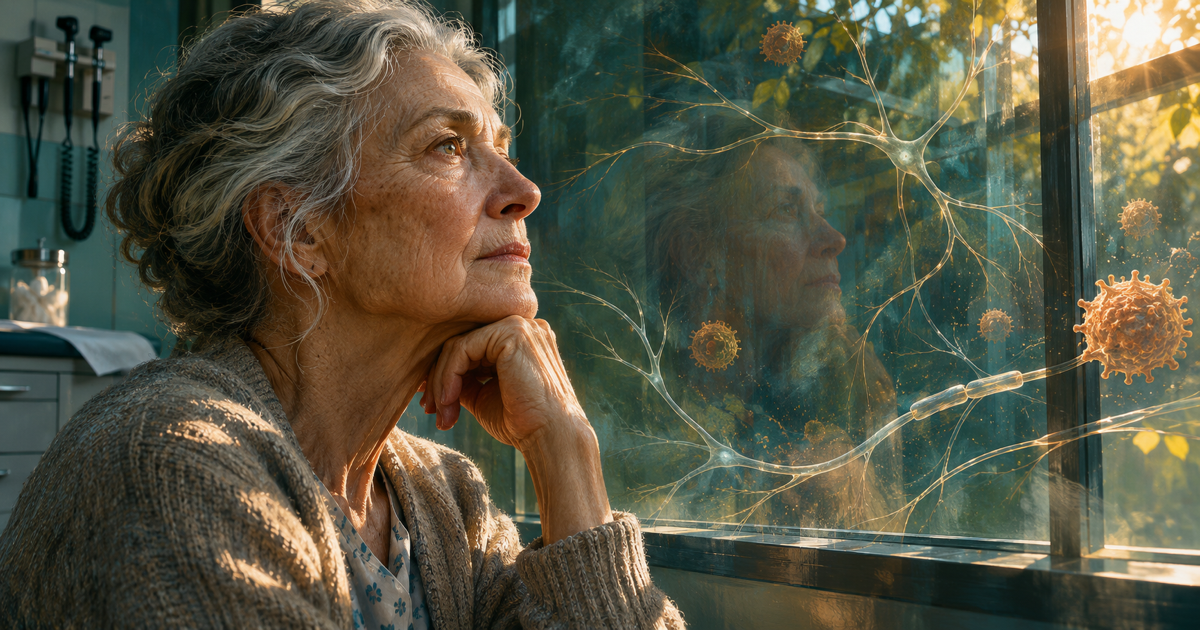
Shingles Vaccination May Lower Dementia Risk; Prevention Remains Unproven
Studies suggest shingles vaccination may reduce dementia diagnoses, but vaccine differences, diagnostic uncertainty and residual bias limit prevention claims.
Table of Contents
DISCLAIMER
This article is for informational purposes only and does not constitute medical advice. The statements in this article have not been evaluated by the FDA. The information presented is based on published research and should not be used as a substitute for professional medical guidance. Consult your physician before starting any supplement or health protocol.
A dementia signal with an important boundary
Research suggests shingles vaccination may offer an additional benefit beyond protection against a painful viral illness: fewer subsequent dementia diagnoses. As of November 7, 2026, however, the findings support a possible protective effect rather than a promise of dementia prevention. The central uncertainty concerns causation, the size of any benefit and whether results from different vaccine formulations describe the same phenomenon.
The distinction matters because a recorded diagnosis may reflect several processes. A vaccine might reduce disease initiation, slow an existing process or postpone the point at which symptoms lead to assessment. Differences in access to assessment might also influence the record. A study showing fewer diagnoses during follow-up may therefore support several explanations, only some of which would amount to preventing the underlying disease.
The most useful reading begins with the comparison each study actually made. One investigation used a birth-date rule that sharply changed vaccine eligibility. Another compared recipients across a switch in vaccine formulation. A newer analysis compared vaccinated and unvaccinated patients within a health system. These approaches may strengthen one another, but they do not estimate an identical effect.
For readers assessing a prevention claim, the practical questions are specific: which vaccine, which population, which comparator and which outcome? A percentage without those details may sound more transferable than the analysis warrants. The studies are potentially important precisely because their designs can be examined, rather than because any single estimate settles the question.
A birth-date cutoff strengthened the causal argument
A 2025 Nature study exploited an unusual feature of the Welsh shingles vaccination programme: eligibility depended on a birth-date cutoff around September 2, 1933. People born just either side of that threshold were almost the same age, yet their opportunities to receive the vaccine differed sharply. This created a natural experiment that may be less vulnerable to the usual differences between vaccine recipients and nonrecipients.
The researchers estimated that receiving the live shingles vaccine may have reduced the probability of a new dementia diagnosis over seven years by 3.5 percentage points. The 95% confidence interval ranged from 0.6 to 7.1 percentage points; the corresponding relative reduction was approximately 20%. These estimates suggest a potentially meaningful effect, with substantial uncertainty about its size. Nature study.
For interpretation, the eligibility effect should remain separate from the estimated vaccination effect. Not everyone offered a vaccine receives it. Moving from an eligibility comparison to an estimate for vaccination requires additional statistical assumptions. The resulting estimate may best describe people near the cutoff whose vaccination decision changed because of the rule, rather than every older adult.
This is also a useful example of why absolute and relative effects should travel together. A relative reduction describes a proportional difference; a percentage-point reduction describes a difference on the risk scale. Neither figure should be treated as a personal forecast. An individual’s potential benefit may differ with baseline risk, age, health history and the period over which outcomes are observed.
The design may improve causal inference without becoming a randomized trial. Its interpretation depends on the assumption that no other relevant factor changed abruptly at the same birth-date boundary. It may also have limited reach beyond the people and programme studied. Strong internal comparisons and broad applicability are separate questions; a persuasive answer to the first does not automatically resolve the second.
The current vaccine requires its own assessment
The Welsh finding concerned a live-attenuated vaccine. Research on the recombinant vaccine, Shingrix, therefore deserves separate attention. A 2024 Nature Medicine study compared 103,837 recipients in a period dominated by the recombinant vaccine with an equally sized matched group from a period dominated by the live vaccine. The analysis suggested more time without a dementia diagnosis after the recombinant formulation. Nature Medicine study.
Its reported 17% increase in diagnosis-free time translated into an estimated 164 additional diagnosis-free days among people subsequently affected. That measure should not be restated as a 17% reduction in lifetime dementia risk. It describes the study’s follow-up and outcome calculation, rather than a guarantee that each recipient might gain a particular number of symptom-free days.
Comparing two vaccine groups may reduce some differences associated with choosing vaccination at all. Yet a comparison across calendar periods may introduce other differences. Assessment practices, record completeness and the circumstances surrounding healthcare visits may change over time. Matching can address measured characteristics, but it may leave unrecorded differences that matter to both vaccination and diagnosis.
A 2026 Nature Communications analysis added a different comparison: 65,800 recombinant-vaccine recipients and 263,200 unvaccinated matches at Kaiser Permanente Southern California. The adjusted hazard ratio for dementia was 0.49. Against recipients of a tetanus, diphtheria and pertussis vaccine, however, it was 0.73. Both comparisons suggested an association, while the differing estimates showed how strongly comparator choice may affect its apparent size. Nature Communications study.
An active comparator may help because both groups have undertaken a preventive healthcare action. It cannot ensure that their reasons for vaccination, underlying vulnerability or likelihood of dementia assessment were equivalent. The remaining association may contain a genuine vaccine effect, residual differences between groups or some combination of the two.
These percentages should therefore remain attached to their designs. A hazard ratio, a change in diagnosis-free time and a seven-year risk difference answer different statistical questions. Combining them into one headline percentage may create precision the studies do not provide. Their agreement in direction may be informative even while their magnitudes remain difficult to compare.
Viral control and immune effects remain competing explanations
The proposed biology begins with varicella-zoster virus, which may reactivate after remaining latent following chickenpox. Researchers have suggested that repeated viral activity might contribute to inflammatory or vascular injury relevant to dementia. The vaccination findings are compatible with that possibility, but they do not establish the chain from a particular reactivation to a later diagnosis.
A separate possibility concerns the immune response stimulated by vaccination. A 2025 npj Vaccines study examined dementia associations following shingles and respiratory syncytial virus vaccination involving AS01 adjuvants. Such comparisons may help investigate whether immune stimulation contributes to the signal beyond protection against one specific pathogen. They remain indirect tests of mechanism. npj Vaccines study.
Several mechanisms might operate together. Reducing infections could lower one source of inflammatory stress, while changes in immune activity might have additional consequences. Conversely, a consistent association across vaccines could partly reflect who receives them. Mechanistic plausibility may make an association worth pursuing; it cannot by itself distinguish a protective pathway from a biased comparison.
A useful mechanistic study would connect successive steps within the same participants: vaccination, measures of viral activity or immune response, and later clinical outcomes. If those changes aligned, they might strengthen a proposed pathway. Even then, an intermediate marker would need careful interpretation. A change in an immune measurement may not translate into a meaningful change in memory, independence or dementia incidence.
Sex differences also warrant restrained interpretation. Several analyses have suggested stronger associations among women. That pattern may motivate investigation of immune responses or other differences, but it does not identify the explanation. A subgroup result becomes more convincing when a study directly tests the difference between groups and an independent dataset reproduces it.
For the same reason, these studies should not be stretched into a general claim that boosting immunity may prevent dementia. That phrase leaves the intervention and mechanism undefined. The scientifically useful question concerns a particular vaccine, a measurable response and a specified clinical endpoint. Broader immune rejuvenation claims would require their own experiments.
Fewer diagnoses may mean delay rather than prevention
A later Cell study extended the Welsh natural-experiment approach to mild cognitive impairment diagnoses and dementia-related deaths among people already living with dementia. The findings suggested that vaccination might influence more than the initial diagnostic threshold. They also raised the possibility of an effect on the course of established disease, while remaining insufficient to establish vaccination as dementia therapy. Cell study.
These outcomes may add useful context, but they should retain their separate meanings. Mild cognitive impairment, a dementia diagnosis and a death attributed to dementia describe different events. A change in one does not specify a change in the others. The underlying analyses may also share participants, records and assumptions, so related publications should not automatically be counted as wholly independent confirmations.
Follow-up length is particularly important when discussing prevention. If vaccination merely moves diagnoses beyond the observation window, a study may initially resemble a prevention success. Longer observation could reveal whether the groups continue to diverge, remain separated or eventually converge. Each pattern would support a different account of timing and cumulative risk.
Delay could still matter to patients, but its value would depend on what happened during the additional time. More time without a recorded diagnosis might accompany preserved function, or it might reflect later recognition of existing impairment. Studies that include repeated cognitive assessment and daily functioning could help distinguish those possibilities more directly than diagnosis codes alone.
Deaths during follow-up also require attention. A person who dies cannot subsequently receive a dementia diagnosis. An analysis of dementia incidence may therefore need to consider mortality alongside diagnosis, rather than treating everyone without a diagnosis as having the same outcome. Different approaches to this competing event may produce estimates with different interpretations.
A more decisive trial would specify its dementia outcome in advance, assess participants consistently and follow them long enough to capture clinically meaningful differences. Any design would also need to respect established reasons for shingles vaccination. Randomizing timing or studying eligible populations under ethically acceptable conditions might answer some questions, but the appropriate design would depend on local practice and clinical judgment.
Clinical decisions still rest on shingles protection
CDC guidance supports shingles vaccination for prevention of shingles and its complications in eligible groups. The agency’s patient information describes strong protection against shingles, while the dementia findings remain a separate, investigational consideration. Eligibility and timing may depend on age, immune status, prior reactions and current illness; local recommendations may differ from United States guidance. CDC shingles vaccination guidance.
The same guidance notes that temporary reactions may include arm pain, fatigue, muscle pain, headache or fever. It also discusses very rare reports of Guillain-Barré syndrome. A discussion of possible dementia benefits should preserve that ordinary clinical context, rather than allowing an uncertain additional benefit to eclipse an individual’s circumstances or the vaccine’s established purpose.
For an eligible person, the dementia literature may be a useful topic for a clinician or pharmacist conversation. It does not establish a reason to seek extra vaccination, disregard contraindications or use vaccination as a substitute for assessment of memory symptoms. Research suggesting an association should not be converted into an individualized schedule or a treatment promise.
The distinction between a prevention decision and a symptom assessment is especially practical. Someone concerned about new memory difficulties may need evaluation regardless of vaccination history. A prior vaccine cannot establish why symptoms occurred, and a subsequent diagnosis would not show that vaccination had failed to provide any benefit. Individual experiences cannot resolve an effect estimated across populations.
For future reporting, the most informative developments may be studies that change the strength of inference rather than simply increase the sample size. Independent replication, better baseline cognitive assessment, consistent outcome adjudication and longer follow-up could each address a different uncertainty. A larger database may narrow a confidence interval while leaving systematic bias largely intact.
The current interpretation is therefore conditional: multiple study designs suggest that shingles vaccination may reduce or delay dementia diagnoses, and the birth-date natural experiment strengthens the causal case. Whether the current vaccine prevents underlying disease, how large any effect might be and who might benefit most remain questions for further investigation.
Frequently asked questions
Does shingles vaccination prevent dementia?
Research suggests it may reduce or delay diagnoses, but prevention of the underlying disease remains unproven.
Do the Welsh results apply directly to Shingrix?
They may inform the hypothesis, but that study used a live vaccine; Shingrix requires its own assessment.
Should memory symptoms be assessed after vaccination?
Yes. Vaccination may not prevent dementia, and new memory difficulties may warrant clinical evaluation.
This article summarises published research and is not medical advice. Consult your healthcare provider before changing your routine.
Frequently Asked Questions
Does shingles vaccination prevent dementia?
Do the Welsh results apply directly to Shingrix?
Should memory symptoms be assessed after vaccination?
Sources
- Nature: A natural experiment on the effect of herpes zoster vaccination on dementia(2026)
- Nature Medicine: The recombinant shingles vaccine is associated with lower risk of dementia(2026)
- Nature Communications: Recombinant zoster vaccine is associated with a reduced risk of dementia(2026)
- npj Vaccines: Lower risk of dementia with AS01-adjuvanted vaccination against shingles and respiratory syncytial virus infections(2026)
- Cell: The effect of shingles vaccination at different stages of the dementia disease course(2026)
- CDC: Shingles Vaccination(2026)
Stay Updated on Longevity Science
Weekly research digests. No spam, unsubscribe anytime.
Related Articles

Arterial Stiffness and Vascular Age: A Longevity Evidence Guide
Understand arterial stiffness vascular age longevity links, key studies, measurement limits, and evidence-based lifestyle implications for healthy aging.
11 min read
Arterial Stiffness and Vascular Aging: What the Evidence Shows
Explore arterial stiffness vascular aging, how vessels change over time, what pulse wave velocity studies show, and practical ways evidence may inform prevention.
10 min read
Autophagy and Aging: Your Body's Cellular Cleanup System
Explore autophagy, your body's cellular cleanup system, and its critical role in aging and longevity. Research suggests modulating autophagy may support cellular health.
12 min read