Respiratory Muscle Strength and Healthy Aging
What inspiratory and expiratory muscle strength can reveal about reserve, mobility, cough, and healthy aging, with practical limits on testing and training claims.
Table of Contents
DISCLAIMER
This article is for informational purposes only and does not constitute medical advice. The statements in this article have not been evaluated by the FDA. The information presented is based on published research and should not be used as a substitute for professional medical guidance. Consult your physician before starting any supplement or health protocol.
Breathing usually feels automatic, which makes its muscular workload easy to overlook. The diaphragm contracts roughly tens of thousands of times a day. Intercostal muscles stabilize and move the rib cage, while abdominal muscles help generate a strong cough. Together they create a reserve that becomes especially important during exercise, infection, surgery, and recovery from illness.
Respiratory muscle strength may decline with age, inactivity, chronic disease, and loss of overall muscle quality. Researchers are studying whether simple pressure tests add useful information about frailty, mobility, pulmonary complications, and resilience. The evidence suggests a meaningful functional signal, but not a standalone longevity biomarker.
How Does Aging Affect the Breathing Muscles?
The diaphragm is skeletal muscle, so it is exposed to many processes that affect limb muscles: motor-unit remodeling, changes in fiber quality, reduced power, inflammation, and lower physical activity. Chest-wall stiffness and changes in spinal posture can increase the mechanical work of breathing. Lung tissue and airways also change, meaning muscles may work against a different load.
Healthy older adults often maintain adequate ventilation at rest. Limitations become more apparent under stress. Exercise requires faster airflow, illness raises metabolic demand, and coughing requires a brief burst of pressure. Reduced reserve may therefore remain hidden during a quiet clinic visit.
Chronic lung disease, heart failure, neurologic disorders, malnutrition, obesity, sleep-disordered breathing, and prolonged hospitalization can influence strength. That makes weak performance clinically important but not specific to aging.
How Is Respiratory Muscle Strength Tested?
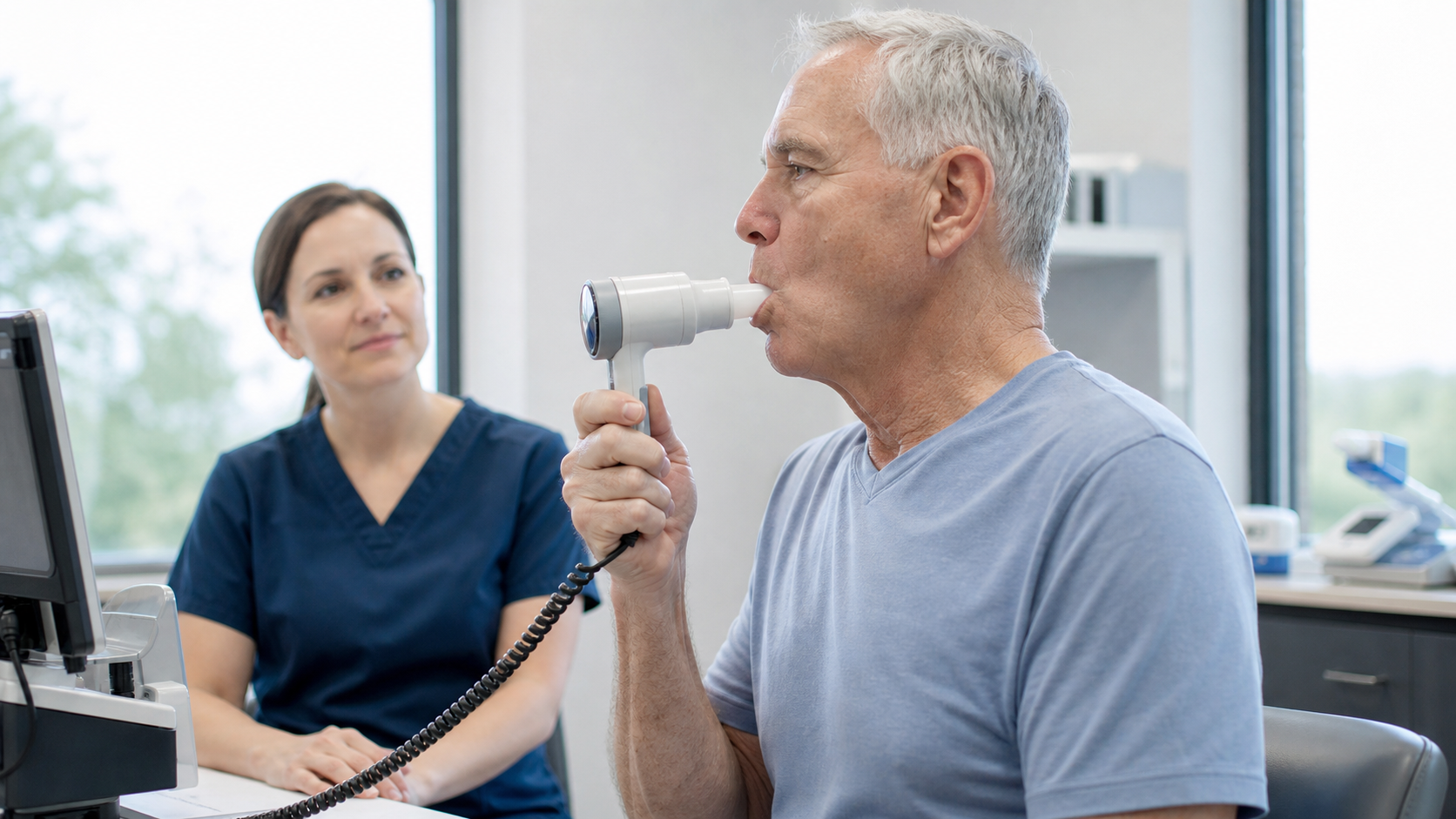
Maximal inspiratory pressure estimates the force generated during inhalation against an occluded mouthpiece. Maximal expiratory pressure assesses force in the opposite direction. Sniff nasal inspiratory pressure is another option. Results depend on equipment, seal, posture, coaching, effort, and reference equations.
Spirometry answers different questions. It measures volumes and flows, not muscle pressure alone. Peak cough flow examines the effectiveness of a protective action. Cardiopulmonary exercise testing evaluates the integrated response of lungs, circulation, and muscles. No single test captures the entire respiratory system.
Because pressure tests are effort-dependent, repeated attempts are usually needed. Dental issues, facial weakness, leaks, pain, and unfamiliarity can lower values. Interpretation should use age- and sex-appropriate reference data and the person’s clinical context rather than an internet cutoff.
Why Might Strength Matter for Healthy Aging?
Stronger respiratory muscles may reduce the relative effort required for ventilation during activity. They also support cough, which helps clear secretions. Observational research has associated lower respiratory pressures with poorer physical performance and frailty, although causality is uncertain.
Respiratory weakness can be both cause and consequence of inactivity. Breathlessness may reduce activity; deconditioning then raises the effort of ordinary tasks. Breaking that cycle may involve diagnosis and broader rehabilitation, not simply a breathing device.
The measure may be particularly useful before major surgery, after critical illness, or when neuromuscular disease is suspected. In healthy-aging research, it complements grip strength, gait speed, leg power, and aerobic capacity by describing a muscle system that is constantly active.
What Does Training Evidence Suggest?
Inspiratory muscle training uses resistance during inhalation. Trials in selected populations report improvements in inspiratory pressure, perceived breathlessness, or aspects of exercise performance. Outcomes vary with baseline weakness, adherence, intensity, duration, and underlying disease.
That does not justify universal protocols or claims that breathing exercises extend life. Excessive resistance or unsupervised breath-holding may be inappropriate for some cardiovascular, pulmonary, or neurologic conditions. A clinician or respiratory therapist can determine whether testing and supervised training are relevant.
General physical activity also challenges the respiratory system while supporting cardiovascular and limb-muscle function. Strength and aerobic exercise remain broader tools for preserving reserve when medically appropriate.
How Should the Signal Be Used?
Respiratory muscle strength is most informative when it answers a practical question: Is unexplained breathlessness partly muscular? Is cough effective? Has hospitalization reduced reserve? Is rehabilitation changing function? Serial results collected with the same method can be more useful than one isolated value.
It should not be interpreted as a direct measure of lung age or lifespan. Breathlessness can signal heart, lung, blood, metabolic, or anxiety-related problems and deserves appropriate assessment. Sudden or severe shortness of breath, chest pain, blue lips, confusion, or fainting requires urgent care.
The breathing muscles are a meaningful part of whole-body resilience. Measuring them can reveal capacity that resting vital signs miss, but the result belongs inside a full clinical and functional picture.
This article is educational and not medical advice. Testing or training decisions should be discussed with a qualified healthcare professional.
Frequently Asked Questions
Which muscles power breathing?
Is respiratory muscle strength the same as lung capacity?
Can breathing exercises reverse respiratory aging?
Sources
Stay Updated on Longevity Science
Weekly research digests. No spam, unsubscribe anytime.
Related Articles
Arterial Calcification and Vascular Aging: Reading the Risk Signals
Arterial calcification can reveal accumulated vascular risk. Learn what calcium scores mean, why calcification develops, and where testing has limits.
10 min read
Arterial Stiffness and Vascular Age: A Longevity Evidence Guide
Understand arterial stiffness vascular age longevity links, key studies, measurement limits, and evidence-based lifestyle implications for healthy aging.
11 min read
Arterial Stiffness and Vascular Aging: What the Evidence Shows
Explore arterial stiffness vascular aging, how vessels change over time, what pulse wave velocity studies show, and practical ways evidence may inform prevention.
10 min read