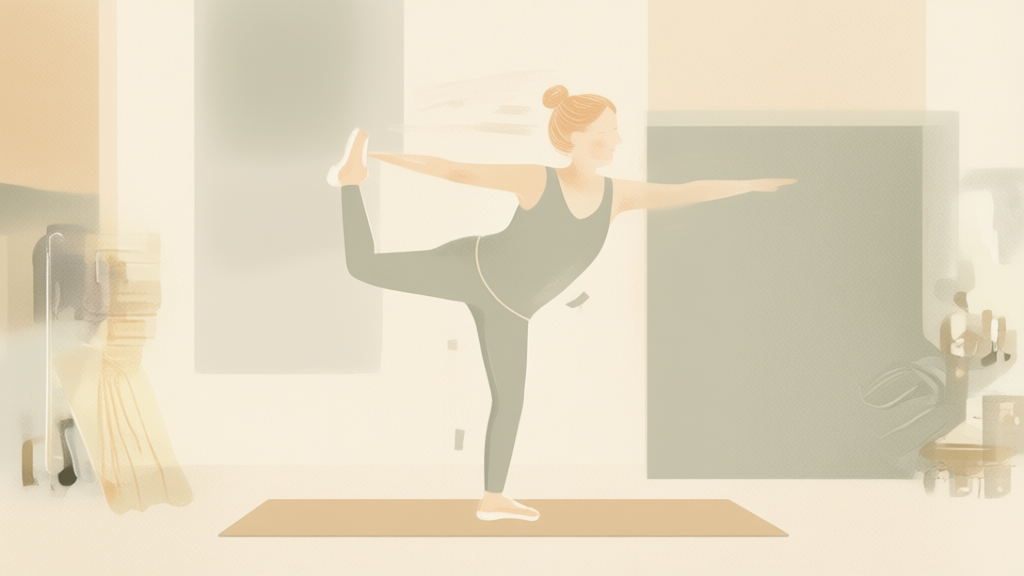
One-Leg Stance and Healthy Aging: What a Simple Balance Test Can Predict
Can a one leg stance test predict healthy aging? Explore what balance research really shows about falls, mortality, and brain health—and its limits.
Table of Contents
DISCLAIMER
This article is for informational purposes only and does not constitute medical advice. The statements in this article have not been evaluated by the FDA. The information presented is based on published research and should not be used as a substitute for professional medical guidance. Consult your physician before starting any supplement or health protocol.
One-Leg Stance and Healthy Aging: What a Simple Balance Test Can—and Cannot—Predict
Standing on one leg for a few seconds looks almost trivial. Yet in aging research, the one leg stance test has attracted outsized attention as a possible window into neuromuscular health, fall risk, and even longevity. The idea that a one leg stance healthy aging connection might exist is appealing precisely because the test is so simple: no laboratory, no blood draw, no expensive imaging—just a stopwatch and a clear floor.
But simplicity cuts both ways. A test that is easy to perform is also easy to overinterpret. This article examines what the research actually shows about single-leg balance and aging outcomes, where the evidence is reasonably strong, where it is thin, and how to think about your own results without spiraling into anxiety over a wobbly ten seconds.
Why Balance Becomes a Focus in Aging Research
Balance is not a single skill. It is the visible output of a complex system that integrates vision, the vestibular apparatus of the inner ear, proprioceptive feedback from joints and muscles, and central nervous system processing that coordinates rapid corrective movements. With age, many of these components can degrade—sometimes subtly, sometimes substantially—and the cumulative effect may show up as postural instability.
That makes balance an attractive candidate biomarker. A biomarker, in the loose sense used in aging research, is a measurable characteristic that may reflect underlying biological or functional status. Balance performance plausibly reflects multiple domains at once: muscle strength, sensory acuity, reaction time, and neural integrity. Researchers have long argued that functional measures—how a person moves, stands, and recovers—may capture aging-relevant information that isolated lab values miss.
The one leg stance test, in particular, has practical appeal. It requires minimal equipment, can be administered in a clinic or a living room, and produces a simple numeric result: time to loss of balance. That combination of accessibility and apparent relevance is why it appears repeatedly in epidemiological studies and clinical assessments of fall risk.
The Science: What Standing on One Leg Actually Measures
The sensorimotor integration problem
Maintaining a single-leg stance demands continuous postural adjustments. When you lift one foot, your base of support shrinks dramatically, and your center of mass shifts. The body must detect that shift through proprioceptive and vestibular signals, then generate corrective muscle activity—often within fractions of a second—to avoid toppling.
This is why balance performance is sometimes described as a “stress test” of sensorimotor integration. It does not isolate any one pathway. A poor result could reflect weak hip abductors, reduced ankle proprioception, vestibular dysfunction, visual impairment, cognitive distraction, fear of falling, or simple unfamiliarity with the task. That multi-determined nature is both the test’s appeal (it captures a lot) and its weakness (it is hard to attribute a poor score to a specific cause).
Age-related changes that may affect performance
Several age-associated changes plausibly contribute to declining single-leg balance. Muscle mass and strength tend to decline with age, and lower-limb strength is directly relevant to postural corrections. Sensory systems may become less reliable: vision changes, peripheral neuropathy, and vestibular decline can all degrade the input signals balance depends on. Central processing speed also tends to slow, which may lengthen the latency of corrective responses.
Importantly, these changes are heterogeneous. Some adults in their 70s maintain impressive balance, while some in their 50s perform poorly. This variability is one reason population-level associations can be misleading when applied to individuals.
Balance as a composite of multiple systems
Researchers sometimes frame balance tests as measures of “functional capacity” rather than of a specific organ system. In that framing, a single-leg stance time is a summary statistic—a rough proxy for how well multiple systems are cooperating. That interpretation is reasonable but inherently imprecise, which is why balance measures are typically used alongside other assessments rather than in isolation.
Key Research Findings
The evidence base on balance and aging outcomes is substantial but uneven. Several lines of research are worth examining, with appropriate caution about what each can and cannot establish.
Balance, falls, and functional decline
Impaired balance is widely recognized as a risk factor for falls, and fall risk assessment commonly includes balance testing. Systematic reviews have generally found that balance and gait measures are associated with fall risk in older adults, though predictive accuracy varies across populations and testing protocols. The relationship is plausible on mechanistic grounds: if you cannot recover from a perturbation, a stumble is more likely to become a fall.
That said, falls are multifactorial. Medications, vision, footwear, home hazards, cognition, and fear of falling all contribute. A balance test captures only part of that picture, which is why clinical fall-risk assessment typically combines multiple measures.
Balance and mortality: the epidemiological signal
A more provocative line of research has examined whether balance performance predicts mortality. Several cohort studies have reported associations between poorer balance—including single-leg stance performance—and higher mortality risk over follow-up periods. These findings have fueled the idea that balance is a marker of broader physiological reserve.
One relevant example is a study by Araujo and colleagues published in 2022 in the Journal of Gerontology (the specific cohort and follow-up details vary by study), which examined associations between postural balance and mortality in older adults. The general pattern across such studies is that worse balance is associated with higher mortality, even after adjustment for some confounders. However, observational associations cannot establish causation, and residual confounding—by physical activity, comorbidity, socioeconomic factors, or subclinical disease—remains a plausible explanation for part of the effect.
Other functional tests show similar patterns. A widely cited 2014 study by de Brito and colleagues in the European Journal of Preventive Cardiology found that the ability to sit and rise from the floor without support was associated with all-cause mortality. And a 2011 analysis by Studenski and colleagues in JAMA reported that gait speed was associated with survival in older adults. These findings collectively suggest that composite functional measures may carry prognostic information—but they also illustrate that balance is one of several such measures, not a unique oracle.
Balance and cognitive or neurological health
There is growing interest in links between balance and cognitive function. Some studies have reported associations between poorer balance and cognitive impairment or future cognitive decline, though the strength and consistency of these findings vary. Mechanistically, balance and cognition share neural resources: attention, executive function, and processing speed all contribute to postural control, particularly under challenging conditions.
This overlap means a balance test might partly reflect cognitive status, which is both interesting and a confounder. If balance predicts cognitive decline, is it because balance is a marker of neural health, or because cognition influences balance performance? Disentangling these directions is an active research question.
The limits of single studies
It is worth emphasizing that individual studies rarely settle questions. Sample composition, testing protocols (eyes open versus closed, footwear, number of attempts, cutoff times), and analytic choices vary widely. A finding in one cohort may not replicate in another. Readers should treat any single headline as one piece of a larger, evolving puzzle.
Practical Implications: What This Means for You
Interpreting your own result cautiously
If you try a single-leg stance at home, you will get a number. Resist the urge to treat it as a diagnosis. Several factors can sway the result on any given day: sleep, recent exercise, footwear, floor surface, distraction, and whether you have practiced the task. A single measurement is a snapshot, not a trajectory.
If you want a more meaningful signal, consider tracking your performance over time under similar conditions—same surface, same footwear, same time of day—and looking at trends rather than absolutes. A gradual decline over months may be more informative than a single disappointing attempt.
Balance as a trainable capacity
The encouraging news is that balance appears to be modifiable. Exercise programs that include progressive balance challenges, strength training, and functional movements are widely recommended for older adults, particularly for fall prevention. Tai chi and similar mind-body practices have been studied for balance and fall-related outcomes, with generally favorable but not uniformly conclusive results.
This does not mean that improving your single-leg stance time will automatically extend your life. But it does suggest that balance training is a reasonable investment in functional independence, which many people value regardless of its effect on mortality statistics.
When to seek professional input
A balance test is not a substitute for clinical evaluation. If you notice recurrent stumbling, unsteadiness that is new or worsening, dizziness, or a fall, it may be worth discussing with a healthcare professional. Balance problems can stem from treatable causes—vision issues, medication side effects, vestibular disorders, neuropathy—and identifying those causes can matter more than any single test score.
Pairing balance with other measures
Given that balance is a composite and imperfect measure, it is reasonable to think of it alongside other functional indicators: grip strength, gait speed, sit-to-stand performance, and general physical activity. No single test captures healthy aging, and a multimodal view is likely more informative than fixating on one number.
Limitations and Future Research
Measurement inconsistency
One of the most practical limitations is the lack of standardization. Studies use different protocols: some allow arm movement, some restrict it; some test eyes-open only, others eyes-closed; some use a fixed cutoff (often 30 seconds) and others record continuous time. This heterogeneity complicates comparisons across studies and makes it hard to derive universal norms.
Confounding and reverse causation
Observational studies of balance and mortality face familiar challenges. People with subclinical disease may have worse balance and higher mortality for reasons unrelated to balance itself. Physical activity, socioeconomic status, and nutrition may influence both. Reverse causation is also possible: early disease may impair balance before it is diagnosed. These issues do not invalidate the associations, but they temper causal claims.
Predictive accuracy for individuals
Even a statistically robust association can be a weak predictor for an individual. A test with modest discriminative ability may stratify risk across a population while misclassifying many individuals. This is a general feature of screening tests and a reason to use balance measures as part of a broader assessment rather than as a standalone verdict.
Future directions
Emerging technologies—wearable sensors, instrumented balance platforms, and digital assessments—may allow more precise and ecologically valid measurement of postural control. Research is also exploring whether balance training produces measurable effects on fall rates, functional independence, and perhaps other health outcomes. Larger, longer-term trials with standardized protocols would help clarify what balance testing can realistically deliver.
The Bottom Line
The one leg stance test is a simple, accessible measure that appears to carry real information about neuromuscular function and, at the population level, is associated with fall risk and mortality. But it is a composite signal, not a crystal ball: results vary day to day, protocols differ across studies, and associations do not guarantee predictions for any individual. Used sensibly—as one input among several, tracked over time, and paired with actionable steps like balance and strength training—it can be a useful prompt for paying attention to functional health as you age.
Frequently Asked Questions
How long should a person be able to stand on one leg by age?
There is no universally accepted cutoff, but observational data suggest that many healthy adults in their 50s and 60s can hold a single-leg stance for roughly 30 seconds or more, with typical times declining with age. Individual variation is large, so a single test result should be interpreted cautiously rather than as a verdict on your health.
Does failing a one-leg balance test mean I will fall or die sooner?
Not necessarily. Balance tests are associated with fall risk and mortality at the population level, but they are imperfect predictors for any one person. Poor performance is best viewed as a signal worth discussing with a clinician and possibly addressing with targeted training, not a prophecy.
Can balance be improved with practice in older adults?
Emerging evidence suggests balance is trainable at older ages, and programs incorporating progressive balance and strength work are generally recommended for fall prevention. Improvements in test performance do not automatically guarantee fewer falls, but they may reflect meaningful gains in neuromuscular control and confidence.
Frequently Asked Questions
How long should a person be able to stand on one leg by age?
Does failing a one-leg balance test mean I will fall or die sooner?
Can balance be improved with practice in older adults?
Sources
Stay Updated on Longevity Science
Weekly research digests. No spam, unsubscribe anytime.
Related Articles
Arterial Stiffness and Vascular Age: A Longevity Evidence Guide
Understand arterial stiffness vascular age longevity links, key studies, measurement limits, and evidence-based lifestyle implications for healthy aging.
11 min read
Arterial Stiffness and Vascular Aging: What the Evidence Shows
Explore arterial stiffness vascular aging, how vessels change over time, what pulse wave velocity studies show, and practical ways evidence may inform prevention.
10 min read
Autophagy and Aging: Your Body's Cellular Cleanup System
Explore autophagy, your body's cellular cleanup system, and its critical role in aging and longevity. Research suggests modulating autophagy may support cellular health.
12 min read