Olfactory Training and Healthy Aging: Can Smell Practice Help?
Smell often weakens with age, illness, or injury. Learn what olfactory training involves, what evidence supports, and when smell loss needs medical assessment.
Table of Contents
DISCLAIMER
This article is for informational purposes only and does not constitute medical advice. The statements in this article have not been evaluated by the FDA. The information presented is based on published research and should not be used as a substitute for professional medical guidance. Consult your physician before starting any supplement or health protocol.
Smell is easy to overlook until coffee loses its aroma, food becomes flat, or smoke becomes harder to notice. The olfactory system also contributes to flavor, appetite, memory, and environmental safety. Its function can decline with age, but age is only one possible explanation.
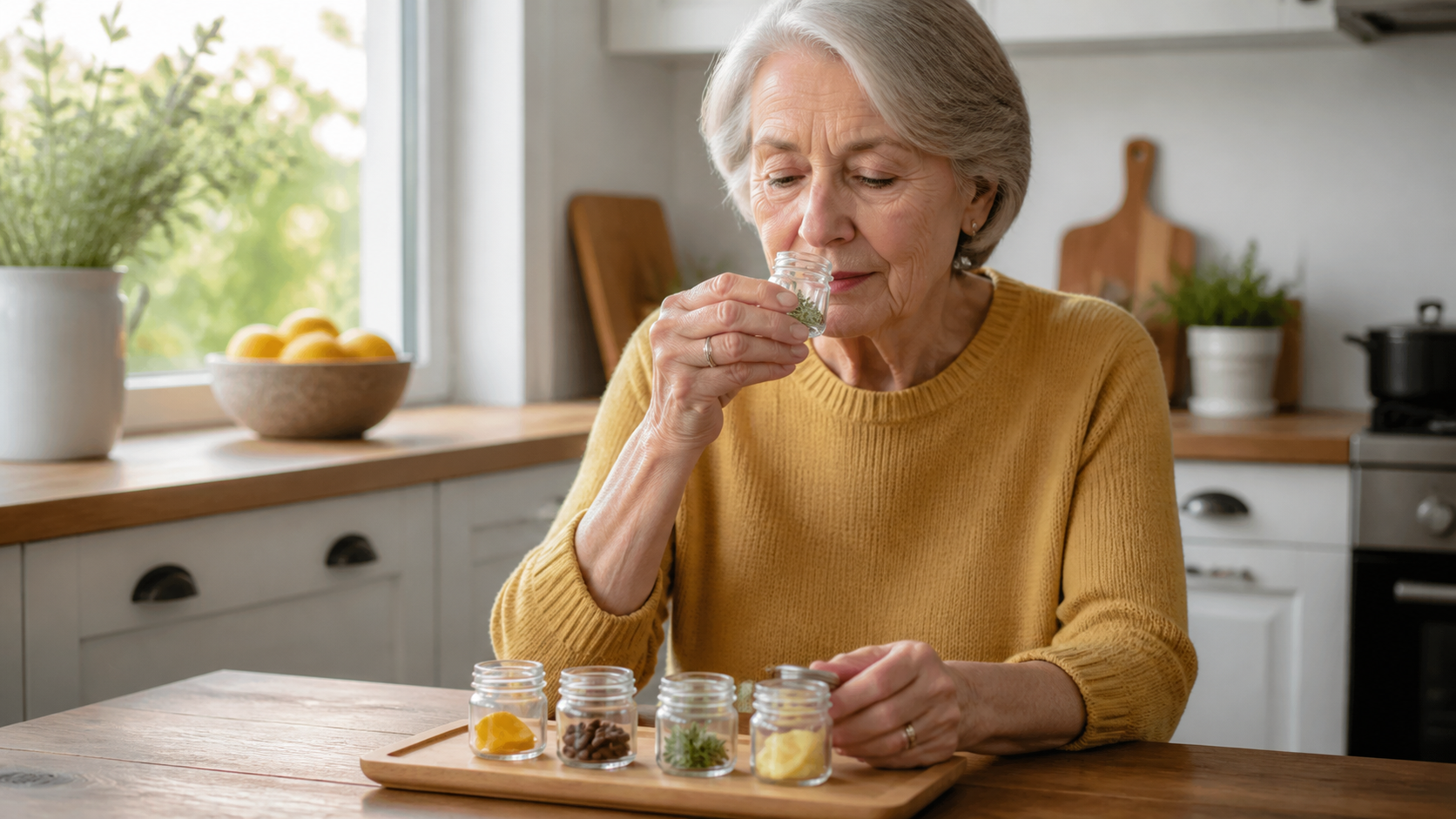
Olfactory training is a structured practice of smelling a small set of distinct odors, usually twice a day, while paying close attention to each one. It is inexpensive and low risk for many people. It is also frequently oversold. Training may support recovery in some forms of smell dysfunction, but it does not reverse every cause of loss or prove that the brain is becoming younger.
Why Smell Can Change With Age
Odor molecules activate receptors high in the nasal cavity. Signals then travel through the olfactory bulb into brain networks involved in perception, emotion, and memory. Aging can affect receptor cells, tissue repair, airflow, signal processing, and the ability to identify an odor after detecting it.
Medication effects, chronic sinus disease, smoking, head injury, viral infection, dental problems, and neurological disease may also alter smell. A blocked nose can reduce odor delivery even when sensory cells remain functional. This is why the label “age-related” should not be applied without context.
Taste and smell are often confused. The tongue detects broad qualities such as sweet, salty, sour, bitter, and umami. Much of a food’s character arrives through aroma traveling from the mouth to the nose. When smell weakens, people may add excess sugar or salt because flavor feels muted.
What Olfactory Training Involves
A typical routine uses four contrasting scents in separate, clearly labeled containers. The person smells each for roughly 10 to 20 seconds, rests briefly, and imagines or recalls the odor while breathing normally. Forceful sniffing is unnecessary.
Consistency is more important than intensity. Practice is usually continued for at least 12 weeks, and some protocols rotate odors over longer periods. A simple log can record whether an odor was detected, how strong it seemed, and whether identification became easier.
Training should use substances that are safe to smell and stored away from children and pets. Essential oils can irritate skin and airways, and they should not be swallowed. People with asthma, migraine triggers, allergies, or chemical sensitivity may need professional guidance before starting.
What the Evidence Suggests
Clinical studies and reviews suggest that olfactory training can improve measured smell function for some people, particularly after post-viral dysfunction. Results vary by diagnosis, starting severity, adherence, testing method, and duration.
The mechanism is not fully settled. Repeated, attentive exposure may support sensory regeneration, improve recognition, or help the brain interpret weak signals more efficiently. These possibilities do not mean that more exposure is always better. Irritating the nose or using dangerously concentrated substances is not a useful training stimulus.
Evidence specific to otherwise healthy older adults remains less complete than the general literature on smell disorders. Training is best viewed as rehabilitation practice, not a proven longevity intervention.
Safety, Nutrition, and Daily Life
Reduced smell creates practical risks. Smoke and natural-gas alarms must work reliably because the nose cannot be the only warning system. Food should be dated and stored carefully; appearance and expiration guidance are safer than sniffing leftovers.
If appetite falls, use texture, temperature, acidity, herbs, and visual contrast to make meals appealing without automatically adding salt or sugar. Unintentional weight loss deserves attention, especially when smell loss follows illness.
Sudden smell loss, one-sided symptoms, recurrent nosebleeds, severe headache, neurological changes, or loss after head injury requires medical assessment. Persistent change also merits review of medications, nasal health, and formal smell testing.
The Healthy-Aging Perspective
Olfactory training illustrates a useful principle: sensory systems can sometimes respond to deliberate practice, but improvement depends on the reason they changed. A low-cost routine may be worth discussing with a clinician after the cause of smell loss has been considered.
The realistic goal is not a younger biological age. It is better function—safer cooking, more enjoyable meals, clearer odor recognition, and less uncertainty about a symptom that affects daily life.
Frequently Asked Questions
What scents are used for olfactory training?
How long does smell training take?
Can smell training diagnose dementia?
Sources
Stay Updated on Longevity Science
Weekly research digests. No spam, unsubscribe anytime.
Related Articles
Arterial Calcification and Vascular Aging: Reading the Risk Signals
Arterial calcification can reveal accumulated vascular risk. Learn what calcium scores mean, why calcification develops, and where testing has limits.
10 min read
Arterial Stiffness and Vascular Age: A Longevity Evidence Guide
Understand arterial stiffness vascular age longevity links, key studies, measurement limits, and evidence-based lifestyle implications for healthy aging.
11 min read
Arterial Stiffness and Vascular Aging: What the Evidence Shows
Explore arterial stiffness vascular aging, how vessels change over time, what pulse wave velocity studies show, and practical ways evidence may inform prevention.
10 min read