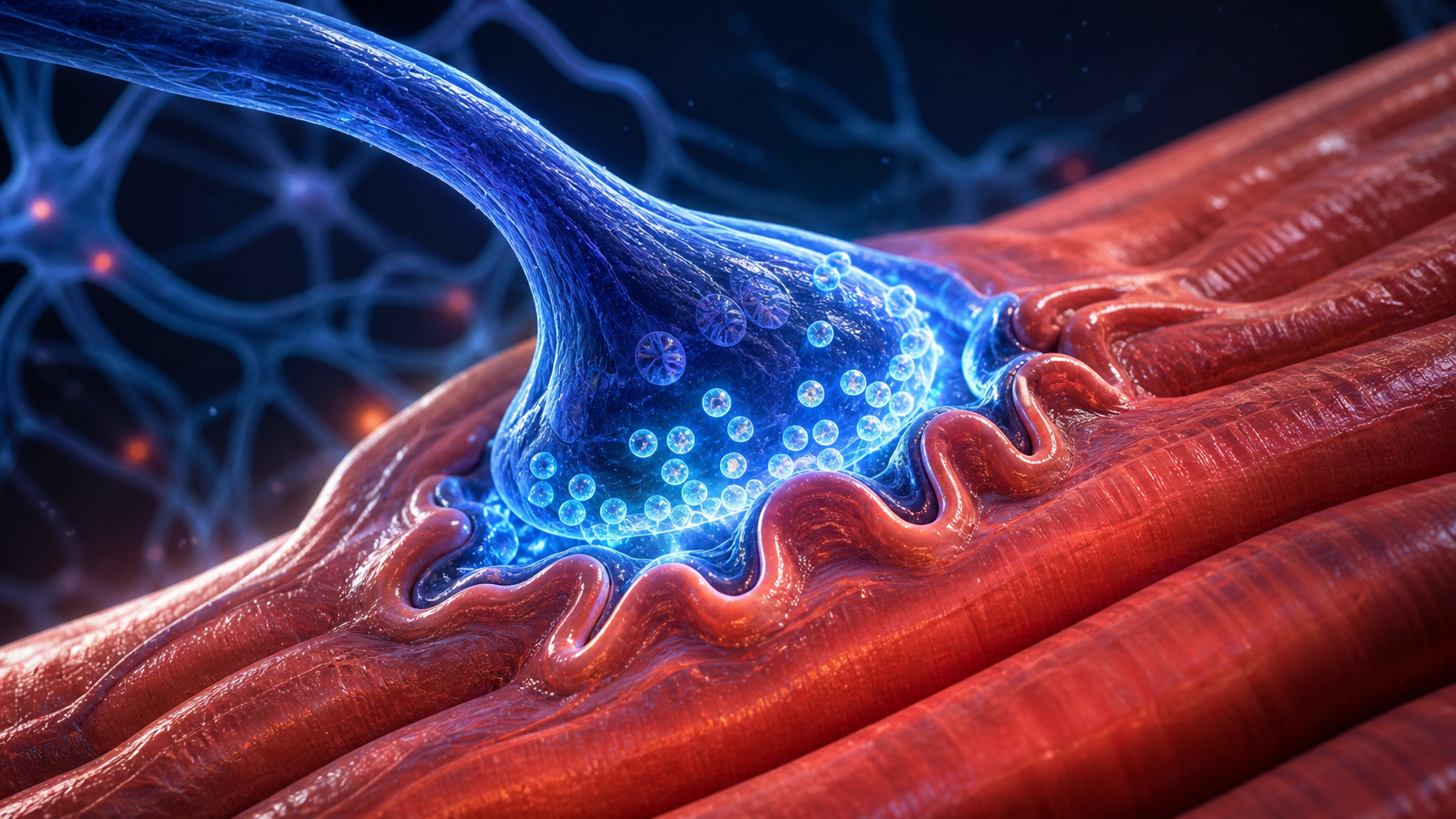
Neuromuscular Junction Aging: Why Nerve-Muscle Communication Matters
Neuromuscular junction aging may affect strength, power, and mobility as nerve-muscle connections remodel. Explore the evidence and practical implications.
Table of Contents
DISCLAIMER
This article is for informational purposes only and does not constitute medical advice. The statements in this article have not been evaluated by the FDA. The information presented is based on published research and should not be used as a substitute for professional medical guidance. Consult your physician before starting any supplement or health protocol.
Neuromuscular junction aging mobility research focuses on a fact that muscle-size discussions often miss: movement begins with communication. A muscle fiber only contracts after a motor neuron delivers a signal across a microscopic synapse called the neuromuscular junction. Aging can influence the neuron, the junction, the muscle fiber, and the feedback systems that coordinate them.
How the Nerve-Muscle Connection Works
A motor neuron branches from the spinal cord to a group of muscle fibers. Together, the neuron and the fibers it controls form a motor unit. When the neuron fires, its terminal releases acetylcholine. The chemical crosses the junction, binds receptors on the muscle membrane, and triggers an electrical signal that leads to contraction.
The junction is not a fixed plug. It is a living structure supported by Schwann cells, receptors, mitochondria, cytoskeletal proteins, and feedback from muscle activity. Repeated use helps maintain organization; illness, inactivity, inflammation, and nerve injury may disrupt it.
What Changes With Age
Motor neuron numbers tend to decline across adulthood, particularly later in life. When one neuron is lost, neighboring surviving neurons may sprout new branches and adopt some of its abandoned muscle fibers. This reinnervation can preserve force, but it creates larger motor units with less fine control.
Fast, powerful fibers may be especially vulnerable. That may help explain why muscle power often falls faster than maximum strength. A person may still produce force in a slow test yet respond less quickly to a trip, stair, or changing surface.
Researchers also observe fragmentation of some neuromuscular junctions, altered acetylcholine receptors, changes in mitochondrial support, and periods of partial denervation. These are population patterns, not a universal timetable. Lifelong activity, disease burden, nutrition, injury history, and genetics influence the trajectory.
What Human Research Can and Cannot Show
Hunter and colleagues reviewed age-related changes across the neuromuscular system and described how neural drive, motor-unit behavior, muscle quality, and contractile changes can contribute to weakness. The evidence argues against a single cause of sarcopenia. Smaller muscles matter, but so do the nervous system and the quality of activation.
Large human studies often use electromyography, nerve-stimulation tests, imaging, strength measurements, and muscle biopsies. Each sees a different piece. Surface electrical signals can estimate recruitment but do not provide a direct photograph of every junction. Biopsies sample a tiny region. Longitudinal studies are therefore especially valuable because they track change within the same person.
Lower strength and slower movement are associated with disability and poorer outcomes, yet association does not prove that junction deterioration caused the result. Arthritis, pain, cardiovascular disease, inactivity, and cognitive change can influence the same tests.
Why Activity May Preserve Function
Resistance training asks the nervous system to recruit motor units and the muscle to produce force. Balance training challenges sensory integration and rapid correction. Carefully progressed power training emphasizes producing force quickly. Together, these modes may address more of the neuromuscular system than muscle size alone.
The practical principle is specificity. Slow strength work can build capacity; faster intent with safe loads may train rapid recruitment; walking and aerobic activity support circulation and endurance; skill practice improves coordination. Not every older adult should begin with explosive movement. Frailty, falls, neuropathy, joint disease, and cardiovascular risk can change the starting point.
Protein and overall energy intake support muscle remodeling, but nutrition cannot replace neural practice. Similarly, a supplement that changes a molecular marker is not proven to rebuild human neuromuscular junctions or prevent falls.
Open Questions and the Bottom Line
Researchers are investigating how immune cells, terminal Schwann cells, mitochondrial quality, motor-neuron health, and muscle-derived signals coordinate junction maintenance. Better biomarkers may eventually identify people whose weakness is driven more by denervation than by muscle loss.
Neuromuscular junction aging helps explain why healthy mobility depends on communication as well as muscle mass. The most evidence-aligned approach is broad: regular movement, progressive resistance work, appropriate balance practice, recovery, and evaluation of unexplained weakness. Anyone with new weakness, numbness, repeated falls, or rapid functional decline should seek clinical assessment rather than assuming normal aging.
Frequently Asked Questions
What is the neuromuscular junction?
Does aging disconnect nerves from muscle?
Can exercise support neuromuscular function?
Sources
Stay Updated on Longevity Science
Weekly research digests. No spam, unsubscribe anytime.
Related Articles
Arterial Calcification and Vascular Aging: Reading the Risk Signals
Arterial calcification can reveal accumulated vascular risk. Learn what calcium scores mean, why calcification develops, and where testing has limits.
10 min read
Arterial Stiffness and Vascular Age: A Longevity Evidence Guide
Understand arterial stiffness vascular age longevity links, key studies, measurement limits, and evidence-based lifestyle implications for healthy aging.
11 min read
Arterial Stiffness and Vascular Aging: What the Evidence Shows
Explore arterial stiffness vascular aging, how vessels change over time, what pulse wave velocity studies show, and practical ways evidence may inform prevention.
10 min read