Intermuscular Fat and Aging: Why Muscle Quality Matters
Intermuscular fat can weaken muscle quality as people age. Learn what research suggests about function, measurement, exercise, and healthy aging.
Table of Contents
DISCLAIMER
This article is for informational purposes only and does not constitute medical advice. The statements in this article have not been evaluated by the FDA. The information presented is based on published research and should not be used as a substitute for professional medical guidance. Consult your physician before starting any supplement or health protocol.
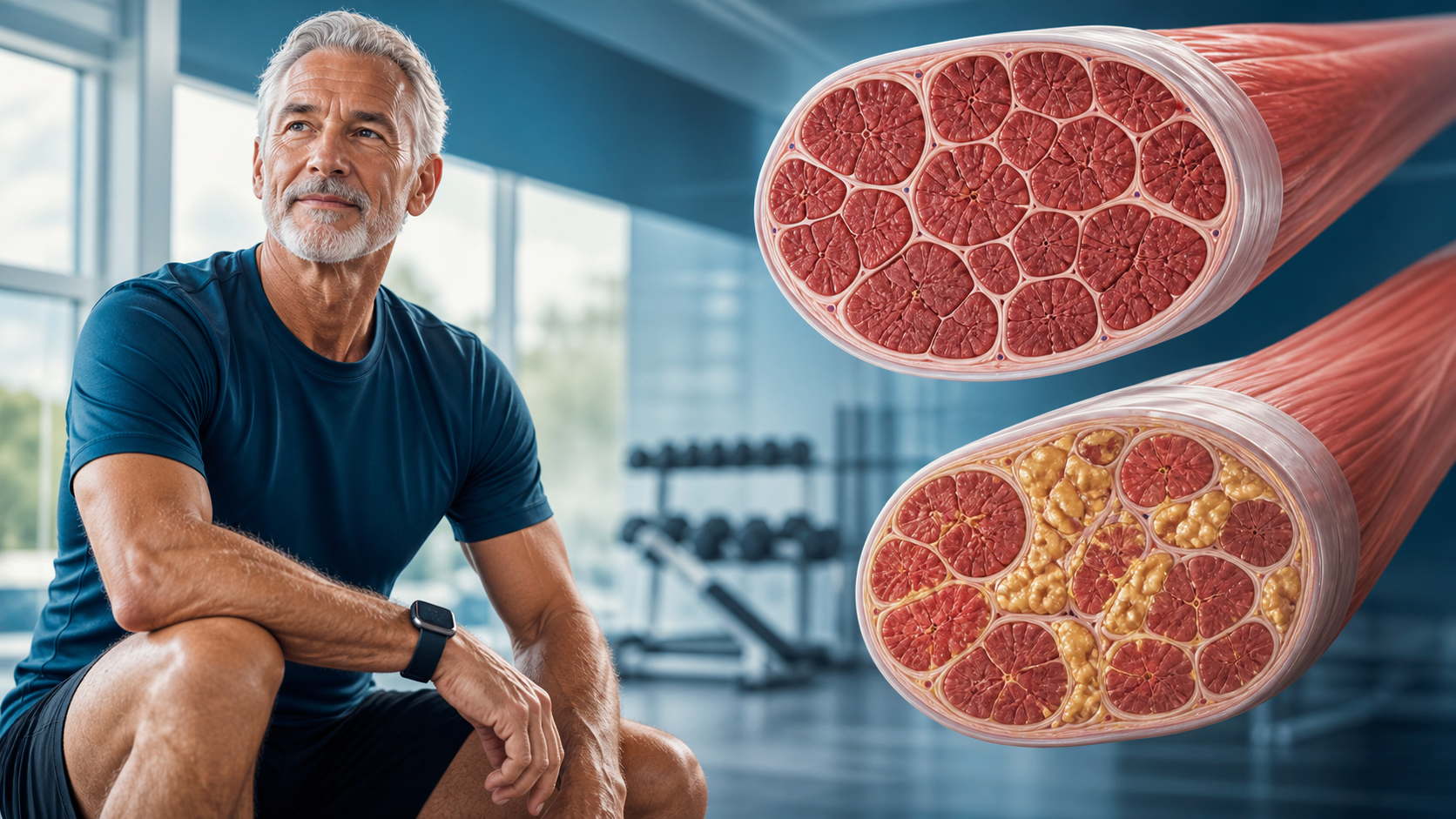
Muscle aging is not only a story about how much tissue remains. It is also about what that tissue can do. Research on intermuscular fat, muscle quality, and aging helps explain why two people with similar-looking muscle mass can differ sharply in strength, balance, and walking speed.
Fat can accumulate beneath the muscle fascia, between muscle groups, and within individual muscles. Researchers often describe this broader pattern as myosteatosis. It is associated with aging, inactivity, insulin resistance, obesity, and several chronic conditions, but it should not be treated as a diagnosis on its own. Imaging findings are one part of a larger functional picture.
What Intermuscular Fat Means
Skeletal muscle contains contractile fibers, connective tissue, blood vessels, nerves, and small energy stores. With age or prolonged inactivity, the balance can shift. More lipid may be stored inside muscle cells, while visible adipose tissue can expand between fascicles and neighboring muscles.
Computed tomography studies often estimate muscle attenuation: lower attenuation generally suggests more lipid within the measured area. Magnetic resonance imaging can separate adipose tissue from lean tissue with greater anatomical detail. Ultrasound is more accessible but depends heavily on technique and interpretation. None of these measures is interchangeable with a bathroom scale or a standard body-fat estimate.
The distinction matters because muscle quantity and muscle quality are different. Quantity describes the amount of lean tissue. Quality describes the force, power, or function produced relative to that tissue, as well as structural features that may influence performance.
Why Muscle Quality Can Decline With Age
Several mechanisms may operate together. Reduced physical activity lowers the repeated mechanical stimulus that helps maintain muscle fibers. Motor units are remodeled as some nerve-muscle connections are lost. Mitochondrial function, capillary supply, inflammation, and connective tissue properties can also change.
Fat infiltration may be both a marker and a contributor. Adipose tissue can release signaling molecules that influence local inflammation and insulin action. Lipid metabolites inside muscle cells may interfere with metabolic signaling when storage and oxidation are poorly matched. At the same time, weak or painful movement can reduce activity, creating a cycle in which less use encourages further compositional change.
This does not mean all intramuscular lipid is harmful. Endurance-trained athletes can store substantial lipid inside muscle while remaining highly insulin sensitive, sometimes called the athlete’s paradox. Location, turnover, fitness, and metabolic context all matter.
What Key Studies Suggest
The Health, Aging and Body Composition Study helped establish that muscle attenuation and strength do not move in lockstep with muscle size. Older adults could lose strength faster than they lost measured lean mass, supporting the idea that quality deserves independent attention.
Longitudinal analyses have linked increasing adipose infiltration with poorer strength and mobility. Observational results cannot prove that the fat itself causes every decline, because illness, inactivity, medication, pain, and nutrition can influence both composition and function.
Modern sarcopenia guidance reflects this broader view. The revised European consensus emphasizes low muscle strength as a central signal, with muscle quantity or quality helping confirm the condition and physical performance indicating severity. That framework moves assessment away from size alone.
Practical Implications for Healthy Aging
Resistance training remains one of the most direct ways to challenge muscle quality. Progressive exercises that include pushing, pulling, squatting, hinging, carrying, and controlled lowering may improve strength and task performance when matched to current ability. Aerobic activity supports mitochondrial and vascular function, while balance and power practice address capacities that ordinary walking may not fully train.
Protein adequacy, overall dietary quality, sleep, and management of medical conditions also shape adaptation. The useful target is not a single scan number. It is a pattern: rising strength, better movement control, improved walking capacity, and a program that can be sustained.
Simple functional measures can be informative. Repeated chair stands, usual walking speed, grip strength, stair control, and the ability to carry everyday loads reveal qualities a scale cannot. A clinician or qualified exercise professional can help interpret changes when pain, unexplained weakness, falls, or rapid functional decline are present.
Limits and Future Research
There is no universal cutoff for “too much” intermuscular fat across every muscle, imaging method, sex, ethnicity, and age. Studies use different scanners, anatomical sites, and definitions. Many are observational, and participants with serious illness may not resemble healthy community-dwelling adults.
Future work needs standardized measures and trials that connect imaging changes with outcomes people actually value: independence, fall risk, recovery after hospitalization, and quality of life. Researchers are also examining whether muscle composition helps identify who benefits most from specific training approaches.
The Bottom Line
Intermuscular fat is a useful clue, not a verdict. Aging muscle should be judged by composition and performance, not mass alone. The most practical response is to build strength, aerobic capacity, balance, and consistency while using medical assessment when functional change is unexplained.
Frequently Asked Questions
What is intermuscular fat?
Can exercise reduce fat infiltration in muscle?
Is muscle mass enough to measure healthy aging?
Sources
Stay Updated on Longevity Science
Weekly research digests. No spam, unsubscribe anytime.
Related Articles
Arterial Calcification and Vascular Aging: Reading the Risk Signals
Arterial calcification can reveal accumulated vascular risk. Learn what calcium scores mean, why calcification develops, and where testing has limits.
10 min read
Arterial Stiffness and Vascular Age: A Longevity Evidence Guide
Understand arterial stiffness vascular age longevity links, key studies, measurement limits, and evidence-based lifestyle implications for healthy aging.
11 min read
Arterial Stiffness and Vascular Aging: What the Evidence Shows
Explore arterial stiffness vascular aging, how vessels change over time, what pulse wave velocity studies show, and practical ways evidence may inform prevention.
10 min read