Heat Shock Proteins and Cellular Aging: The Stress-Response Connection
Heat shock proteins help cells fold and protect proteins under stress. Explore how this defense changes with age and what human evidence can support.
Table of Contents
DISCLAIMER
This article is for informational purposes only and does not constitute medical advice. The statements in this article have not been evaluated by the FDA. The information presented is based on published research and should not be used as a substitute for professional medical guidance. Consult your physician before starting any supplement or health protocol.
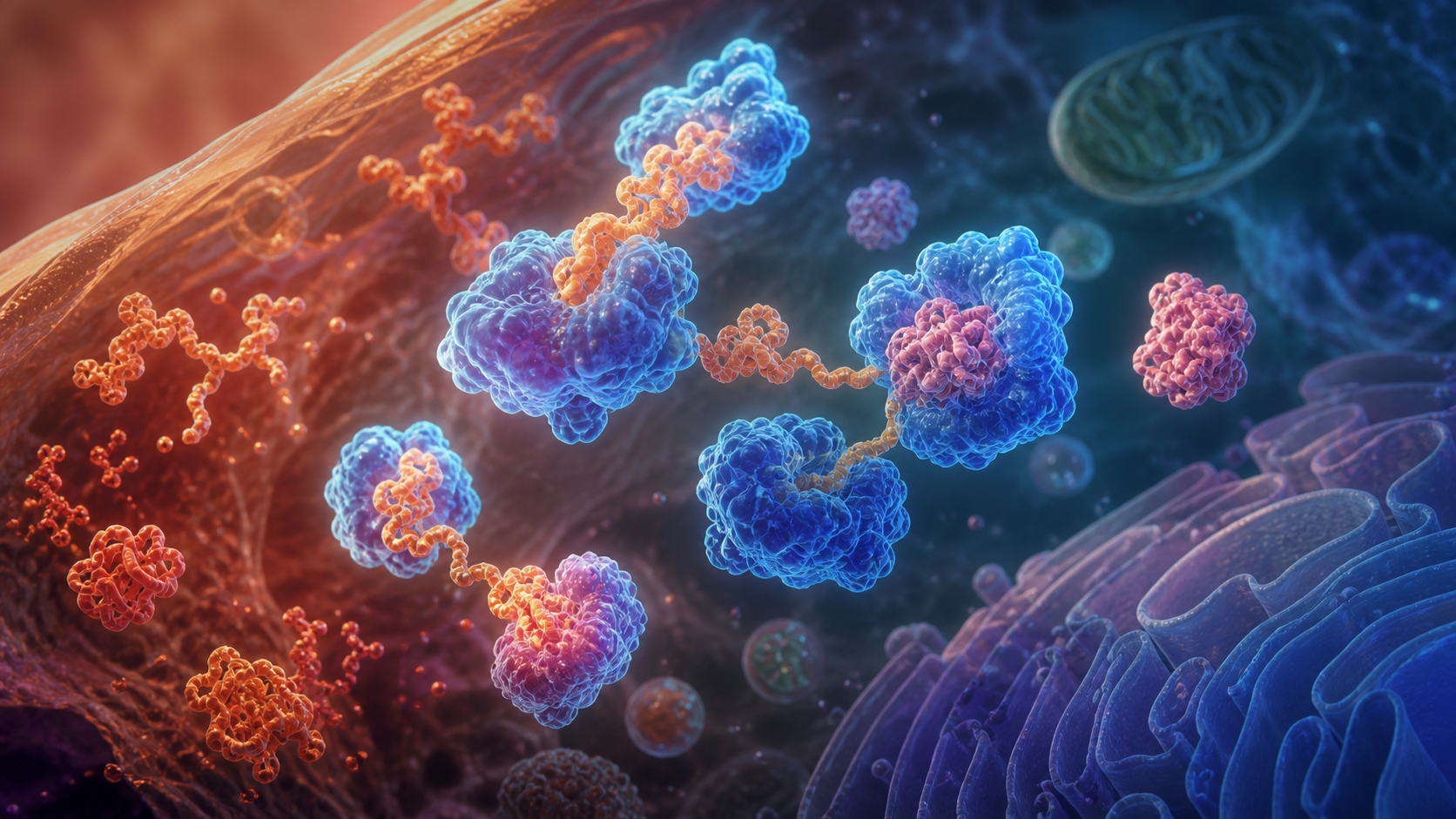
Proteins must fold into precise shapes to work. Heat, inflammation, toxins, oxidation, and ordinary metabolic activity can destabilize those shapes. Heat shock proteins help cells protect, refold, or dispose of stressed proteins before they form damaging aggregates.
Despite the name, these molecular chaperones respond to much more than heat. They are part of a wider stress-defense network that supports proteostasis—the maintenance of a functional protein environment.
How the Heat Shock Response Works
When proteins begin to misfold, heat shock factor 1 (HSF1) can activate genes encoding chaperones such as HSP70 and HSP90. Chaperones bind exposed regions that would otherwise stick to other proteins. Some help a protein try folding again; others cooperate with proteasomes or autophagy pathways to remove damage that cannot be repaired.
The response is dynamic. Cells keep enough chaperone capacity for normal conditions, then increase it during stress. After recovery, signaling should settle. A permanently elevated marker can indicate chronic stress rather than superior resilience.
Different heat shock proteins also have different jobs and locations. Results from one protein in blood cannot be generalized to every tissue or the entire network.
What Changes With Age
Proteostasis becomes harder to maintain as damage accumulates and several quality-control systems lose flexibility. Experimental models show that older cells may activate HSF1 less effectively or recover more slowly after stress. Damaged proteins can then persist, interfere with cellular machinery, and burden disposal pathways.
This decline is relevant to neurodegenerative disorders in which specific proteins aggregate, but it is not a single-cause explanation. Genetics, inflammation, mitochondrial function, clearance systems, and cell-type vulnerability all interact.
Longevity studies in model organisms suggest that strengthening selected chaperone pathways can improve stress resistance and sometimes extend lifespan. Translating that result to humans is difficult because continuous pathway activation may have costs, and some cancers exploit chaperones to stabilize growth-promoting proteins.
Exercise, Heat, and Hormetic Stress
Exercise exposes muscle and other tissues to temperature change, mechanical load, altered energy demand, and oxidative signals. Those short challenges can induce chaperones and support adaptation. Repeated training may improve the efficiency of the response, although protocols and measured tissues vary across studies.
Passive heat exposure can also raise body and tissue temperature enough to influence heat shock pathways. Observational research on sauna use has reported associations with health outcomes, but those studies cannot isolate HSP activation from fitness, socioeconomic factors, relaxation, or other behaviors.
The concept of hormesis describes a small, recoverable stress that promotes adaptation. It does not mean that more heat or harder training is always better. Dehydration, cardiovascular instability, medication effects, and impaired temperature regulation can make heat risky, especially for some older adults.
What the Evidence Supports Today
Heat shock proteins are valuable research markers and plausible participants in healthy aging. They are not a clinical age score, and no accepted target tells a person to maximize HSP70 or HSP90.
Exercise remains useful because randomized trials support strength, mobility, metabolic health, and cardiovascular fitness—not because a single chaperone measurement promises longevity. Heat exposure may be a comfortable adjunct for suitable people, but it should not replace activity or medical care.
The most defensible interpretation is that resilient aging requires coordinated stress response and recovery. Heat shock proteins are one important part of that system, not a standalone anti-aging switch.
Frequently Asked Questions
What do heat shock proteins do?
Does sauna use increase heat shock proteins?
Are heat shock protein supplements proven?
Sources
Stay Updated on Longevity Science
Weekly research digests. No spam, unsubscribe anytime.
Related Articles
Arterial Calcification and Vascular Aging: Reading the Risk Signals
Arterial calcification can reveal accumulated vascular risk. Learn what calcium scores mean, why calcification develops, and where testing has limits.
10 min read
Arterial Stiffness and Vascular Age: A Longevity Evidence Guide
Understand arterial stiffness vascular age longevity links, key studies, measurement limits, and evidence-based lifestyle implications for healthy aging.
11 min read
Arterial Stiffness and Vascular Aging: What the Evidence Shows
Explore arterial stiffness vascular aging, how vessels change over time, what pulse wave velocity studies show, and practical ways evidence may inform prevention.
10 min read