Hearing Loss and Cognitive Aging: What the Evidence Shows
Hearing loss and cognitive aging are linked in large studies. Explore possible mechanisms, the ACHIEVE trial, screening, and what remains uncertain.
Table of Contents
DISCLAIMER
This article is for informational purposes only and does not constitute medical advice. The statements in this article have not been evaluated by the FDA. The information presented is based on published research and should not be used as a substitute for professional medical guidance. Consult your physician before starting any supplement or health protocol.
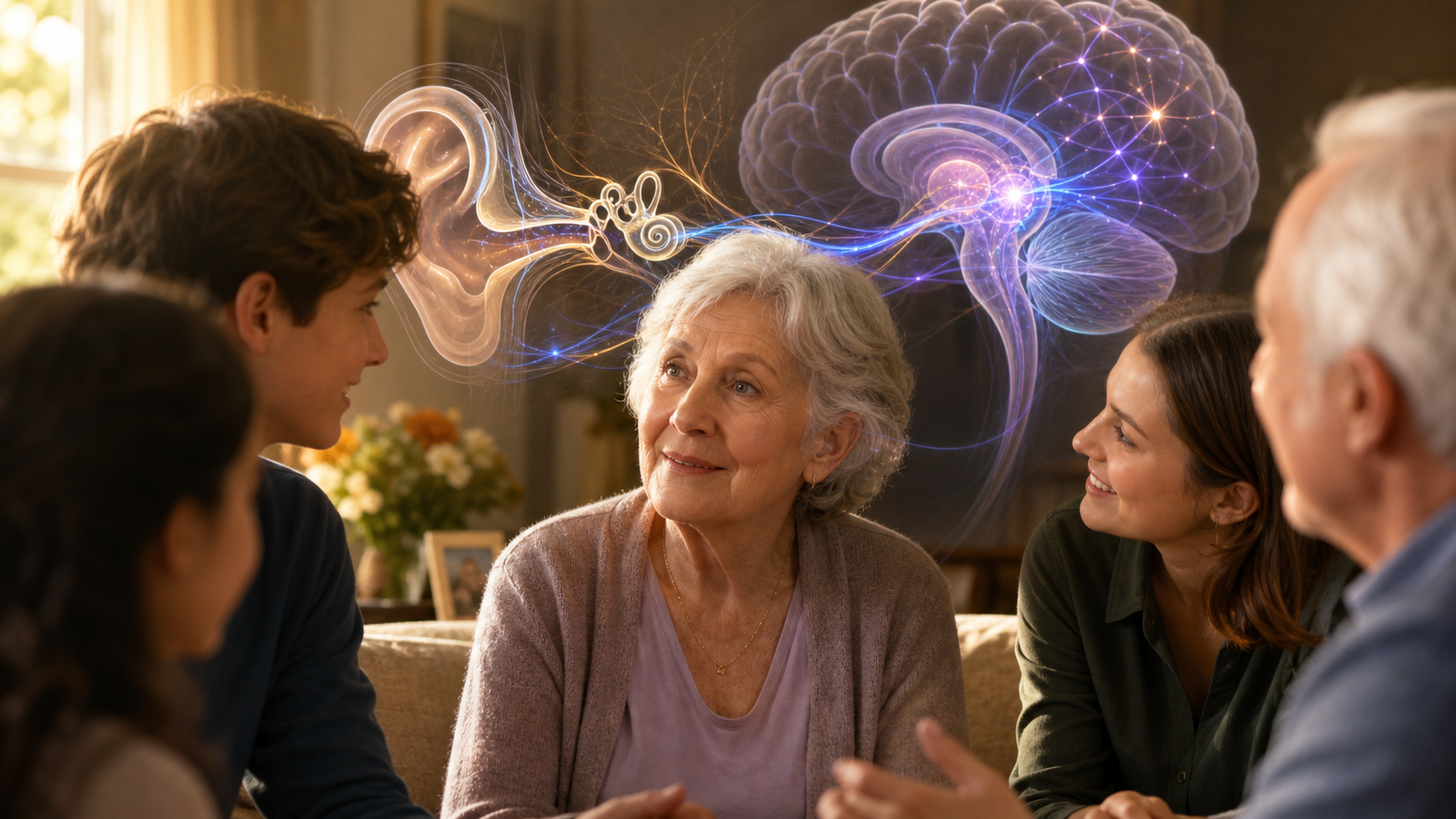
Age-related hearing change can look like a problem of volume. In reality, it can reshape conversation, attention, confidence, and social participation. That is why research on hearing loss and cognitive aging evidence has become a major part of dementia-prevention science.
Large cohort studies repeatedly find that adults with greater hearing loss have a higher rate of later cognitive decline and dementia. The association is important, but it is not destiny. Hearing ability, brain health, education, vascular risk, social life, and access to care interact over decades.
Why Hearing and Cognition May Be Connected
One explanation is cognitive load. When speech is degraded, the brain must spend more effort identifying words and filling gaps. That extra work can leave fewer resources for memory and comprehension during the same conversation.
A second pathway involves social engagement. People who struggle to follow speech may avoid restaurants, meetings, calls, or group activities. Reduced interaction can mean less cognitive stimulation and more loneliness, both of which are associated with poorer health outcomes.
A third possibility is shared biology. Vascular disease, inflammation, smoking, diabetes, and other exposures can influence both the auditory system and the brain. Neurodegenerative processes may also affect central auditory processing before conventional cognitive symptoms are obvious.
Measurement adds another complication. Many cognitive tests are delivered verbally. If a participant cannot hear instructions or test items clearly, performance may underestimate actual cognition. Careful studies adapt testing, but this problem cannot always be eliminated.
What Observational Research Shows
In a widely cited 2011 cohort analysis, Frank Lin and colleagues reported a graded association between hearing loss and incident dementia. Greater baseline loss was linked with higher subsequent risk after adjustment for several confounders.
Later studies and meta-analyses have generally supported an association. The 2020 Lancet Commission listed hearing loss among potentially modifiable dementia risk factors. “Modifiable” does not mean that correcting one factor guarantees prevention. It means population risk might be reduced if effective, accessible interventions improve the relevant pathway.
Observational evidence has limits. People who choose hearing aids may differ from non-users in income, health literacy, healthcare access, and social activity. Those differences can create an apparent benefit even after statistical adjustment.
What the ACHIEVE Trial Changed
The ACHIEVE trial tested a hearing intervention against health education in older adults with untreated hearing loss. Over three years, the trial did not find a significant cognitive benefit across the full combined study population.
The picture was more nuanced in a prespecified higher-risk group recruited from an existing cardiovascular cohort. Participants in that subgroup appeared to experience slower cognitive decline with the hearing intervention. In the healthier volunteer group, cognitive change was smaller, leaving less room for a measurable difference.
This result is neither a universal victory nor a failure. It suggests baseline risk may determine how quickly a cognitive effect becomes visible. Longer follow-up may clarify whether benefits emerge over a wider time window.
The intervention was also more than handing someone a device. It included professional fitting, counseling, communication strategies, and ongoing support. Real-world outcomes may depend on comfort, consistent use, expectations, and whether family members adapt how they communicate.
Practical Meaning for Adults and Families
Hearing care has value even when a cognitive effect remains uncertain. Better communication may support relationships, workplace function, safety, and enjoyment. Treating hearing as part of healthy aging avoids the false choice between “brain benefit” and “quality-of-life benefit.”
Useful communication changes include facing the listener, reducing background noise, improving lighting, speaking clearly without shouting, and confirming important details in writing. Devices range from professionally fitted hearing aids to newer over-the-counter options in eligible markets. The right path depends on the type and degree of loss, dexterity, budget, and clinical red flags.
Sudden hearing loss, marked asymmetry, ear pain, drainage, severe dizziness, or neurological symptoms require timely medical attention. Gradual difficulty also deserves evaluation because wax, medication effects, middle-ear disease, and other conditions can mimic or compound age-related loss.
What Remains Uncertain
Researchers still need to determine which people are most likely to gain cognitive benefit, how much daily use matters, and whether starting earlier changes the trajectory. Trials also need diverse participants and outcomes that reflect communication in real life.
Hearing is only one part of dementia risk. Physical activity, blood pressure, smoking, diabetes, sleep, education, depression, and social connection may matter as well. A single device should not be marketed as a complete brain-health strategy.
The Bottom Line
Hearing loss is consistently associated with cognitive aging, but the causal pathway is complex. Hearing care may improve communication and could help slow decline in some higher-risk adults. The evidence supports taking hearing seriously while avoiding promises that any one intervention can determine a person’s cognitive future.
Frequently Asked Questions
Does hearing loss cause dementia?
Do hearing aids prevent cognitive decline?
When should an adult get hearing tested?
Sources
Stay Updated on Longevity Science
Weekly research digests. No spam, unsubscribe anytime.
Related Articles
Arterial Calcification and Vascular Aging: Reading the Risk Signals
Arterial calcification can reveal accumulated vascular risk. Learn what calcium scores mean, why calcification develops, and where testing has limits.
10 min read
Arterial Stiffness and Vascular Age: A Longevity Evidence Guide
Understand arterial stiffness vascular age longevity links, key studies, measurement limits, and evidence-based lifestyle implications for healthy aging.
11 min read
Arterial Stiffness and Vascular Aging: What the Evidence Shows
Explore arterial stiffness vascular aging, how vessels change over time, what pulse wave velocity studies show, and practical ways evidence may inform prevention.
10 min read