Handgrip Strength Asymmetry and Healthy Aging
Grip strength asymmetry may add context to a standard handgrip test. Learn how it is measured, what can distort it, and when a side-to-side difference deserves attention.
Table of Contents
DISCLAIMER
This article is for informational purposes only and does not constitute medical advice. The statements in this article have not been evaluated by the FDA. The information presented is based on published research and should not be used as a substitute for professional medical guidance. Consult your physician before starting any supplement or health protocol.
A handgrip test usually produces one headline number: how hard a person can squeeze. But the comparison between hands may contain a second signal. Handgrip strength asymmetry describes a meaningful side-to-side difference that is larger than expected from ordinary hand dominance or measurement noise.
Researchers have linked greater asymmetry with poorer physical performance and some adverse outcomes in older populations. That does not make asymmetry a diagnosis or a biological-age score. It makes it a clue—one that belongs beside absolute strength, walking ability, pain, medical history, and daily function.
How Is Grip Asymmetry Measured?
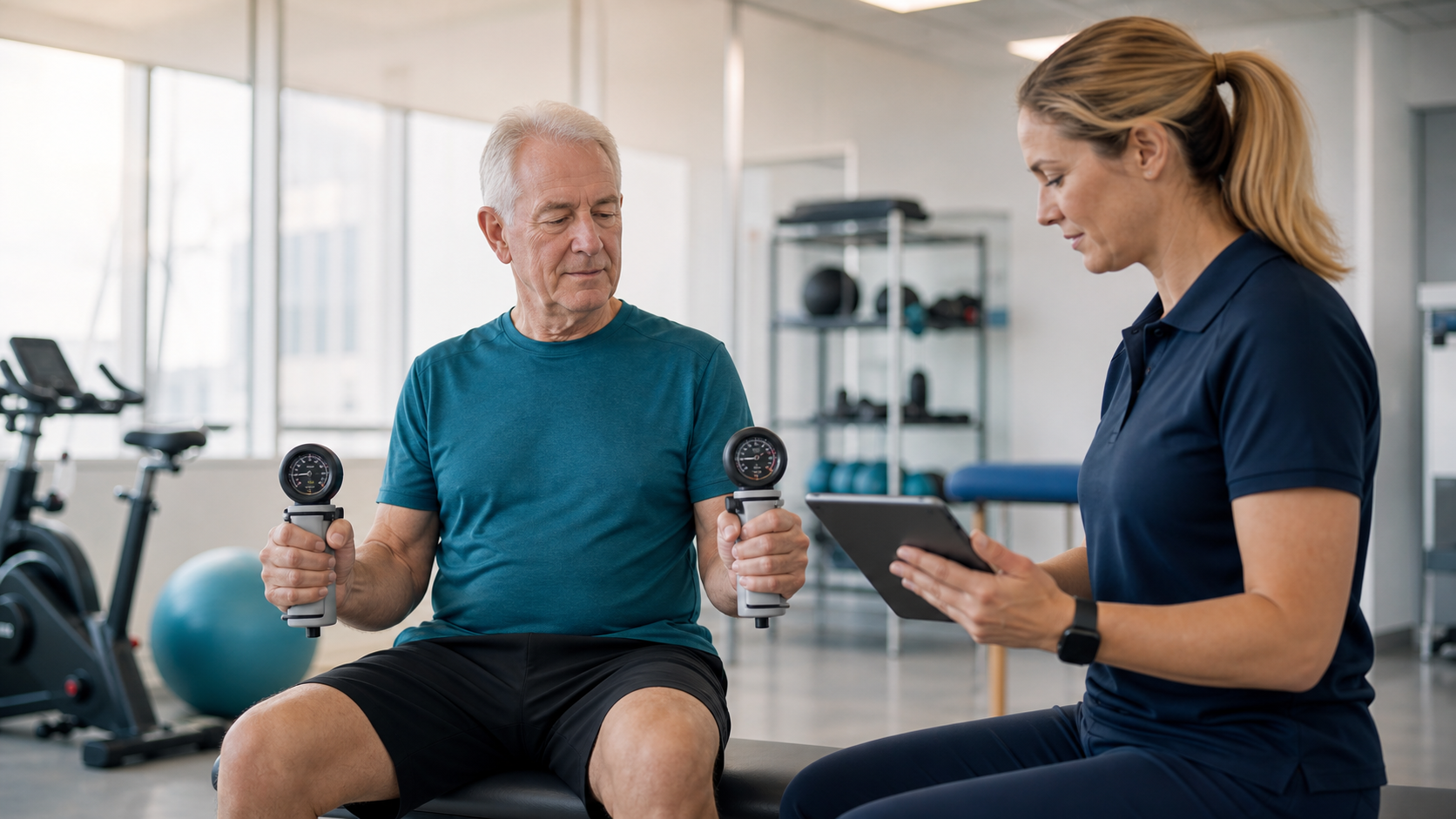
A clinician or researcher uses a hand dynamometer and tests both hands under the same protocol. Position matters: elbow angle, shoulder position, wrist alignment, instructions, and the number of trials can all change the result. Many protocols take two or three attempts per hand and retain the best or average value.
The raw difference can be expressed in kilograms, but a percentage is often more useful because a five-kilogram gap means something different for a very strong person than for someone with low strength overall. One simple calculation divides the weaker value by the stronger value and looks at the size of the remaining gap.
Cutoffs vary across studies. Some research defines differences above roughly 10% as notable, while other work uses thresholds informed by hand dominance. These are study definitions, not universal clinical rules.
Why Might Asymmetry Increase With Age?
The two sides of the body do not age in perfect synchrony. Arthritis, tendon problems, nerve compression, shoulder pain, stroke, prior fracture, and reduced use can affect one side more than the other. A person may gradually avoid loading a painful hand, producing a cycle of lower use and lower strength.
Neurological control matters too. Grip is not only a forearm-muscle test; it requires coordinated activation from the brain, spinal cord, peripheral nerves, and hand. A new side-to-side difference accompanied by numbness, clumsiness, facial weakness, or speech changes requires prompt medical attention rather than home tracking.
Ordinary handedness creates expected variation. The dominant hand is often stronger, although occupation, sport, injury history, and individual habit can reverse the pattern. This is why a single internet cutoff cannot explain an individual result.
What Can Distort the Result?
Device settings are a common source of noise. A handle that is too wide or narrow can reduce force. Testing one hand first on every visit may introduce learning or fatigue. Encouragement, posture, pain, and even unfamiliarity with the device can matter.
For repeat testing, use the same dynamometer, handle position, body position, instructions, and trial count. Alternate the starting hand when appropriate and allow consistent rest. Compare like with like.
Do not overreact to a small change. Consumer dynamometers may be useful for trends, but measurement error can look like improvement or decline. The strongest interpretation comes from repeated results collected consistently.
How Does Asymmetry Fit With Sarcopenia Screening?
International sarcopenia guidance places low muscle strength near the beginning of assessment, commonly using grip strength or a chair-stand test. Absolute weakness matters because it reflects limited reserve for carrying, rising, bracing during a stumble, and other daily tasks.
Asymmetry answers a different question: is one side performing substantially below the other? A person can have symmetrical but low strength, or strong overall grip with a large side-to-side gap. Both patterns may deserve attention for different reasons.
A fuller assessment may include walking speed, repeated chair stands, balance, muscle-mass measurement, nutrition, medication review, and evaluation of pain or neurological symptoms.
What Should You Do With a Large Difference?
Start with context. Ask whether there is pain, a recent injury, hand swelling, numbness, weakness elsewhere, or a long-standing occupational explanation. Repeat the test under standardized conditions before treating the number as a trend.
When a clinician rules out an acute problem, progressive resistance training may help rebuild usable strength. Programs should include both bilateral movements and appropriate unilateral work so the stronger side does not quietly perform most of the task. The goal is not perfect numerical symmetry; it is safe, capable function.
Grip asymmetry is most valuable when it changes the next question. It may prompt a closer look at pain, nerve function, movement patterns, or general strength. Used that way, it adds detail to healthy-aging assessment without pretending that one squeeze can summarize the body.
This article is educational and not medical advice. Seek urgent care for sudden one-sided weakness or other possible stroke symptoms, and discuss persistent or painful asymmetry with a qualified healthcare professional.
Frequently Asked Questions
How much grip-strength asymmetry is normal?
Does a weaker nondominant hand mean something is wrong?
Can grip asymmetry diagnose sarcopenia?
Sources
Stay Updated on Longevity Science
Weekly research digests. No spam, unsubscribe anytime.
Related Articles

Arterial Calcification and Vascular Aging: Reading the Risk Signals
Arterial calcification can reveal accumulated vascular risk. Learn what calcium scores mean, why calcification develops, and where testing has limits.
10 min read
Arterial Stiffness and Vascular Age: A Longevity Evidence Guide
Understand arterial stiffness vascular age longevity links, key studies, measurement limits, and evidence-based lifestyle implications for healthy aging.
11 min read
Arterial Stiffness and Vascular Aging: What the Evidence Shows
Explore arterial stiffness vascular aging, how vessels change over time, what pulse wave velocity studies show, and practical ways evidence may inform prevention.
10 min read