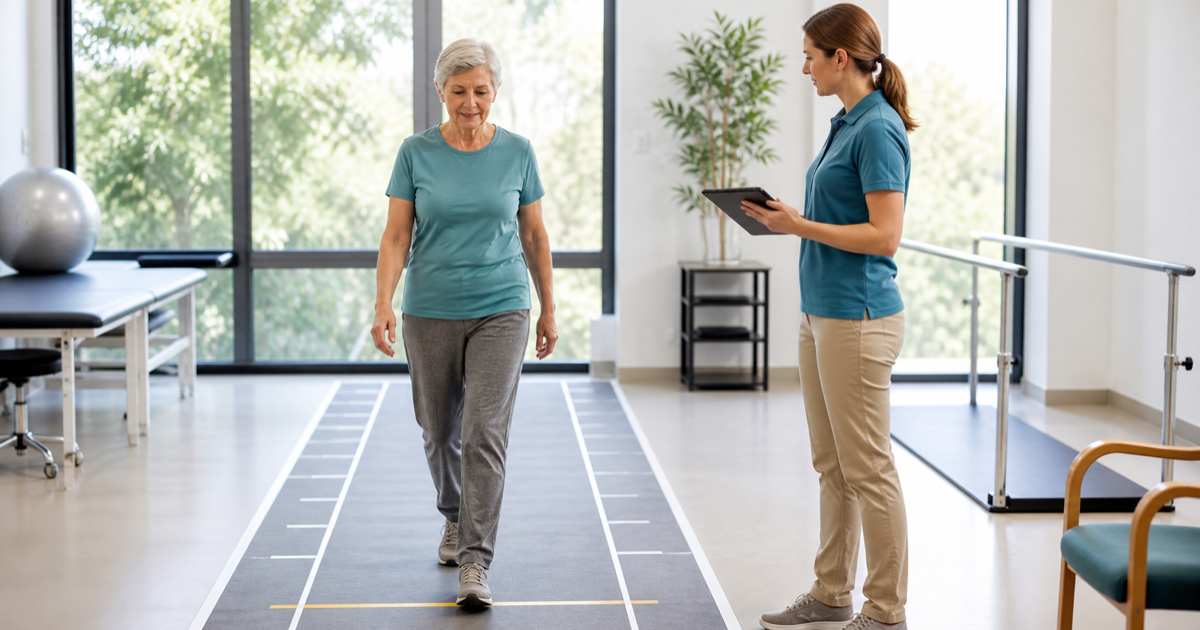
Gait Variability and Healthy Aging: What Uneven Steps May Reveal
Gait variability describes stride-to-stride changes. Learn what influences walking consistency, how it is measured, and when a change deserves attention.
Table of Contents
DISCLAIMER
This article is for informational purposes only and does not constitute medical advice. The statements in this article have not been evaluated by the FDA. The information presented is based on published research and should not be used as a substitute for professional medical guidance. Consult your physician before starting any supplement or health protocol.
Walking is never perfectly repetitive. Every step adapts to surface, speed, direction, fatigue, and the movement of the body above the feet. Some variation is useful: it allows a person to respond to a curb, avoid an obstacle, or change pace. Too much irregularity under steady conditions, however, may suggest that the walking system is working harder to maintain control.
Gait variability measures how much step timing, stride length, step width, or other features change from one step to the next. Researchers study it as one dimension of mobility and fall risk. It is not a diagnosis, and a consumer-device score should not be treated as a verdict on neurological or biological age.
Consistency Is Different From Speed
Usual walking speed reports how fast a person covers a distance. Variability describes the pattern inside that average. Two people can cross a hallway in the same time while one takes relatively even steps and the other alternates short and long strides.
Common metrics include variation in step time, stride time, stride length, and step width. Laboratories may use pressure-sensitive walkways, motion capture, or wearable sensors. Clinical observation can identify obvious changes, but subtle variability usually requires several consecutive steps and standardized measurement.
More is not always worse. Step width may vary when a surface is uneven or when a person deliberately navigates obstacles. Extremely rigid walking can also reflect limited adaptability. Interpretation depends on the task and on which feature is being measured.
Short walkways introduce another problem: starting, stopping, and turning are naturally less steady than continuous walking. A device that records only a few strides may confuse transitions with the person’s typical gait.
What Can Make Steps More Variable
Pain can shorten the time spent on one leg. Reduced sensation in the feet may make foot placement less certain. Vision, vestibular function, joint mobility, strength, reaction time, and confidence all influence the pattern. Medication effects, fatigue, acute illness, and poor sleep may temporarily change coordination.
Attention also matters. Walking while talking, calculating, carrying an object, or scanning traffic divides cognitive resources. Dual-task gait testing intentionally adds a second task to see how walking changes, but it should be supervised when balance is uncertain.
Environment can dominate the signal. Crowds, slopes, loose rugs, low light, and wet floors require legitimate adjustments. Comparing indoor treadmill data with outdoor walking data may therefore say more about the context than the person.
A new asymmetry, foot drag, freezing episode, or rapidly changing pattern deserves attention, especially when paired with weakness, numbness, dizziness, confusion, or falls. Those observations are more clinically meaningful than chasing a small change in a watch-generated percentage.
How to Evaluate a Walking Change
Start with the timeline. Did the change appear suddenly or gradually? Does it occur at the beginning of a walk, after fatigue, during turns, in dim light, or only while multitasking? Are there new shoes, medicines, pain, or vision changes? A short video recorded safely in a familiar environment may help a qualified clinician understand an intermittent problem.
A broader mobility assessment may include walking speed, chair rises, balance, strength, foot sensation, joint range, vision, and home hazards. Recent falls and near-falls matter even when no injury occurred. The CDC’s STEADI framework emphasizes combining history, examination, and practical risk reduction rather than relying on one metric.
Consumer wearables can be useful for trends if the same device and conditions are used consistently. Their algorithms, sampling, and definitions vary, and software updates can shift results. Treat the data as a prompt for observation, not as proof of disease.
Supporting More Stable, Adaptable Walking
The goal is not robotic sameness. Healthy gait must be both repeatable and adaptable. Progressive lower-body strengthening, balance practice, walking, and task-specific training may support that capacity when matched to current ability. Addressing vision, footwear, pain, and home hazards can reduce demands on the walking system.
Practice should be appropriately challenging but safe. People with recent falls, severe unsteadiness, unexplained weakness, or significant dizziness may benefit from professional supervision rather than unstable surfaces or eyes-closed drills at home.
Track function in ordinary terms too: confidence outdoors, ability to turn without hesitation, tolerance for longer walks, and recovery after a trip or stumble. These outcomes often matter more than a sensor score.
Gait variability is best viewed as a window into coordination. It can reveal how strength, sensation, attention, and environment meet in each step. Used in context, it helps turn walking from a single speed number into a richer picture of mobility and healthy aging.
Frequently Asked Questions
What is gait variability?
Does uneven walking mean someone will fall?
Can a phone or watch diagnose abnormal gait?
Sources
Stay Updated on Longevity Science
Weekly research digests. No spam, unsubscribe anytime.
Related Articles

Arterial Calcification and Vascular Aging: Reading the Risk Signals
Arterial calcification can reveal accumulated vascular risk. Learn what calcium scores mean, why calcification develops, and where testing has limits.
10 min read
Arterial Stiffness and Vascular Age: A Longevity Evidence Guide
Understand arterial stiffness vascular age longevity links, key studies, measurement limits, and evidence-based lifestyle implications for healthy aging.
11 min read
Arterial Stiffness and Vascular Aging: What the Evidence Shows
Explore arterial stiffness vascular aging, how vessels change over time, what pulse wave velocity studies show, and practical ways evidence may inform prevention.
10 min read