Gait Speed as a Longevity Biomarker: What Walking Pace Reveals
How gait speed functional longevity biomarker research links walking pace with survival, disability risk, independence, and healthier aging signals.
Table of Contents
DISCLAIMER
This article is for informational purposes only and does not constitute medical advice. The statements in this article have not been evaluated by the FDA. The information presented is based on published research and should not be used as a substitute for professional medical guidance. Consult your physician before starting any supplement or health protocol.
Introduction
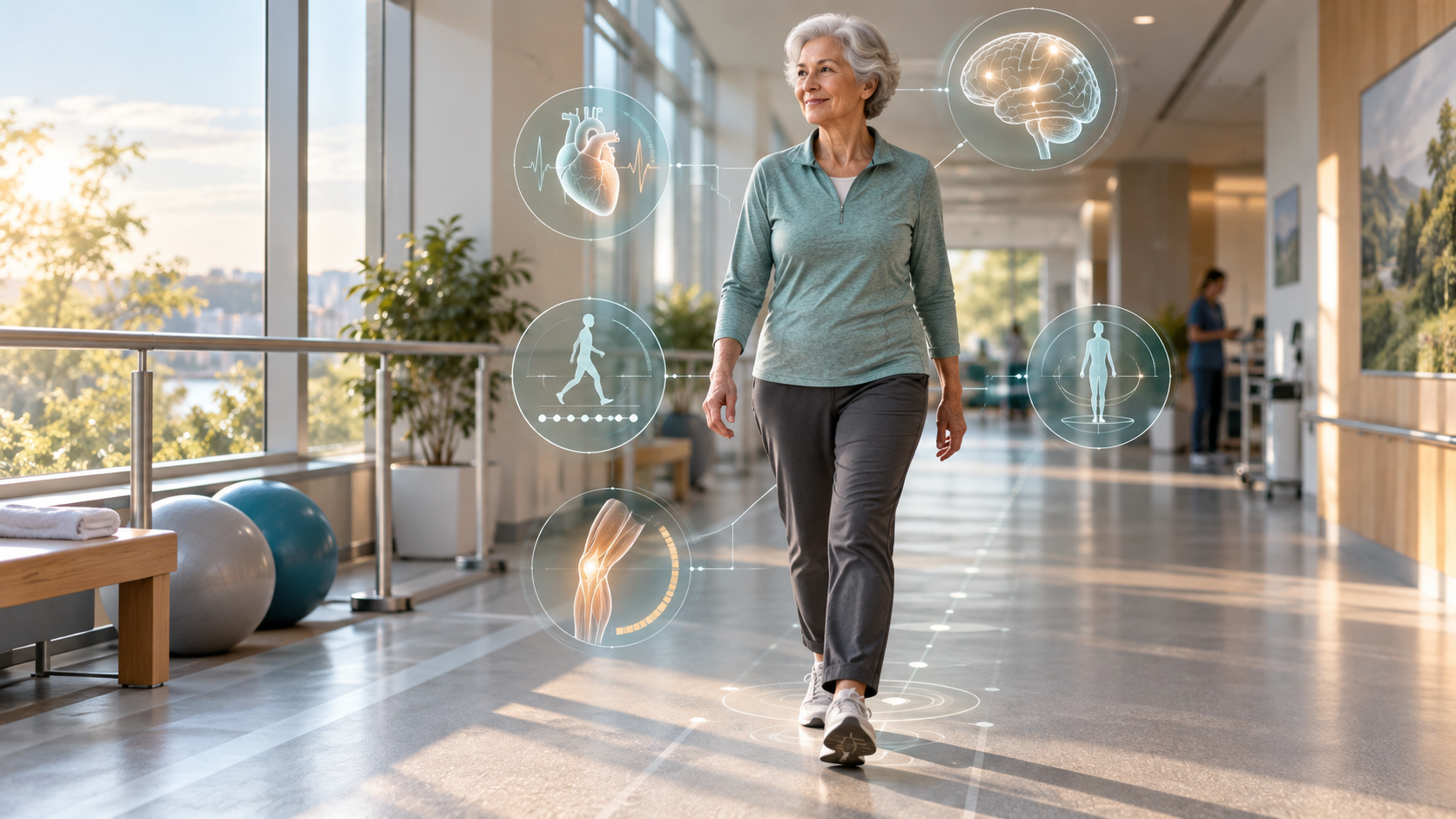
A gait speed functional longevity biomarker is unusually simple: it asks how quickly a person walks at a normal, comfortable pace. Yet behind that small measurement sits a surprisingly rich picture of human aging. Walking speed appears to capture the integrated performance of the brain, nerves, muscles, joints, heart, lungs, blood vessels, balance systems, and motivation. That is why researchers sometimes describe gait speed as a functional vital sign.
Unlike a blood marker or genetic score, gait speed measures what the body can do in real time. It is not a single molecular pathway. It is a whole-system output. A person may have favorable lab values but still move slowly because of muscle weakness, pain, neurologic change, poor balance, fatigue, cardiopulmonary limitation, or fear of falling. Conversely, a brisk usual walking pace may suggest that many body systems are working together with reasonable reserve.
This does not mean walking pace is destiny. Gait speed is not a diagnosis, and it cannot predict an individual future with certainty. It may, however, offer a practical window into functional longevity: the ability to remain mobile, independent, resilient, and engaged with daily life as years pass. For aging science, that makes gait speed valuable because it connects biological aging to outcomes people can actually feel.
The Science
Why Walking Pace Reflects Whole-Body Reserve
Walking looks automatic, but it is biologically demanding. Each step requires sensory input, postural control, muscle power, joint mobility, energy production, cardiovascular support, and executive planning. The body must coordinate rhythm, direction, force, balance, and environmental awareness while adapting to changing surfaces and distractions.
Because gait depends on so many systems, slowing pace may reflect accumulated deficits rather than one isolated problem. Mitochondrial function may influence muscle endurance. Chronic inflammation may contribute to weakness, fatigue, and tissue remodeling. Arterial stiffness may reduce cardiovascular adaptability. Neurologic changes may affect reaction time, coordination, and dual-task walking. Musculoskeletal changes may alter stride length and confidence.
This broad integration is what makes gait speed compelling as an aging biomarker. Many biomarkers are upstream signals, such as inflammatory proteins, DNA methylation patterns, or metabolic markers. Gait speed sits closer to lived function. It may help show whether the body can convert biological capacity into everyday movement.
Muscle, Power, and Neuromuscular Aging
Age-related loss of muscle mass and strength is one contributor to slower gait, but walking speed is especially sensitive to power: the ability to generate force quickly. Rising from a chair, catching balance, climbing stairs, and crossing a street all require rapid force production. Lower limb power may decline earlier or more steeply than maximal strength, which may partly explain why gait speed changes can appear before severe disability is obvious.
The nervous system matters as much as muscle. Motor unit remodeling, slower nerve conduction, reduced proprioception, and changes in central motor planning may all influence step timing and stride variability. A person with adequate muscle size may still walk more slowly if coordination, balance, or confidence has declined.
Energy, Cardiovascular Capacity, and Fatigue
Walking speed also depends on energy availability. The heart and lungs must deliver oxygen, blood vessels must respond to demand, and muscle cells must generate ATP efficiently. When cardiorespiratory capacity is lower, even ordinary walking may feel more effortful. People often compensate by shortening stride, slowing pace, or avoiding longer distances.
This is one reason gait speed may be more informative than a snapshot measure taken at rest. Resting numbers may look acceptable, while walking reveals limited physiologic reserve under mild demand. In aging research, that distinction matters. Longevity is not only about surviving at rest; it is about adapting to stressors, recovering after illness, and maintaining enough capacity for daily life.
Brain Health and Cognitive Load
Walking is not purely mechanical. Navigation, attention, hazard detection, and pace regulation involve the brain. Research has associated slower gait and more variable gait with cognitive decline in some populations, though the relationships are complex and not uniform for every person.
Dual-task walking, such as walking while talking or counting backward, may reveal additional vulnerability because it stresses executive function and motor control at the same time. This supports the idea that gait speed can be a functional readout of brain-body integration, not merely a leg-strength test.
Key Research Findings
Studenski et al., JAMA, 2011
One of the most influential studies on this topic is the 2011 JAMA pooled analysis by Stephanie Studenski and colleagues, titled “Gait speed and survival in older adults.” The researchers analyzed individual data from 34,485 community-dwelling adults aged 65 or older across nine cohort studies. Baseline gait speed was associated with survival across studies.
The study reported that each 0.1 meter per second higher gait speed was associated with a lower hazard of death. Importantly, gait speed added practical prognostic information and performed comparably to more complex models using multiple health variables. The finding does not show that walking faster directly causes longer life, but it strongly suggests that usual walking speed reflects underlying health status in a way that is clinically meaningful.
This paper helped establish gait speed as more than a mobility metric. It suggested that a simple timed walk may summarize multiple dimensions of aging risk in a format that is easy to measure, repeat, and understand.
Abellan van Kan et al., Journal of Nutrition, Health and Aging, 2009
In 2009, G. Abellan van Kan and colleagues published an International Academy on Nutrition and Aging task force review in the Journal of Nutrition, Health and Aging. The paper examined gait speed at usual pace as a predictor of adverse outcomes in community-dwelling older adults.
The review concluded that usual gait speed appeared to be a practical screening marker for risk stratification in older populations. It discussed associations between slower walking speed and outcomes such as disability, institutionalization, falls, cognitive decline, and mortality. The authors highlighted the appeal of gait speed because it is inexpensive, quick, and feasible in many settings.
For longevity science, this matters because a useful biomarker should not only be biologically interesting. It should be measurable, repeatable, and connected to meaningful outcomes. Gait speed meets many of those criteria, even though it remains an indirect signal rather than a complete explanation of aging biology.
Perera et al., Journal of Gerontology: Medical Sciences, 2016
A 2016 pooled analysis by Subashan Perera and colleagues, published in the Journal of Gerontology: Medical Sciences, examined whether gait speed predicts incident disability. The study included 27,220 community-dwelling adults aged 65 or older from seven studies and followed participants for disability and mortality outcomes.
The results suggested a graded relationship: faster baseline gait speed was associated with lower rates of new dependence in bathing or dressing and lower rates of mobility difficulty over three years. The study also found that gait speed improved prediction when added to other risk factors.
This finding is central to the concept of functional longevity. Longevity without preserved function is not the goal most people have in mind. A measure that may help forecast future difficulty with basic or mobility-related tasks is therefore especially relevant for healthy aging research.
What the Research Pattern Suggests
Across these studies, a consistent pattern emerges. Gait speed appears to predict meaningful outcomes across diverse older adult cohorts. It is associated with survival, mobility limitation, and disability risk. It also appears to have a dose-response pattern, meaning that risk may shift gradually across the range of walking speeds rather than only above or below one rigid cutoff.
Still, these are mostly observational findings. Slower gait may be a marker of underlying disease burden, lower activity, pain, neurologic change, frailty, or environmental barriers. It should not be framed as the single cause of worse outcomes. The most defensible interpretation is that gait speed is a compact functional summary of many interacting systems.
How Gait Speed Is Measured
Usual Pace Testing
The most common research approach is a timed walk at usual pace over a short distance, often 4 meters, 5 meters, or 10 meters. The person is typically asked to walk at their normal comfortable speed. Speed is calculated as distance divided by time, usually reported in meters per second.
For example, if a person walks 4 meters in 4 seconds, the speed is 1.0 meter per second. If the same distance takes 6 seconds, the speed is about 0.67 meters per second. In research and clinical settings, protocols may include acceleration and deceleration zones, repeated trials, assistive devices if normally used, and documentation of pain, fatigue, footwear, and walking surface.
Why Standardization Matters
Small differences in testing setup can affect results. A crowded hallway, slippery floor, unclear instructions, recent illness, or unfamiliar shoes may change pace. Motivation also matters. “Usual pace” is different from “fast pace,” and the two should not be compared as if they measure the same thing.
Because of this, a single gait speed measurement is best viewed as a baseline estimate. Repeated measurements under similar conditions may be more informative than one reading. Trends over time can help distinguish a stable personal pattern from a meaningful change.
Common Reference Points
Researchers often discuss approximate reference points. A usual gait speed around 1.0 meter per second is frequently associated with community ambulation and lower functional risk in older populations. Speeds below about 0.8 meters per second are often used in frailty and geriatric research as a sign of higher vulnerability. Very slow speeds may indicate greater need for functional assessment.
These thresholds are not universal rules. Age, height, environment, neurologic history, recent injury, medication effects, and chronic conditions may all influence walking speed. The number is most useful when interpreted with context and tracked over time.
Practical Implications
A Readout of Functional Longevity
For readers interested in longevity, gait speed offers a practical reminder: aging is not only molecular. It is also functional. A body that can walk with reasonable speed, rhythm, and confidence may have better reserve for daily demands.
Tracking walking pace may help people notice changes earlier than they would through subjective impressions alone. A gradual slowdown may reflect lower activity, loss of strength, pain, poor sleep, recovery from illness, or changing confidence. It may also suggest that a clinician should evaluate possible contributors, especially when the change is sudden or accompanied by symptoms.
What Readers Can Observe Without Overinterpreting
A person does not need a laboratory to notice walking function. Useful observations may include whether normal routes feel harder, whether stairs require more effort, whether walking pace has changed relative to peers, whether balance feels less automatic, or whether fatigue appears earlier than expected.
However, gait speed should not become a source of overanalysis. Daily pace varies with sleep, stress, illness, temperature, footwear, terrain, mood, and workload. The more useful question is whether there is a persistent pattern over weeks or months.
Movement Quality Matters Too
Walking speed is only one dimension. Stride length, step symmetry, posture, balance, arm swing, pain, and confidence can all matter. Someone may walk quickly but with poor stability, or slowly because they are being cautious after an injury. A complete functional picture may include strength, balance, endurance, flexibility, reaction time, and perceived exertion.
This is why gait speed is best treated as a screening signal rather than a stand-alone verdict. It can point attention toward mobility, but it cannot explain every cause of mobility change.
Supporting Healthy Walking Capacity
General healthy-aging practices that may support walking capacity include regular physical activity, resistance exercise, balance work, adequate protein intake, sleep consistency, and management of cardiovascular and metabolic risk factors. Research suggests these domains may influence the systems that contribute to gait, including muscle function, energy metabolism, vascular health, and neuromotor coordination.
This is not individualized medical advice. People with pain, falls, dizziness, chest discomfort, neurologic symptoms, or major changes in walking ability should seek professional evaluation. For older adults or people with chronic conditions, a physical therapist, physician, or qualified clinician may help interpret gait changes in context.
Limitations and Future Research
Association Is Not Causation
The strongest gait speed findings come from observational cohorts. These studies can show that slower walking speed is associated with later outcomes, but they cannot fully prove why. Slower gait may reflect underlying illness, inactivity, frailty, inflammation, medication burden, depression, pain, or social and environmental factors.
This distinction matters. Improving gait speed may be a good sign, but the goal is not simply to chase a number. The broader goal is to improve the underlying capacities that make movement safer, easier, and more resilient.
Population Averages Do Not Define Individuals
A gait speed value that appears concerning in one person may be less meaningful in another. Height, leg length, orthopedic history, neurologic conditions, assistive device use, and testing conditions all shape walking speed. Cultural and environmental factors may also influence how often people walk and how comfortable they are moving quickly in public spaces.
Future research may refine gait speed interpretation by age, sex, body size, disease history, and digital mobility patterns. More personalized reference ranges could make the measure more useful without turning it into an overly rigid score.
Digital Gait Tracking Is Promising but Uneven
Wearables and smartphones may eventually make gait monitoring more continuous. Instead of measuring one short walk in a clinic, digital tools may estimate real-world walking speed across daily life. This could reveal patterns such as fatigue-related slowing, variability by time of day, or recovery after illness.
Still, digital gait analysis faces challenges. Device placement, algorithms, walking context, privacy, and validation all matter. A phone-based estimate is not automatically equivalent to a standardized research gait test. More studies are needed before consumer metrics can be interpreted with the same confidence as controlled assessments.
Mechanisms Need More Detail
The biology linking gait speed to longevity is probably multi-factorial. Muscle mitochondrial function, vascular aging, neurodegeneration, inflammation, joint integrity, sensory feedback, and motivation may all contribute. Future research may help determine which biological pathways most strongly explain gait decline and which changes are most reversible.
This is where gait speed may become especially useful. It can serve as a bridge between molecular biomarkers and functional outcomes. If a lifestyle, rehabilitation, or biomedical strategy changes a lab marker but does not improve function, its real-world value may be limited. Gait speed helps keep aging research connected to daily capability.
The Bottom Line
Gait speed is a practical functional longevity biomarker because it reflects how well multiple body systems work together during ordinary movement. Research suggests that usual walking pace is associated with survival, disability risk, and independence in older adults, though it should not be interpreted as a stand-alone prediction.
The most useful takeaway is simple: walking pace can be a meaningful signal of functional reserve. When measured consistently and interpreted with context, it may help connect aging biology to the lived goal of staying mobile, capable, and resilient.
Frequently Asked Questions
Why is gait speed considered a longevity biomarker?
What walking speed is linked with healthy aging?
Can improving gait speed improve longevity?
Sources
- Gait speed and survival in older adults(2011)
- Gait Speed Predicts Incident Disability: A Pooled Analysis(2016)
- Gait speed at usual pace as a predictor of adverse outcomes in community-dwelling older people an International Academy on Nutrition and Aging (IANA) Task Force(2009)
- A short physical performance battery assessing lower extremity function(1994)
- Walking speed: the sixth vital sign(2009)
Stay Updated on Longevity Science
Weekly research digests. No spam, unsubscribe anytime.
Related Articles
Arterial Stiffness and Vascular Age: A Longevity Evidence Guide
Understand arterial stiffness vascular age longevity links, key studies, measurement limits, and evidence-based lifestyle implications for healthy aging.
11 min read
Arterial Stiffness and Vascular Aging: What the Evidence Shows
Explore arterial stiffness vascular aging, how vessels change over time, what pulse wave velocity studies show, and practical ways evidence may inform prevention.
10 min read
Autophagy and Aging: Your Body's Cellular Cleanup System
Explore autophagy, your body's cellular cleanup system, and its critical role in aging and longevity. Research suggests modulating autophagy may support cellular health.
12 min read