Five-Times Sit-to-Stand Test and Healthy Aging
The five-times sit-to-stand test may reveal changes in lower-body function. Learn what it measures, what affects results, and how to use it safely.
Table of Contents
DISCLAIMER
This article is for informational purposes only and does not constitute medical advice. The statements in this article have not been evaluated by the FDA. The information presented is based on published research and should not be used as a substitute for professional medical guidance. Consult your physician before starting any supplement or health protocol.
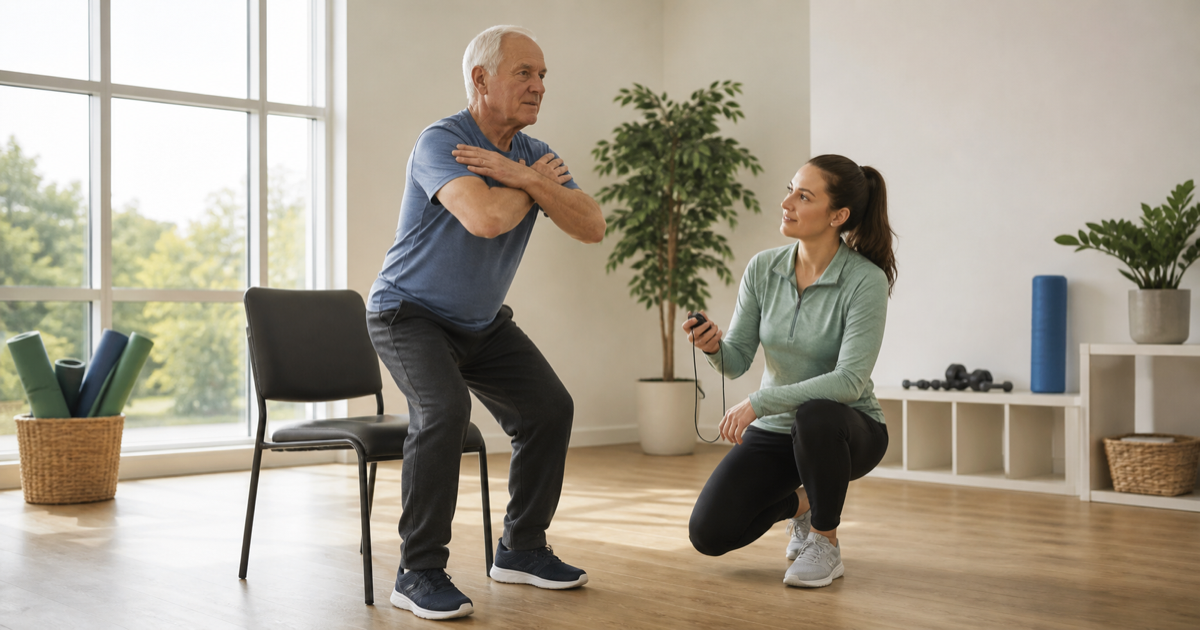
Standing up from a chair looks simple because the body normally solves several problems at once. The feet create a stable base, the trunk shifts forward, the hips and knees generate force, and balance moves from a broad seated surface to two relatively small points of contact. Repeating that sequence five times turns an everyday action into a compact view of physical function.
The five-times sit-to-stand test is used in rehabilitation, geriatric assessment, and mobility screening. It is not a stand-alone measure of biological age and cannot identify a diagnosis. It may, however, help reveal whether lower-body function is changing and whether a more complete assessment would be useful.
What the Test Actually Measures
The test begins in a standardized chair, usually with the participant seated back and the feet placed securely. The person stands fully and sits down five times while an observer records the elapsed time. Some protocols ask the participant to fold the arms; others allow arm use when safety or current ability requires it.
The result is often described as a measure of leg strength, but that description is incomplete. Rising quickly requires force to be produced at the right moment. Ankle mobility, hip strategy, sensation, vision, reaction, balance, and familiarity with the task also contribute. Pain or fear of falling can slow the movement even when muscle capacity is adequate.
That is why the test is best understood as a functional task, not a laboratory isolation of one muscle group. Its value comes from integrating several systems that matter for daily independence.
Why Results Can Change
Chair height has a major influence. A low, soft chair demands more hip and knee motion than a firm, higher seat. Footwear, floor grip, arm position, warm-up, instructions, and the location of the feet can also change performance. Comparing a kitchen chair result with a clinic result may create a false impression of improvement or decline.
Short-term factors matter too. Poor sleep, a hard exercise session, illness, joint irritation, medication effects, or simple hesitation may alter one attempt. A single slow result should not be treated as proof of accelerated aging. Repeating the assessment under similar conditions and looking at the broader functional picture is more informative.
Age-based reference values exist in research, but they vary with protocol and population. A number printed in an app cannot account for an individual’s height, medical history, assistive-device use, or movement strategy. The safest interpretation is contextual: compare like with like and ask what changed.
How It Fits Into Healthy-Aging Assessment
Chair-rise performance complements other measures rather than replacing them. Usual walking speed reflects locomotion. Single-leg or tandem stance adds balance information. Grip strength offers a different view of force capacity. Daily-life questions—such as difficulty climbing stairs, carrying groceries, or getting off the floor—may reveal limitations that a brief test misses.
A clinician may also consider vision, sensation, joint range, cardiovascular symptoms, neurological signs, nutrition, medicines, and recent falls. If several measures decline together, the pattern deserves more attention than a small change in one stopwatch time.
The test can also expose movement strategies. Pushing the knees against the chair, rocking repeatedly, collapsing into the seat, or shifting most of the load to one side may be more useful observations than the final time. These patterns may suggest that technique, pain, confidence, or asymmetry warrants evaluation.
A Safe Way to Track Function
For home tracking, use the same stable chair against a wall, the same footwear, and a clear non-slip floor. Have a capable person nearby if balance is uncertain. Do not rush through dizziness, chest discomfort, unusual breathlessness, or sharp pain. Stop and seek appropriate medical advice when symptoms are new or concerning.
Tracking every day is rarely necessary. Monthly or quarterly checks under similar conditions may reveal a trend without turning normal variation into anxiety. Record whether the arms were used, the chair height, any symptoms, and whether the movement felt unusually difficult.
Improving the test is not about rehearsing it as fast as possible. A broader program may include progressive resistance work, balance practice, walking, and movements matched to current capacity. The National Institute on Aging and CDC recommend combining aerobic, muscle-strengthening, and balance activities for older adults, while adapting activity to health status and ability.
The chair-rise test is useful precisely because it is ordinary. It translates strength and coordination into a task that supports autonomy. Used carefully, it can turn a vague feeling—“getting up seems harder”—into a trackable observation and a better conversation with a qualified professional.
Frequently Asked Questions
What does the five-times sit-to-stand test measure?
Is a faster chair-stand time always better?
Can someone practice the test at home?
Sources
Stay Updated on Longevity Science
Weekly research digests. No spam, unsubscribe anytime.
Related Articles
Arterial Calcification and Vascular Aging: Reading the Risk Signals
Arterial calcification can reveal accumulated vascular risk. Learn what calcium scores mean, why calcification develops, and where testing has limits.
10 min read
Arterial Stiffness and Vascular Age: A Longevity Evidence Guide
Understand arterial stiffness vascular age longevity links, key studies, measurement limits, and evidence-based lifestyle implications for healthy aging.
11 min read
Arterial Stiffness and Vascular Aging: What the Evidence Shows
Explore arterial stiffness vascular aging, how vessels change over time, what pulse wave velocity studies show, and practical ways evidence may inform prevention.
10 min read