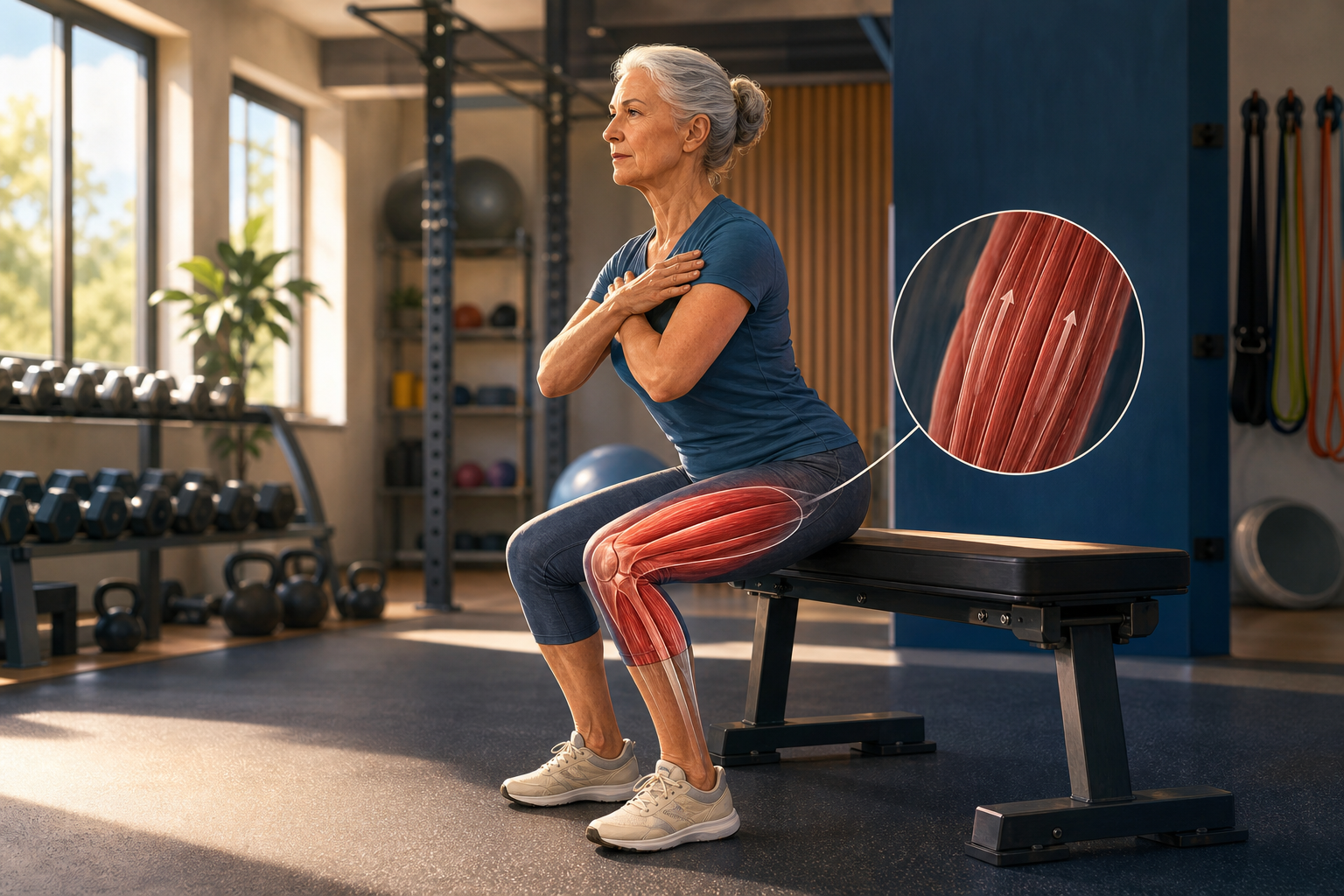
Eccentric Training and Muscle Aging: The Science of Controlled Lowering
Eccentric contractions produce high force while muscles lengthen. Explore their role in strength, function, soreness, and exercise programming with age.
Table of Contents
DISCLAIMER
This article is for informational purposes only and does not constitute medical advice. The statements in this article have not been evaluated by the FDA. The information presented is based on published research and should not be used as a substitute for professional medical guidance. Consult your physician before starting any supplement or health protocol.
Most people think about lifting a weight. Aging, however, often reveals the importance of lowering it well. Descending stairs, sitting into a chair, walking downhill, and stopping a forward fall all require muscles to produce force while lengthening.
That action is an eccentric contraction. It can generate high force at a lower metabolic cost than a similar shortening contraction, which makes it scientifically interesting for older adults. It can also create pronounced soreness when introduced too aggressively. The useful story is therefore not that eccentric work is superior, but that controlled lowering trains a capacity daily life repeatedly demands.
Three Ways Muscle Produces Force
During a concentric contraction, a muscle shortens as it produces force—the quadriceps while standing from a chair, for example. During an isometric contraction, force is produced without visible length change. During an eccentric contraction, the active muscle lengthens as it resists an external load.
Eccentric force can exceed concentric force because of cross-bridge behavior and passive structural contributions within muscle. Neural recruitment and energy cost also differ. These features allow a person to lower more load than they can lift.
That mechanical advantage has a practical consequence: the lowering phase deserves attention even in ordinary resistance training. Dropping quickly through it gives up a major part of the movement.
Why It Matters With Age
Muscle mass and strength can decline with age, particularly when activity falls or illness creates prolonged inactivity. Power—the ability to produce force quickly—often declines faster than maximal strength and is closely related to tasks such as rising, climbing, and recovering balance.
Eccentric capacity may be relatively preserved compared with concentric capacity, although this is not universal. That relative preservation can be used to expose muscle to meaningful tension without requiring equally demanding lifting work.
Daily life also contains many eccentric “braking” tasks. The quadriceps control knee flexion while descending stairs. Hip muscles decelerate the trunk. Calf muscles manage the body’s forward movement over the foot. Poor control can make movement look abrupt even when a standard strength test seems acceptable.
What Studies Suggest
Training studies report that eccentric-focused programs can increase strength, muscle size, and functional performance. Some use specialized machines that overload the lowering phase; others use simple slow lowering, assisted lifting, or downhill movement.
The evidence is heterogeneous. Programs differ in load, speed, duration, supervision, participant health, and comparison group. A large improvement produced by a motorized eccentric device in a research center cannot be assumed from casual “negative reps” at home.
Eccentric work also causes a repeated-bout effect: after a carefully dosed initial exposure, the same activity usually produces less muscle damage and soreness. This adaptation is useful, but it is not permission to make the first session extreme.
Claims that eccentric training uniquely lengthens lifespan or rejuvenates muscle are not established. The supported outcomes are more ordinary and valuable: strength, tissue tolerance, movement control, and task performance.
The Soreness and Recovery Problem
Delayed-onset muscle soreness commonly peaks one to three days after unfamiliar eccentric exercise. Soreness does not prove a workout was effective, and pursuing it can interfere with walking, sleep, and the next training session.
Excessive loading can be especially disruptive for someone who is deconditioned, taking certain medications, recovering from illness, or managing tendon or joint symptoms. Severe swelling, profound weakness, dark urine, or pain that is escalating rather than settling requires medical attention.
Progression should begin below the person’s theoretical capacity. The first goal is to learn the movement and observe the recovery response. Volume can rise gradually before load or range becomes more demanding.
Practical Ways to Train Controlled Lowering
Many exercises already contain an eccentric phase:
- take two to four seconds to sit into a chair, then stand normally;
- lower the heel slowly from a comfortable raised position while holding support;
- descend a low step with control, keeping the knee aligned;
- lower a dumbbell after a curl without letting it fall;
- use both limbs to lift a manageable load and one limb to lower only when appropriate and supervised.
Tempo is not magic. Slower movement increases time under tension but may reduce the load that can be used. The best tempo is one that preserves control, range, breathing, and technique.
A complete program still needs concentric strength, power practice where suitable, aerobic activity, and balance work. Training only the lowering phase would ignore the need to rise from the floor, accelerate, carry, and climb.
Programming for Healthy Aging
Start with movements that match current function. Someone who struggles with stairs may benefit first from supported sit-to-stands and low step-downs rather than maximal eccentric loading. Two nonconsecutive resistance sessions per week can be a reasonable framework, but individual recovery and medical factors matter.
Use a stable surface, avoid breath-holding, and stop if pain changes movement quality. Muscle effort is expected; sharp joint pain, new neurological symptoms, or loss of control is not.
Track useful outcomes: smoother stair descent, less collapse into a chair, improved load tolerance, and steady progress in resistance. These are more meaningful than soreness or a complicated eccentric-to-concentric ratio.
The Bottom Line
Eccentric contractions are not a niche bodybuilding technique. They are the body’s braking system. Training them can strengthen a part of movement that becomes conspicuous when it fails.
Their high-force, relatively energy-efficient nature creates opportunity, while their capacity to cause soreness creates the need for restraint. Controlled lowering belongs inside a balanced resistance program—not above it, and not as a promise to reverse aging.
For healthy aging, the best eccentric exercise is the one that improves control without stealing function from the next day.
Frequently Asked Questions
What is an eccentric contraction?
Is eccentric training safer for older adults?
Do negative repetitions reverse muscle aging?
Sources
Stay Updated on Longevity Science
Weekly research digests. No spam, unsubscribe anytime.
Related Articles
Arterial Calcification and Vascular Aging: Reading the Risk Signals
Arterial calcification can reveal accumulated vascular risk. Learn what calcium scores mean, why calcification develops, and where testing has limits.
10 min read
Arterial Stiffness and Vascular Age: A Longevity Evidence Guide
Understand arterial stiffness vascular age longevity links, key studies, measurement limits, and evidence-based lifestyle implications for healthy aging.
11 min read
Arterial Stiffness and Vascular Aging: What the Evidence Shows
Explore arterial stiffness vascular aging, how vessels change over time, what pulse wave velocity studies show, and practical ways evidence may inform prevention.
10 min read