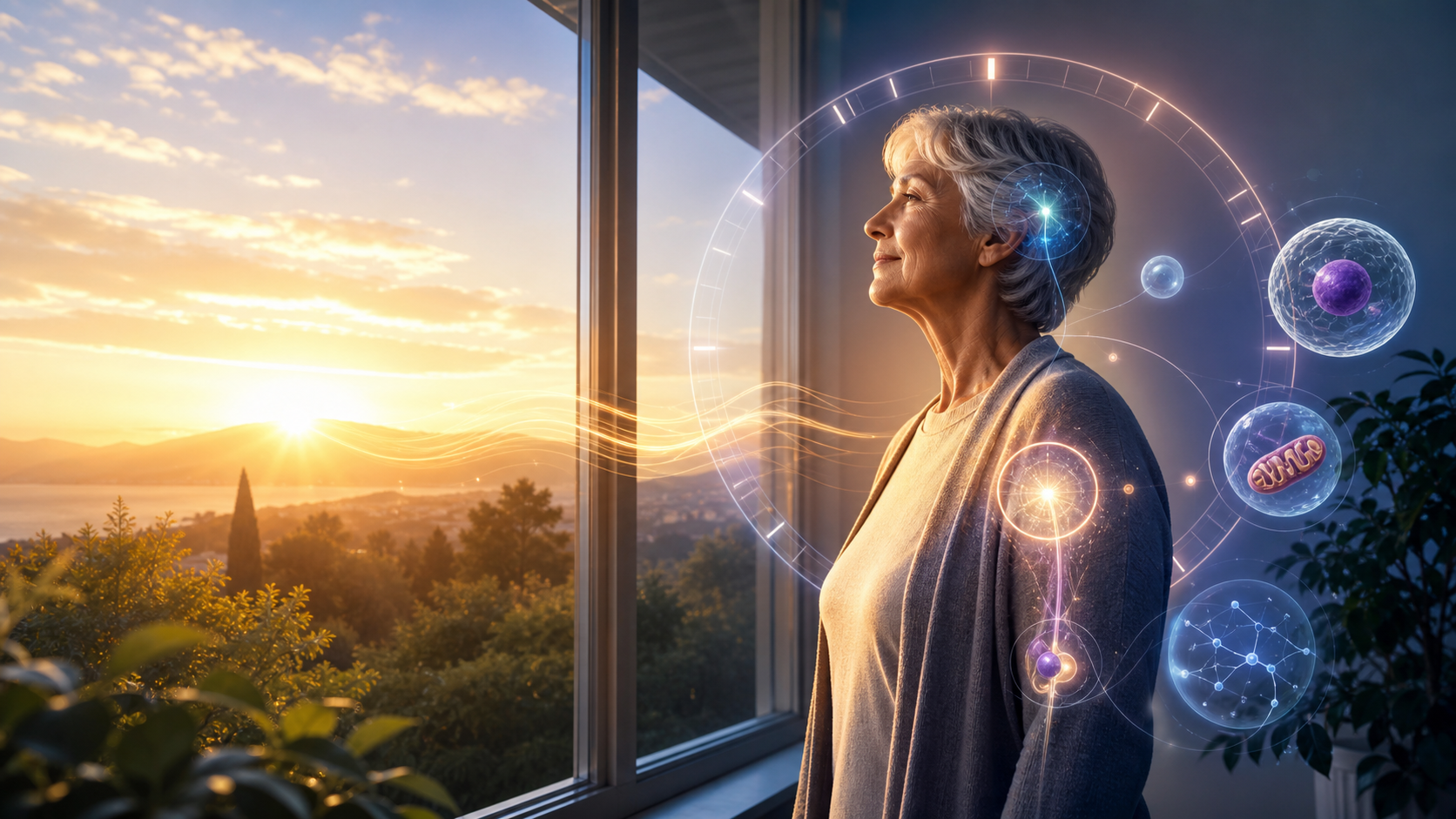
Circadian Light Exposure and Healthy Aging: Timing Matters
Explore circadian light exposure healthy aging research, from morning brightness to evening darkness, and how timing may support sleep and metabolic rhythms.
Table of Contents
DISCLAIMER
This article is for informational purposes only and does not constitute medical advice. The statements in this article have not been evaluated by the FDA. The information presented is based on published research and should not be used as a substitute for professional medical guidance. Consult your physician before starting any supplement or health protocol.
Introduction
Circadian light exposure healthy aging research starts with a deceptively simple idea: the body does not interpret light only by how bright it is, but also by when it arrives. Morning light, afternoon light, dim evenings, and darkness at night each send different timing signals to the brain and body. These signals help coordinate sleep, alertness, temperature, hormones, glucose handling, immune activity, and cellular repair rhythms.
Aging often changes this timing system. Many older adults receive less bright outdoor light during the day, more fragmented light exposure indoors, and more artificial light in the evening. At the same time, the aging eye may transmit light differently, sleep may become lighter, and the circadian clock may show lower amplitude or earlier timing. Research suggests that this combination may weaken the contrast between biological day and biological night.
This does not mean that light timing is a standalone answer to aging. Human longevity depends on genetics, socioeconomic context, movement, nutrition, sleep, medical history, environmental exposures, and many other variables. Still, light is one of the strongest environmental inputs to the circadian system, and it is unusually practical. Unlike many biological aging pathways, light exposure can often be adjusted through daily routines, home design, workplace habits, and evening screen behavior.
The central question is not simply whether light is good or bad. It is whether the right kind of light arrives at the right time.
The Science
The Master Clock and the Retina
The central circadian clock sits in the suprachiasmatic nucleus, a small paired structure in the hypothalamus. It receives light information from the retina and uses that information to synchronize internal time with the external 24-hour day.
This pathway is not the same as ordinary vision. Rods and cones help form images, detect contrast, and support color vision. Circadian timing also depends heavily on intrinsically photosensitive retinal ganglion cells, often called ipRGCs. These cells contain melanopsin, a light-sensitive pigment especially responsive to short-wavelength blue-cyan light.
Hattar and colleagues, writing in Science in 2002, helped clarify the architecture and projections of melanopsin-containing retinal ganglion cells. Their work supported the concept that a specialized retinal pathway sends light information to circadian centers, including the suprachiasmatic nucleus. This helped explain why light can shift body-clock timing, suppress nighttime melatonin, influence alertness, and affect physiology beyond image-forming vision.
Why Timing Matters
Light has different effects depending on circadian phase. Light in the biological morning tends to advance the clock, meaning it may shift rhythms earlier. Light in the biological evening or early night tends to delay the clock, meaning it may push sleep and melatonin timing later. Light during the night may also acutely suppress melatonin and increase alertness.
This phase-dependent response is one reason evening light can be disruptive even when it feels ordinary. A bright screen or overhead lighting late at night may not seem biologically dramatic, but the circadian system can interpret it as a timing signal. Conversely, dim indoor mornings may fail to provide a strong daytime cue, especially for people who spend most hours indoors.
Zeitzer, Dijk, Kronauer, and Czeisler reported in the Journal of Physiology in 2000 that the human circadian pacemaker responds to nocturnal light in a dose-dependent way, with melatonin suppression and phase resetting varying by illuminance. This study is a reminder that light is not just a visual convenience. It is a biological input with timing, intensity, and duration dimensions.
Aging, the Eye, and Circadian Signal Strength
Healthy aging can change how light reaches the circadian system. The crystalline lens tends to yellow with age, which may reduce transmission of shorter wavelengths. Pupils may become smaller, reducing retinal illumination. Cataracts, retinal disease, and some medications may also affect light perception or sleep-wake rhythms.
However, the relationship is not simple. Some studies suggest older adults may show altered, rather than uniformly weaker, nonvisual responses to light. Najjar, Prayag, and Gronfier reported in the Journal of Pineal Research in 2024 that melatonin suppression by light involved different photoreceptor contributions in young and older adults. In their study, young participants’ melatonin suppression was best explained largely by melanopsin-driven responses, while older participants showed a more complex pattern involving melanopsin and cone-related inputs.
This suggests that aging may reshape circadian photoreception. It does not mean older adults cannot respond to light. Rather, the timing system may require more careful attention to light quality, timing, and daily consistency.
Peripheral Clocks and Whole-Body Aging
The suprachiasmatic nucleus is the master coordinator, but it is not the only clock. Liver, muscle, fat, immune, vascular, and gut tissues all contain molecular clocks. These local clocks regulate rhythmic gene expression and help organize tissue-specific functions.
Light primarily reaches these peripheral clocks indirectly. Morning light can shift the central clock, which then influences hormones, autonomic signals, body temperature, activity timing, and sleep-wake behavior. Food timing, exercise, stress, and temperature also affect peripheral clocks. When these signals align, the body may receive a coherent message: daytime is for activity, feeding, and alertness; nighttime is for sleep, fasting, and restoration.
When signals conflict, circadian misalignment may occur. For example, bright light late at night, irregular sleep, late meals, and weak daytime light may create mixed timing cues. Scheer, Hilton, Mantzoros, and Shea reported in Proceedings of the National Academy of Sciences in 2009 that experimentally induced circadian misalignment was associated with adverse metabolic and cardiovascular changes in humans. While this study was not a healthy aging trial, it provides mechanistic evidence that clock disruption can affect systems central to age-related health risk.
Key Research Findings
Short-Wavelength Light Can Affect Older Adults
Figueiro, Lesniak, and Rea published a 2011 study in BMC Research Notes examining controlled short-wavelength light exposure in adults over age 50. Participants were exposed to different corneal irradiances of 470-nm light during the night while researchers measured melatonin suppression.
The study found that melatonin suppression depended on both irradiance and exposure duration. Corneal irradiances as low as 2 microW/cm2 reliably suppressed melatonin after 90 minutes, while the lowest tested irradiance did not. The sample was small, so the results should be interpreted cautiously, but the study suggests that older adults can still show measurable circadian responses to carefully controlled short-wavelength light.
For healthy aging, the implication is practical but not prescriptive: evening and nighttime blue-enriched light may matter, even in later life. It also suggests that daytime lighting environments may need to be strong enough and appropriately timed to reinforce the desired rhythm.
Moderate Light Can Shift Circadian Phase in Older Adults
Scheuermaier, Lee, and Duffy published a preliminary report in the Journal of Biological Rhythms in 2019 evaluating phase shifts to moderate-intensity light exposure in older adults. The study addressed an important question: does the aging circadian clock remain responsive to realistic light levels?
Their findings suggested that moderate-intensity light could produce measurable phase shifts in older adults. Because the report was preliminary, it should not be overextended into a universal rule. Still, it supports the view that older adults are not biologically indifferent to indoor lighting. The timing of exposure remains relevant.
This finding matters because many real-world environments for older adults are dim during the day and bright enough at night to blur circadian timing. Homes, assisted-living spaces, hospitals, and offices may unintentionally provide weak day-night contrast. Research increasingly suggests that lighting design may be part of healthy aging infrastructure, not merely interior decoration.
Photoreceptor Contributions May Change With Age
Najjar, Prayag, and Gronfier’s 2024 Journal of Pineal Research study adds nuance to the idea that aging simply reduces light sensitivity. Their within-subject design exposed young and older participants to narrow-band lights across a range of wavelengths at night and measured melatonin suppression over time.
The researchers reported that young participants’ responses were largely consistent with melanopsin-driven photoreception. Older participants, by contrast, appeared to show a broader contribution from melanopsin and cone pathways, with peak sensitivity shifted compared with young adults.
This does not provide a simple consumer rule such as one color of light being ideal for every older adult. It does suggest that aging changes the visual and nonvisual processing of light. Future lighting recommendations for older adults may need to consider age, lens status, retinal health, timing, intensity, spectrum, and duration together.
Circadian Misalignment Affects Metabolic Physiology
The Scheer et al. 2009 PNAS study is important because it connects circadian timing to metabolic and cardiovascular regulation. Under controlled laboratory conditions, participants experienced circadian misalignment, and the researchers observed less favorable changes in glucose, insulin, leptin, blood pressure, and related markers.
This does not prove that one late night or one evening of bright light causes long-term harm. It does suggest that repeated misalignment may push physiology in an unfavorable direction. Since aging is already associated with higher risk of metabolic dysfunction, vascular stiffness, inflammation, and sleep fragmentation, circadian alignment may be one supportive layer in a broader healthy aging strategy.
Light Is One Signal Among Several
Light is the dominant cue for the central clock, but it does not work alone. Activity timing, meal timing, social routines, temperature, medication schedules, and sleep regularity all contribute to circadian organization. A person who gets bright morning light but eats late at night and sleeps irregularly may still send conflicting signals to peripheral clocks.
This is why circadian light exposure should be viewed within a full daily rhythm pattern. Research suggests that the strongest routines often combine bright daytime environments, predictable sleep timing, daytime movement, earlier food timing, and lower nighttime stimulation. The evidence is strongest for circadian biology and sleep-wake regulation, while direct claims about human lifespan remain more tentative.
Practical Implications
Build a Stronger Day-Night Contrast
The most practical lesson from circadian research is contrast. The body appears to benefit from clear differences between day and night: brighter, more active, and more socially engaged days; darker, quieter, and more regular nights.
For many people, modern life reverses this pattern. Days are spent in dim indoor lighting, while evenings involve bright overhead fixtures, phones, tablets, televisions, and late work. This pattern may flatten circadian amplitude. For older adults, who may already experience weaker rhythm signals, the contrast may be especially relevant.
A circadian-friendly routine may include seeking outdoor light earlier in the day, keeping living and workspaces brighter during daytime hours, and reducing bright light exposure in the late evening. These are general wellness practices, not individualized medical instructions.
Morning Light May Help Anchor the Clock
Morning light is often discussed because it can help signal the start of biological day. Exposure to outdoor light after waking may support alertness and may help stabilize sleep-wake timing. Outdoor light is typically much brighter than indoor light, even on cloudy days.
For older adults, morning light may be especially useful when sleep timing has drifted later, daytime alertness is low, or indoor routines are dim and sedentary. However, the best timing can vary. People with very early sleep timing, bipolar disorder, migraine, retinal disease, or unusual work schedules may need personalized guidance.
The practical principle is simple: the first half of the day should not look like twilight to the circadian system.
Evening Light Should Be More Deliberate
Evening light is not inherently harmful. People need light for safety, reading, cooking, caregiving, and social life. The concern is bright, blue-enriched, close-range, or prolonged light late in the evening, especially when it pushes sleep later or reduces sleepiness.
Lowering overhead lighting, using warmer lamps, increasing distance from bright screens, and creating a consistent wind-down environment may help signal biological night. Blue-light filters may reduce some short-wavelength exposure, but they should not be viewed as a complete answer. Brightness, timing, duration, screen content, and behavioral stimulation all matter.
A practical evening goal is not total darkness before bed. It is a gradual reduction in circadian stimulation.
Darkness at Night Remains Biologically Meaningful
Sleep is not the only nighttime signal. Darkness itself helps protect the melatonin rhythm and reinforces the distinction between day and night. Even relatively modest light during the night may affect some individuals, particularly if exposure is close to the eyes or repeated over time.
Nightlights may still be important for fall risk and safety, especially in older adults. The circadian tradeoff can often be reduced by using low-positioned, dim, warm lighting for navigation rather than bright overhead lights. Safety should come first, but lighting can usually be designed more thoughtfully.
Consider the Built Environment
Circadian light exposure is not only a personal habit. It is also shaped by architecture and caregiving environments. Older adults in hospitals, long-term care facilities, small apartments, or window-poor homes may receive limited daytime light and irregular nighttime exposure.
Healthy aging research may increasingly influence building design. Better daylight access, brighter daytime common areas, dimmer evenings, and lighting schedules that mirror natural day-night patterns may support circadian organization. These changes are unlikely to be magic bullets, but they may reduce one source of avoidable physiological confusion.
Track Responses, Not Just Rules
Because light sensitivity varies, people may learn more by observing patterns than by chasing universal rules. Useful signals may include sleep onset timing, nighttime awakenings, morning alertness, daytime sleepiness, mood, and consistency of wake time.
Wearables can estimate sleep and activity timing, but they do not directly measure circadian phase. Melatonin testing under controlled dim-light conditions is used in research and some clinical settings, but it is not a routine consumer metric for most people. For everyday purposes, repeated patterns matter more than single-night fluctuations.
Limitations and Future Research
Circadian light exposure is a promising area, but the evidence has important limits. Many controlled studies are small, short-term, or performed under laboratory conditions that do not fully match ordinary life. Melatonin suppression and circadian phase shifts are useful biological markers, but they are not the same as long-term health outcomes.
Aging research also has heterogeneity problems. A healthy 55-year-old outdoor worker, an 80-year-old with cataracts, a shift-working caregiver, and a nursing-home resident may have very different light exposure patterns and circadian responses. Studies that average across age groups may miss important subgroups.
Another challenge is measuring light accurately. Light at the ceiling, light at the wrist, and light reaching the retina are not identical. Spectrum, angle, duration, pupil size, lens status, and prior light history all influence biological response. Future studies may need more precise wearable light sensors, retinal-light modeling, and longer follow-up.
There is also a need for more outcome-focused trials. Researchers still need to clarify whether changing light exposure patterns can improve durable endpoints such as sleep quality, metabolic health, mood, cognitive performance, fall risk, inflammation markers, or biological aging markers in diverse older populations. The current evidence supports circadian plausibility, but direct healthy aging claims should remain measured.
Finally, light should be studied alongside other timing cues. Meal timing, exercise timing, medication timing, social rhythms, and sleep regularity may interact with light. Future research may find that combined circadian routines are more meaningful than any single lighting adjustment.
The Bottom Line
Circadian light exposure appears to be an important timing signal in healthy aging, especially because aging can weaken or alter the body’s day-night rhythm. Research suggests that brighter days, more deliberate evenings, and darker nights may help reinforce circadian organization, although individual needs vary.
The strongest conclusion is not that light timing can control aging, but that it may shape the biological context in which aging unfolds. Timing matters because the body is listening to light all day, not only when the eyes are trying to see.
Frequently Asked Questions
What is circadian light exposure in healthy aging?
Is morning light better than evening light for older adults?
Can reducing blue light at night improve healthy aging?
Sources
- Implications of controlled short-wavelength light exposure for sleep in older adults(2011)
- Phase Shifts to a Moderate Intensity Light Exposure in Older Adults: A Preliminary Report(2019)
- Melatonin suppression by light involves different retinal photoreceptors in young and older adults(2024)
- Sensitivity of the human circadian pacemaker to nocturnal light: melatonin phase resetting and suppression(2000)
- Adverse metabolic and cardiovascular consequences of circadian misalignment(2009)
Stay Updated on Longevity Science
Weekly research digests. No spam, unsubscribe anytime.
Related Articles
Arterial Stiffness and Vascular Age: A Longevity Evidence Guide
Understand arterial stiffness vascular age longevity links, key studies, measurement limits, and evidence-based lifestyle implications for healthy aging.
11 min read
Arterial Stiffness and Vascular Aging: What the Evidence Shows
Explore arterial stiffness vascular aging, how vessels change over time, what pulse wave velocity studies show, and practical ways evidence may inform prevention.
10 min read
Autophagy and Aging: Your Body's Cellular Cleanup System
Explore autophagy, your body's cellular cleanup system, and its critical role in aging and longevity. Research suggests modulating autophagy may support cellular health.
12 min read