Urolithin A vs CoQ10: Which Has Better Mitochondrial Evidence?
A science-based look at Urolithin A vs CoQ10, comparing mitophagy, energy support, muscle data, and where the human evidence is stronger.
Table of Contents
SUPPLEMENT NOTICE
The supplements discussed in this article are not intended to diagnose, treat, cure, or prevent any disease. Dosages mentioned reflect those used in specific research studies and should not be interpreted as recommendations. Always consult a healthcare professional before beginning any supplement regimen, especially if you have existing health conditions or take medications.
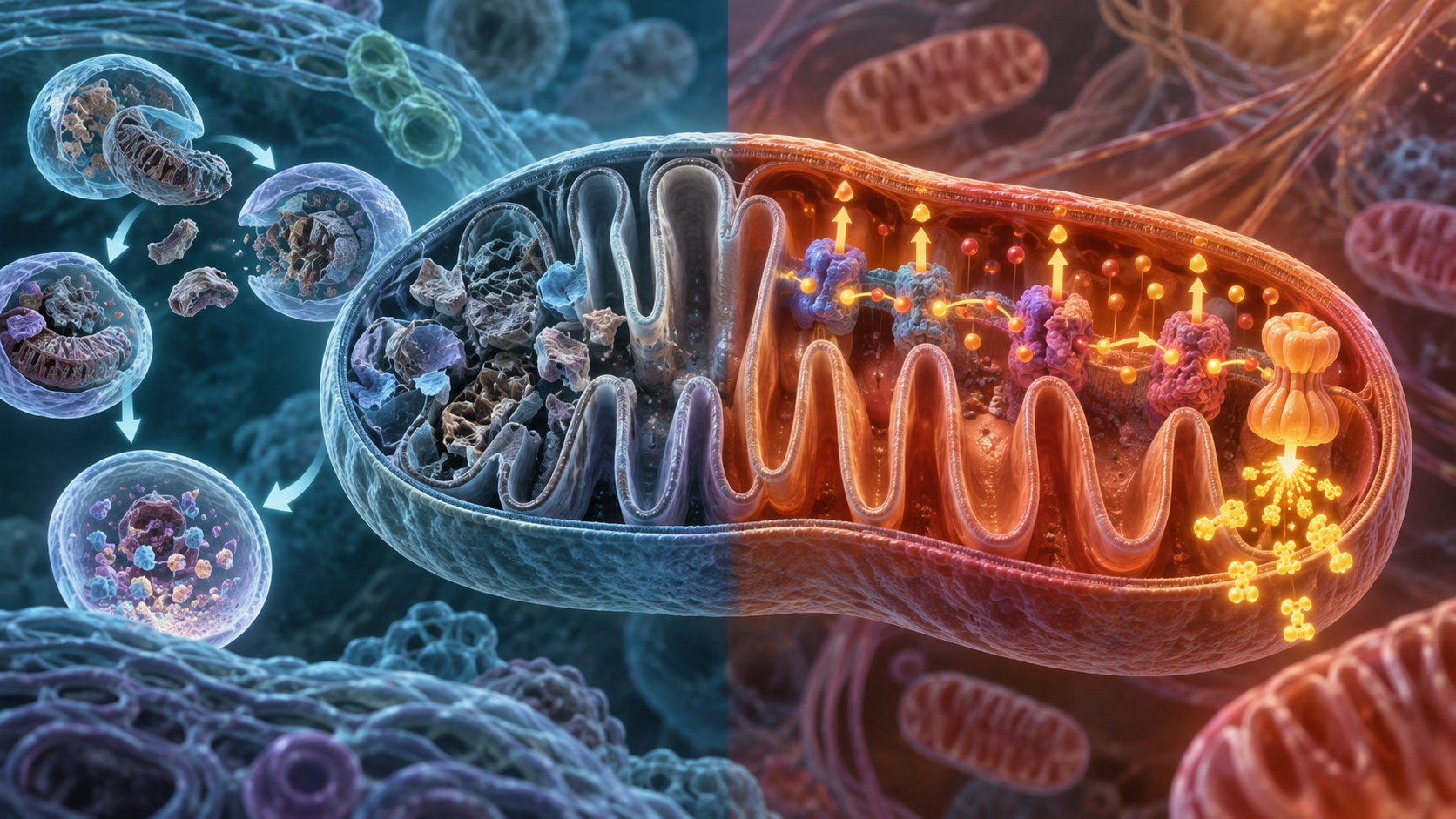
Urolithin A vs CoQ10 is becoming a common comparison in longevity circles because both compounds are linked to mitochondrial health, yet they appear to work in very different ways. Research suggests Urolithin A may help cells clear damaged mitochondria through mitophagy, while CoQ10 plays a central role in day-to-day energy production inside the electron transport chain. For readers trying to decide which has stronger evidence, the best answer is not simply which one is “better,” but which biological problem each supplement may be better suited to address.
Evidence ladder for this comparison
The sections below keep three evidence levels separate. Human trials are used for claims about strength, endurance, symptoms, or safety in people. Animal studies can support biological plausibility but do not demonstrate a healthy-aging benefit in humans. Cell-culture and biochemical studies explain mitophagy, electron transport, or antioxidant mechanisms, yet those mechanisms are not treated as clinical outcomes. Neither supplement has been shown to extend human lifespan, and neither should be interpreted as a substitute for diagnosis, rehabilitation, or evidence-based treatment.
Why this comparison matters
Mitochondria sit at the center of many healthy aging discussions for a reason. They generate cellular energy, influence oxidative stress, affect inflammation, and help determine how well tissues with high energy demand, such as muscle, heart, and brain, continue to function over time. When mitochondrial quality declines, people may notice lower exercise capacity, slower recovery, and changes in overall vitality.
That is why supplements positioned around mitochondrial support attract so much interest. But the category is often confusing. Some ingredients may support energy transfer directly. Others may help with mitochondrial turnover, signaling, or resilience. Urolithin A and CoQ10 illustrate this difference clearly.
What is Urolithin A?
Urolithin A is a postbiotic compound produced when certain gut microbes metabolize ellagitannins, polyphenols found in foods such as pomegranate, walnuts, and berries. Not everyone produces Urolithin A efficiently from food, which is one reason the compound has drawn attention as a supplement.
The main reason researchers care about Urolithin A is mitophagy. Mitophagy is the selective removal of damaged mitochondria so the cell can recycle dysfunctional components and maintain a healthier mitochondrial pool. A 2016 study by Ryu and colleagues, published in Nature Medicine, reported that Urolithin A induced mitophagy, improved muscle function in rodents, and extended lifespan in C. elegans (PMID: 27435154).
That does not prove broad anti-aging benefits in humans. But it does provide a biologically coherent mechanism that fits a major aging theme, namely declining mitochondrial quality control.
What is CoQ10?
CoQ10, or coenzyme Q10, is a naturally occurring compound present in almost every cell. It acts as an electron carrier in the mitochondrial electron transport chain, which means it helps move electrons during ATP production. In its reduced form, ubiquinol, it also functions as a lipid-soluble antioxidant.
This makes CoQ10 different from Urolithin A. CoQ10 does not primarily attract interest because it may help dispose of damaged mitochondria. Instead, it is studied because it may support the performance of existing mitochondria and reduce oxidative strain on membranes and mitochondrial structures.
Research indicates endogenous CoQ10 levels may decline with age in some tissues. That decline has led to the idea that supplementation may help older adults maintain cellular energy support, especially in contexts involving fatigue, cardiovascular function, or increased oxidative stress.
Urolithin A vs CoQ10: the core biological difference
The clearest way to compare these compounds is to separate mitochondrial cleanup from mitochondrial energy support.
| Feature | Urolithin A | CoQ10 |
|---|---|---|
| Primary mechanism | May stimulate mitophagy | Supports electron transport and antioxidant defense |
| Main research focus | Mitochondrial quality control, muscle aging | Cellular energy production, oxidative stress, cardiovascular support |
| Human evidence pattern | Smaller but targeted trials in older adults | Longer history across broader clinical contexts |
| Best-known aging angle | Removing dysfunctional mitochondria | Supporting existing mitochondrial function |
| Evidence gaps | Long-term outcomes, broader aging endpoints | Mixed results across populations, variable absorption |
This distinction matters because two people may be asking different questions when they say they want “mitochondrial support.” One person may be interested in cleaner mitochondrial turnover and muscle aging. Another may be more focused on day-to-day energy metabolism or oxidative stress.
What does the human research on Urolithin A suggest?
The most interesting Urolithin A data so far may be its human trials in older adults. A 2021 randomized, double-blind, placebo-controlled trial reported improvements in muscle endurance after supplementation in healthy older participants (PMID: 33857317). A 2022 randomized clinical trial also suggested benefits in muscle strength-related outcomes and quality-of-life measures in older adults (PMID: 35508822).
These findings are notable for a few reasons.
1. The outcomes are functional, not just theoretical
A lot of longevity supplement discussion stays trapped in mechanisms and biomarkers. Urolithin A at least has early human data linked to physical performance measures, especially in aging muscle.
2. The mechanism matches the outcome
Skeletal muscle is heavily dependent on mitochondrial quality. If a compound may improve mitophagy, it makes sense that researchers would look first at endurance, fatigue resistance, and muscle function.
3. The evidence is still early
The trials are promising, but they are not the final word. They do not establish that Urolithin A improves lifespan, broadly lowers disease risk, or meaningfully changes every aging biomarker. More large, long-duration studies are needed before stronger conclusions can be made.
What does the human research on CoQ10 suggest?
CoQ10 has a longer research history, though the studies are spread across many use cases. In aging and mitochondrial discussions, two recurring themes show up: oxidative stress and mitochondrial function.
A 2014 paper examining age-related oxidative stress and mitochondrial function suggested CoQ10 may help support mitochondrial status in aging-related contexts (PMID: 25282515). A 2021 study also reported that CoQ10 supplementation decreased oxidative stress and improved mitochondrial function markers (PMID: 33371862).
This does not mean every CoQ10 study is uniformly positive. CoQ10 research is broad, and outcomes vary depending on population, formulation, baseline deficiency, and whether the endpoint is fatigue, exercise, heart health, or biochemical markers.
Still, CoQ10 has a few advantages in practical evidence terms.
1. It has a longer clinical track record
Compared with Urolithin A, CoQ10 has been discussed for decades, not just years. That does not automatically make it more effective, but it does mean the safety and application landscape is better characterized.
2. It fits a direct mitochondrial role
Because CoQ10 sits inside the electron transport chain, its biological role is straightforward. It is not a speculative add-on to mitochondrial biology. It is part of the machinery itself.
3. It may be more relevant in certain populations
Research suggests CoQ10 may be particularly relevant in people with lower endogenous levels, higher oxidative burden, or cardiovascular contexts where mitochondrial energy demand is important.
Which has stronger evidence for healthy aging?
The answer depends on what “stronger” means.
If the question is about targeted muscle-aging data
Urolithin A may currently look more intriguing. Its early human trials were designed around older adults and functional outcomes relevant to aging muscle. That gives it a sharper longevity narrative.
If the question is about breadth and clinical familiarity
CoQ10 still has the advantage. It has a longer research history, wider clinical use, and clearer context around mitochondrial energy support and oxidative stress.
If the question is about mechanism novelty
Urolithin A stands out. Mitophagy is a compelling concept because aging is not only about making more energy. It is also about clearing damaged cellular components before they accumulate.
If the question is about proven anti-aging impact
Neither supplement has definitive evidence for broad anti-aging outcomes in humans. Research suggests both may support parts of mitochondrial biology, but that is very different from proving a meaningful effect on lifespan or all-cause age-related decline.
Urolithin A vs CoQ10 for different use cases
For muscle aging and endurance
Urolithin A may currently have a more targeted case. The available human trials are one reason it is often framed as a “mitochondrial quality” supplement rather than just an energy product.
For energy production support
CoQ10 may make more sense conceptually because it participates directly in ATP production. This may be especially relevant when the question is cellular energy handling rather than mitochondrial turnover.
For oxidative stress support
CoQ10 likely has the clearer case because of its antioxidant role, particularly in lipid environments and mitochondrial membranes.
For people interested in a newer longevity-oriented mechanism
Urolithin A may be more appealing because mitophagy is a high-interest target in geroscience. That said, newer and more exciting do not always mean better validated.
Could they be complementary rather than competitive?
Possibly. This is one of the more reasonable interpretations of the current evidence.
Research suggests Urolithin A and CoQ10 may act at different points in the mitochondrial maintenance cycle:
- Urolithin A may help identify and recycle damaged mitochondria
- CoQ10 may help functioning mitochondria transfer electrons efficiently
- Both may contribute to a healthier mitochondrial environment through different routes
This is why some supplement stacks combine them. But it is important to stay careful here. A plausible stack is not the same thing as a clinically validated combination. Direct human trials testing Urolithin A plus CoQ10 for aging-related outcomes remain limited.
Important limitations in the current evidence
A balanced comparison needs to highlight what is still unknown.
Limited head-to-head data
There are no robust large-scale trials directly comparing Urolithin A vs CoQ10 in older adults on the same endpoints. Most comparisons are indirect.
Biomarkers do not equal long-term outcomes
Even when studies report improved mitochondrial markers, it does not automatically mean better long-term healthspan or lower disease burden.
Response may vary by individual biology
Baseline mitochondrial status, diet, gut microbiome composition, age, medication use, and training level may all affect response. Urolithin A may be especially sensitive to microbiome-related context when obtained from food, while CoQ10 may vary in absorption depending on formulation.
Marketing often outruns data
Both compounds can be oversold. Urolithin A may be packaged as a cutting-edge longevity breakthrough, and CoQ10 may be marketed as a universal energy fix. The evidence for both is more nuanced than the marketing language usually suggests.
A practical way to think about the decision
For readers evaluating Urolithin A vs CoQ10, a useful framework may look like this:
- Interested in muscle aging and mitophagy research? Urolithin A may be the more relevant compound to investigate.
- Interested in classic mitochondrial energy support and antioxidant biology? CoQ10 may be the more established option.
- Interested in a stack? Theoretical complementarity exists, but direct clinical evidence is still limited.
- Interested in broad anti-aging promises? Caution is warranted because neither supplement has established that level of evidence.
Lifestyle context also matters. Exercise, sleep quality, cardiometabolic health, protein adequacy, and overall dietary pattern likely shape mitochondrial function far more profoundly than any single supplement. Research on supplements is most useful when viewed as an adjunct to those foundations, not a replacement for them.
The bottom line
In the Urolithin A vs CoQ10 comparison, Urolithin A may have the more focused longevity story because of its link to mitophagy and its early trials in older adults with muscle-related outcomes. CoQ10, meanwhile, has the advantage of a longer research history and a more established role in mitochondrial energy transfer and oxidative defense.
Rather than asking which is universally better, it may be more accurate to ask which mitochondrial problem a reader is trying to address. Evidence remains promising but incomplete for both, and any decision about supplement use should be made cautiously and in context. Always consult your healthcare provider.
This content is for educational purposes only. It does not provide medical advice, diagnosis, or treatment. Consult a qualified professional before making health decisions. Individual response can vary.
Frequently Asked Questions
Is Urolithin A or CoQ10 better for mitochondrial health?
Can Urolithin A and CoQ10 be taken together?
Which supplement has better human research in older adults?
Sources
- Urolithin A induces mitophagy and prolongs lifespan in C. elegans and increases muscle function in rodents(2016)
- Urolithin A supplementation improves muscle endurance in healthy elderly subjects: A randomized, double-blind, placebo-controlled trial(2021)
- Urolithin A improves muscle strength and quality of life in older adults: A randomized clinical trial(2022)
- Coenzyme Q10 supplementation decreases oxidative stress and improves mitochondrial function(2021)
- Effect of coenzyme Q10 on aged-related oxidative stress and mitochondrial function(2014)
Stay Updated on Longevity Science
Weekly research digests. No spam, unsubscribe anytime.
Related Articles
Alpha-Ketoglutarate (AKG) and Aging: What Research Reveals
Explore how alpha-ketoglutarate (AKG) may influence aging through epigenetic regulation, mitochondrial function, and cellular energy metabolism.
12 min read
Apigenin and Healthy Aging: What the Evidence Really Shows
An evidence review of apigenin, separating cell and animal findings from human data on absorption, sleep, inflammation, safety, and longevity claims.
15 min read
Best Longevity Supplement Stack in 2026: An Evidence-First Guide
A cautious 2026 guide to evaluating longevity supplements, separating human outcomes from biomarkers, animal research, and marketing claims.
15 min read