Apigenin and Healthy Aging: What the Evidence Really Shows
An evidence review of apigenin, separating cell and animal findings from human data on absorption, sleep, inflammation, safety, and longevity claims.
Table of Contents
SUPPLEMENT NOTICE
The supplements discussed in this article are not intended to diagnose, treat, cure, or prevent any disease. Dosages mentioned reflect those used in specific research studies and should not be interpreted as recommendations. Always consult a healthcare professional before beginning any supplement regimen, especially if you have existing health conditions or take medications.
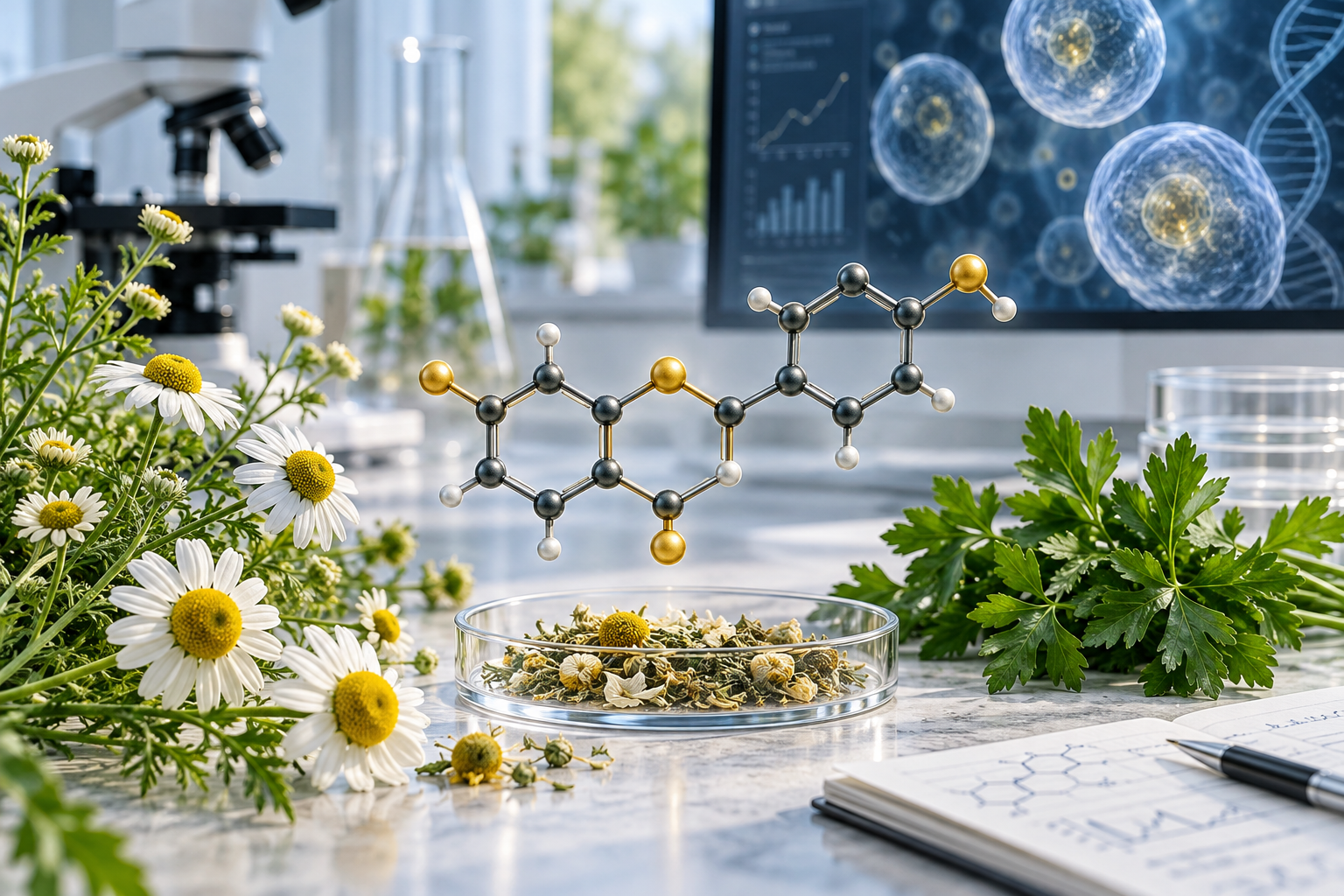
Apigenin is a plant flavone found in foods and herbs including parsley, celery, and chamomile. It has become a popular longevity ingredient because laboratory studies connect it to CD38, NAD metabolism, inflammation, oxidative stress, sleep biology, and cell survival pathways. That list sounds impressive. It also illustrates how easily a supplement story can run ahead of human evidence.
The honest conclusion in 2026 is simple: apigenin is biologically interesting, but it is not a proven human longevity intervention. Researchers have identified mechanisms in cells and animals. Reviews have mapped plausible therapeutic targets. What remains missing is a robust set of independent human trials showing that a defined oral apigenin product improves meaningful aging outcomes.
This article separates what has been observed in test tubes, animals, and people; examines conflicting and incomplete findings; and offers practical criteria for deciding whether a claim deserves confidence. It does not provide a personalized dose or treatment recommendation.
What Apigenin Is—and Is Not
Apigenin belongs to the flavone class of polyphenols. Plants make flavonoids for functions that include pigmentation and responses to environmental stress. People encounter small, variable quantities through food. Chamomile is often associated with apigenin, but a cup of tea is a mixture of many compounds rather than a standardized dose of isolated apigenin.
After ingestion, apigenin must be released from the food or preparation, absorbed through the intestine, modified by intestinal and liver enzymes, distributed through the body, and eventually eliminated. Much of it circulates as conjugated metabolites rather than as the unchanged molecule commonly used in cell experiments. This distinction matters because a concentration that changes a pathway in a dish may never occur in a human tissue after an ordinary oral product.
The 2017 review of flavone sources, metabolism, and bioactivity describes these absorption and metabolism constraints. It is useful background, not proof that a retail capsule produces a clinical benefit.
The CD38 and NAD Hypothesis
What the preclinical study found
A frequently cited 2013 paper reported that apigenin inhibited CD38, an enzyme that consumes NAD, and altered NAD-related metabolism in experimental systems. The work included cell experiments and a mouse model. It helped establish a testable mechanism: if CD38 activity contributes to lower NAD availability, then inhibiting CD38 could change downstream metabolic signaling.
That is a legitimate scientific finding. It does not show that an apigenin supplement safely preserves NAD in older humans, improves function, or changes lifespan. The route from enzyme inhibition to clinical benefit includes exposure, selectivity, compensatory biology, tissue differences, and long-term safety.
What has not been established
No cited human randomized trial demonstrates that oral apigenin produces a durable, clinically meaningful NAD benefit. Even a measured rise in a blood NAD-related marker would be an intermediate outcome. A useful longevity claim would require evidence that people move, think, recover, or remain independent better—and that harms do not outweigh benefits.
The distinction is especially important because NAD is involved in many processes. Changing a central pathway is not automatically beneficial in every tissue or disease state. A mechanism can be real without being a safe consumer strategy.
Is Apigenin a Senolytic?
Senolytics are interventions intended to preferentially remove senescent cells. Apigenin is sometimes placed in this category based on laboratory observations involving cell-cycle control, apoptosis, or inflammatory signaling. The label is premature for routine human use.
A compound can kill a selected cell line at a laboratory concentration without selectively clearing harmful senescent cells in a living person. Researchers must establish which cells are affected, what exposure is required, whether normal cells are spared, and whether tissue function improves. Human trials would also need to monitor off-target effects, because senescence participates in wound healing and tumor suppression as well as age-related dysfunction.
At present, apigenin should be described as a compound with preclinical senescence-related hypotheses, not as a clinically validated senolytic. Combining it with other experimental senolytics does not solve the evidence gap; it creates additional interaction and attribution problems.
Inflammation and Oxidative Stress
Apigenin affects inflammatory and oxidative-stress pathways in many experimental models. A 2022 systematic review and meta-analysis of lung-injury models found preclinical evidence for changes in inflammatory and oxidative markers. The key word is preclinical: the included evidence came from animal models rather than trials demonstrating better respiratory outcomes in people taking apigenin.
This area also illustrates a common marketing error. “Reduces inflammation” is treated as universally desirable, yet inflammatory signaling is part of infection control, tissue repair, and adaptation. Whether modulating a pathway helps depends on the cause, magnitude, timing, tissue, and host. A lower laboratory marker is not inherently proof of healthier aging.
The 2019 review of apigenin’s therapeutic potential summarizes a wide range of mechanisms across cancer, neurological, metabolic, and inflammatory research. Such a review is a map of hypotheses. It should not be read as a list of conditions that apigenin improves in people.
Sleep: Plausible, Familiar, but Still Unsettled
Chamomile has a long cultural association with relaxation and sleep. A 2024 review examined apigenin at the intersection of sleep and aging, including potential receptor and circadian mechanisms. The review helps explain why the topic deserves research, but it does not convert evidence about chamomile preparations into proof for isolated apigenin.
Human studies of chamomile use different teas, extracts, populations, and outcome measures. The preparation contains more than apigenin, blinding can be difficult, and self-reported sleep is sensitive to expectations. An improvement in a questionnaire after a botanical preparation would not reveal which molecule caused it.
For readers, the practical question is not whether apigenin can interact with a receptor in principle. It is whether a clearly characterized product improves sleep duration, efficiency, next-day function, or another meaningful outcome in a well-controlled trial. That evidence remains too limited for strong claims.
Human, Animal, and Cell Evidence at a Glance
| Claim | Cell or biochemical evidence | Animal evidence | Human outcome evidence |
|---|---|---|---|
| Inhibits CD38 | Yes | Reported in preclinical work | Not established as a clinical benefit |
| Preserves NAD | Mechanistically plausible | Reported in models | No robust longevity or functional trial |
| Reduces inflammatory signaling | Common experimental finding | Supported across several models | Condition-specific benefit not established |
| Acts as a senolytic | Hypothesized from cell studies | Incomplete | No validated senolytic outcome trial |
| Improves sleep | Plausible mechanisms; botanical tradition | Some supportive models | Limited and preparation-dependent |
| Extends lifespan | Not answerable in a dish | No basis for a general human conclusion | Not demonstrated |
This table does not say that future trials will be negative. It shows where uncertainty sits today.
Bioavailability Changes the Question
Apigenin has limited water solubility and undergoes extensive metabolism. Researchers explore delivery systems designed to increase exposure, but a more bioavailable formulation is not automatically a better consumer product. Higher exposure can increase both desired and undesired effects.
The phrase “enhanced absorption” should prompt four questions:
- Was absorption measured in humans or inferred from a laboratory model?
- Which chemical forms appeared in blood, and for how long?
- Did the higher exposure improve a meaningful outcome?
- Did safety monitoring cover the organs and medicines most likely to be affected?
Without those answers, a delivery claim is a formulation feature, not a health result.
Drug Interactions and Safety Uncertainty
Apigenin can affect enzymes and transporters in experimental systems. A 2023 pharmacokinetic study found that apigenin altered exposure to dasatinib in an experimental model, illustrating interaction potential. It does not define the size of an interaction in every patient, but it is a reason not to dismiss concentrated flavonoids as inert.
People using anticoagulants, anti-seizure medicines, immunosuppressants, cancer therapies, sedating medicines, or other drugs with narrow therapeutic ranges should not rely on a generic interaction checker alone. A pharmacist or clinician can assess the specific medicine, formulation, timing, liver and kidney function, and available evidence.
Food-level exposure and concentrated extracts are different. Longstanding dietary use supports the ordinary consumption of foods, not unlimited supplemental exposure. Pregnancy, breastfeeding, active cancer treatment, liver disease, and complex medication regimens are situations where evidence gaps matter more.
How to Judge an Apigenin Claim
Check the study material
Was the research on pure apigenin, chamomile tea, a multi-ingredient botanical extract, a nanoparticle formulation, cells, or animals? These are not interchangeable.
Check the outcome
An enzyme assay, inflammatory marker, mouse behavior, sleep questionnaire, and clinical event answer different questions. Prefer outcomes that a person can feel or that predict health reliably.
Check the population
Older adults with insomnia, healthy young volunteers, mice with induced disease, and cancer cell lines cannot be pooled into a single “anti-aging” conclusion.
Check the time horizon
Healthy aging unfolds over years. A short exposure study may establish pharmacokinetics or immediate tolerability but cannot establish long-term benefit or safety.
Check conflicts and replication
Funding and author affiliations do not automatically invalidate a paper. They do make independent replication and complete reporting more valuable. A single positive study should not carry the weight of a mature evidence base.
Practical Reader Framework
If apigenin is being considered for a defined reason, begin with the reason—not the ingredient. Persistent sleep difficulty, fatigue, or other symptoms can have treatable medical, behavioral, medication-related, or environmental causes. A supplement should not postpone assessment.
For someone who simply wants dietary flavonoids, foods containing varied polyphenols provide nutrients and a food matrix without pretending that one molecule is a lifespan drug. For someone considering a concentrated product, a reasonable process includes reviewing medicines, avoiding multi-ingredient blends that obscure attribution, choosing independently tested products, and predefining what would count as benefit or harm.
Do not use a change in a consumer “biological age” score as proof that apigenin worked. Many such scores have measurement variability, and short-term movement may not correspond to clinical aging.
The Bottom Line
Apigenin deserves scientific interest because it interacts with biologically important pathways, including CD38 and inflammatory signaling. The evidence is strongest at the mechanistic and preclinical levels. Human evidence is not yet strong enough to claim that isolated apigenin slows aging, clears senescent cells, preserves cognition, or extends life.
The most useful conclusion is therefore not “take it” or “ignore it.” It is to match confidence to evidence. Foods and chamomile can be enjoyed as foods and beverages. Concentrated products should be treated as biologically active and potentially interactive. Future independent human trials need defined formulations, pharmacokinetics, clinically meaningful outcomes, adequate duration, and transparent safety reporting before apigenin can move from an intriguing molecule to an evidence-based healthy-aging intervention.
Frequently Asked Questions
Has apigenin been shown to extend human lifespan?
Does apigenin raise NAD in people?
Is chamomile tea equivalent to an apigenin supplement?
Can apigenin interact with medicines?
Sources
- Flavonoid apigenin is an inhibitor of the NAD+ ase CD38: implications for cellular NAD+ metabolism, protein acetylation, and treatment of metabolic syndrome(2013)
- Apigenin: a natural molecule at the intersection of sleep and aging(2024)
- Flavones: Food Sources, Bioavailability, Metabolism, and Bioactivity(2017)
- The Therapeutic Potential of Apigenin(2019)
- Effects of Apigenin on Pharmacokinetics of Dasatinib and Probable Interaction Mechanism(2023)
- The effects of apigenin administration on inflammatory responses and oxidative stress in lung injury models: a systematic review and meta-analysis of preclinical evidence(2022)
Stay Updated on Longevity Science
Weekly research digests. No spam, unsubscribe anytime.
Related Articles
Alpha-Ketoglutarate (AKG) and Aging: What Research Reveals
Explore how alpha-ketoglutarate (AKG) may influence aging through epigenetic regulation, mitochondrial function, and cellular energy metabolism.
12 min read
Best Longevity Supplement Stack in 2026: An Evidence-First Guide
A cautious 2026 guide to evaluating longevity supplements, separating human outcomes from biomarkers, animal research, and marketing claims.
15 min read
CoQ10 and Mitochondrial Health: What Research Suggests
Explore how CoQ10 may support mitochondrial function and healthy aging, including dosage research, absorption forms, and clinical evidence.
12 min read