AREDS2 May Delay Late Macular Degeneration in Eyes Already at Risk
AREDS2 supplements may delay late macular degeneration in eyes already at risk. The trials explain who may benefit and why an older formula raised safety concerns.
Table of Contents
SUPPLEMENT NOTICE
The supplements discussed in this article are not intended to diagnose, treat, cure, or prevent any disease. Dosages mentioned reflect those used in specific research studies and should not be interpreted as recommendations. Always consult a healthcare professional before beginning any supplement regimen, especially if you have existing health conditions or take medications.
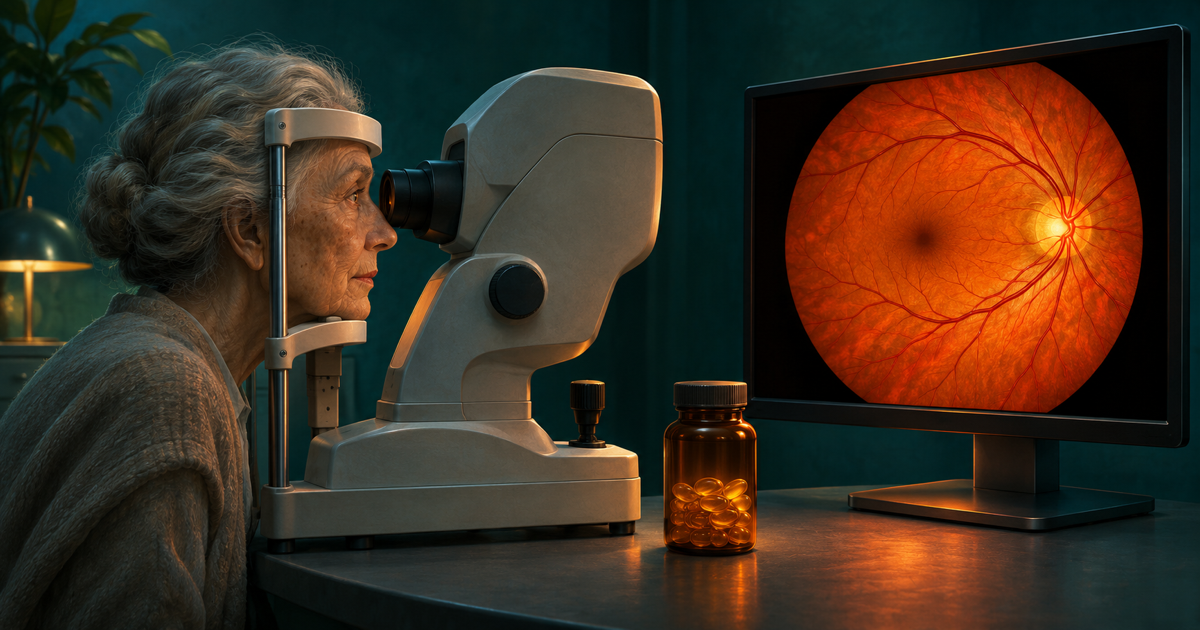
At a retinal exam, an eye doctor can photograph large deposits beneath the retina in an eye that still reads well on the chart. If those findings put the eye in the intermediate stage of age-related macular degeneration, or AMD, the exam may change the answer to a question that comes up at the pharmacy counter: whether an AREDS2 supplement could help preserve the sight the person still has. National Eye Institute guidance on AREDS2
The deposits are called drusen. Their size and pattern can help an ophthalmologist judge the risk of progression, while an eye chart measures how well the person sees under test conditions. Those two assessments can tell different stories about the same eye. The studies behind AREDS2 make sense when read with that distinction in mind: the researchers asked whether a supplement could change the course of a disease already visible on examination. Original AREDS trial
The original AREDS trial measured an eight-point gap
The National Eye Institute’s original Age-Related Eye Disease Study enrolled 3,640 adults ages 55 to 80 in its AMD trial. Participants were randomly assigned to one of four groups: an antioxidant mixture, zinc with copper, the combination, or placebo. Researchers used photographs and treatment records to track progression to advanced AMD. They also tracked whether visual acuity fell by at least 15 letters from baseline, a separate measure of what participants could see. AREDS Report No. 8
Among participants in the higher-risk categories, the estimated five-year probability of advanced AMD was 28% with placebo and 20% with the combined formula. That is an eight-percentage-point difference. Put another way, if 100 people in each group had the same risks as the trial groups, the estimates would correspond to about eight fewer people reaching advanced AMD within five years with the combination. The National Eye Institute’s widely quoted figure of about 25% describes a relative reduction. The absolute figures show the size of the difference in the population studied. Original trial results
The eye-chart result gives the anatomical finding some practical context. In the same higher-risk categories, the estimated five-year probability of losing at least 15 letters was 29% with placebo and 23% with the combination. The findings suggest that fewer people assigned to the formula experienced substantial measured vision loss during follow-up. A threshold like 15 letters captures a group-level outcome and gives limited information about whether any one person would find reading or recognizing faces easier. AREDS visual acuity results
The five-year window matters, too. An eye that stayed below the advanced-disease threshold through year five could still cross it later. Another eye might have stayed below that threshold regardless of which capsule its owner received. Randomization helps estimate how often progression happened across groups. At an individual exam, the result can inform a conversation about risk over time, while the photographs and acuity measurements show what has happened in that particular eye so far. AREDS trial methods and outcomes
Disease stage changes what the evidence can support
In the original trial’s milder category, the estimated five-year probability of progression to advanced AMD in the placebo group was about 1.3%. There were few advanced cases in that category during the trial, so the researchers had little information about whether the formula affected that outcome in people with milder findings. The contrast in baseline risk helps explain why an estimate from participants with more extensive retinal changes would be a poor forecast for someone with early AMD. AREDS outcomes by baseline category
The National Eye Institute says AREDS2 may help when an examination shows intermediate AMD in one or both eyes. If one eye already has late disease, the formula may help slow progression in the other eye. In that situation, the evidence concerns what might happen next to the fellow eye. Its stage can therefore matter as much to the supplement decision as the symptoms in the eye that prompted the appointment. National Eye Institute guidance on who may benefit
Age, family history and difficulty reading may bring someone to an eye exam, but the studies tied eligibility and risk to specific findings in the retina. Even the size of drusen mattered to the way participants were grouped. Someone who remembers being told they have deposits may find it more helpful to ask which stage was documented in each eye than to infer it from whether they can still read comfortably or whether their glasses prescription recently changed. AREDS baseline categories
AREDS2 tested additions to an existing formula
By the time AREDS2 enrolled 4,203 people at high risk of progression, the original supplement had become the basis for a new set of comparisons. Participants were randomly assigned to lutein plus zeaxanthin, two omega-3 fatty acids, both additions, or a placebo for those additions. The trial also compared versions of the underlying AREDS formula, including versions with and without beta-carotene. The main experiment therefore asked what happened when specific ingredients were added to an existing approach. AREDS2 randomized trial
At five years, the main analysis found no statistically clear reduction in progression to advanced AMD for any of the three add-on groups compared with the group assigned placebo for the additions. For lutein and zeaxanthin, the estimated hazard ratio was 0.90, with an interval that included 1. The estimate was compatible with some benefit, and the trial’s prespecified comparison left enough uncertainty that researchers could not conclude the pigments gave an additional overall benefit. AREDS2 primary results
That design explains why the strongest placebo-controlled estimate for the full combination comes from the original AREDS trial. AREDS2 helped investigators decide how to revise that combination. The two trials answer related questions that matter when reading a supplement label. The first estimated the effect of a particular mixture in people at risk. The second examined whether changing parts of the mixture could improve it. The omega-3 arms, for example, offered no clear evidence of an extra benefit against progression in the study population. Original AREDS trial · AREDS2 randomized trial
The beta-carotene swap followed a lung cancer signal
During the randomized phase of AREDS2, 28 participants assigned to receive beta-carotene reported lung cancer, compared with 11 assigned to a formula without it. The groups each contained about 1,350 participants, so those counts represented about 2.1% and 0.9%, respectively. Most of the cases occurred in former smokers. Current smokers were excluded from the beta-carotene comparison, which makes the finding particularly relevant to people who may assume that a smoking history stops mattering after they quit. AREDS2 trial safety results
In the follow-up through roughly 10 years from enrollment, the estimated odds of lung cancer were 1.82 times as high in the group originally assigned beta-carotene as in the comparison group. The confidence interval was wide, so the exact size of the excess remained uncertain. The researchers found no statistically clear increase in lung cancer among those originally assigned lutein and zeaxanthin. Together, those findings support the move to the beta-carotene-free AREDS2 formula and explain why the National Eye Institute highlights the original formula in its guidance for current and former smokers. AREDS2 Report No. 28 · National Eye Institute formulation guidance
The follow-up grouped participants by their original randomized assignment. After the trial ended, participants could receive the revised formula containing lutein and zeaxanthin. The later results can therefore shed light on differences associated with the initial assignments, while offering less certainty about the effects of taking different ingredients continuously for a decade. For someone comparing products, the distinction with the clearest practical consequence is whether the ingredient list still includes beta-carotene. AREDS2 long-term follow-up methods
Retinal photographs suggest a smaller, more specific benefit
A later analysis led by Tiarnán Keenan revisited images from both trials to look at geographic atrophy, a late form of AMD in which areas of retinal tissue deteriorate. The team focused on eyes where the damaged area initially spared the fovea, the point at the center of the macula used for fine detail. They measured how quickly the damaged area approached that point. The choice of measurement matters because a patch can expand along several edges, with different consequences depending on how close it comes to the center. Keenan and colleagues’ retinal-image analysis
In 208 eyes from the original AREDS trial with atrophy away from the center, the estimated rate of approach was about 51 micrometers a year with the trial’s antioxidant mixture and about 73 without it. In a selected AREDS2 comparison involving 325 eyes from participants assigned to a base formula without beta-carotene, the corresponding estimates were about 80 micrometers a year with lutein and zeaxanthin and 114 without them. The two comparisons came from different trial groups and suggest that the direction in which a lesion grows could be sensitive to supplementation. Geographic atrophy results
The analysis was retrospective and the results were more consistent for movement toward the center than for growth in total damaged area. An average rate measured from photographs cannot establish how much more time a person might spend reading comfortably. The starting distance from the fovea varies, and a person’s reading ability can depend on both eyes. A prospective study that measures visual outcomes alongside lesion movement could test whether the difference on the photographs translates into a benefit people notice. Keenan and colleagues’ analysis and limitations
The eye exam gives the supplement label context
Two bottles marketed for eye health can have different ingredients, and two eyes in the same person can have different stages of AMD. The trials give the most concrete basis for a discussion when both details are available. An exam report can identify the stage in each eye, while the ingredient panel can show whether the product resembles the formula evaluated in the studies and whether it includes beta-carotene. The National Eye Institute also advises reviewing other medicines and supplements with an eye care professional because the concentrated ingredients may interact with them. National Eye Institute supplement guidance
For someone with intermediate AMD who can still read comfortably, a realistic expectation is a possible reduction in the chance of reaching late disease over several years. The same expectation may apply to the fellow eye when one eye already has late AMD. What matters at the next exam is whether the retina has changed and whether measured vision has changed. The capsule studies provide probabilities for groups, and those probabilities become informative when the exam shows which group best resembles the person considering the supplement. AREDS trial · National Eye Institute patient guidance
Frequently asked questions
Can AREDS2 prevent AMD from starting?
The available trials have not shown that AREDS2 prevents the onset of AMD. The clearest evidence concerns progression after intermediate changes are present.
Can AREDS2 bring back vision already lost to AMD?
The trials have not shown that AREDS2 restores lost sight. The evidence suggests it may reduce the risk of further loss in some people.
Why does past smoking matter when comparing formulas?
The older AREDS formula contains beta-carotene, which was linked to more lung cancers, mostly in former smokers. The revised AREDS2 formula uses lutein and zeaxanthin.
This article summarises published research and is not medical advice. Consult your healthcare provider before changing your routine.
Frequently Asked Questions
Can AREDS2 prevent AMD from starting?
Can AREDS2 bring back vision already lost to AMD?
Why does past smoking matter when comparing formulas?
Sources
Stay Updated on Longevity Science
Weekly research digests. No spam, unsubscribe anytime.
Related Articles
Alpha-Ketoglutarate (AKG) and Aging: What Research Reveals
Explore how alpha-ketoglutarate (AKG) may influence aging through epigenetic regulation, mitochondrial function, and cellular energy metabolism.
12 min read
Apigenin and Healthy Aging: What the Evidence Really Shows
An evidence review of apigenin, separating cell and animal findings from human data on absorption, sleep, inflammation, safety, and longevity claims.
15 min read
Best Longevity Supplement Stack in 2026: An Evidence-First Guide
A cautious 2026 guide to evaluating longevity supplements, separating human outcomes from biomarkers, animal research, and marketing claims.
15 min read