NAD+ Precursors and Aging: Biomarker Gains Are Not Clinical Outcomes
NR and NMN can raise NAD-related metabolites in people, but the key question is whether that produces durable improvements in health, function, and safety.
Table of Contents
DISCLAIMER
This article is for informational purposes only and does not constitute medical advice. The statements in this article have not been evaluated by the FDA. The information presented is based on published research and should not be used as a substitute for professional medical guidance. Consult your physician before starting any supplement or health protocol.
Nicotinamide adenine dinucleotide, usually shortened to NAD+, sits at the center of energy transfer, redox chemistry, DNA repair, and cell signaling. NAD-related metabolism changes with age in many tissues and model organisms. That makes precursors such as nicotinamide riboside (NR) and nicotinamide mononucleotide (NMN) scientifically interesting.
It does not make a higher blood NAD+ measurement synonymous with younger biology.
The most useful way to read the evidence on NAD precursors and aging is to separate four questions: Does the ingredient reach the body? Does it change the intended pathway? Does it improve a function people can feel or measure? Do benefits persist without unacceptable risk?
What NAD+ does—and why the pathway is complicated
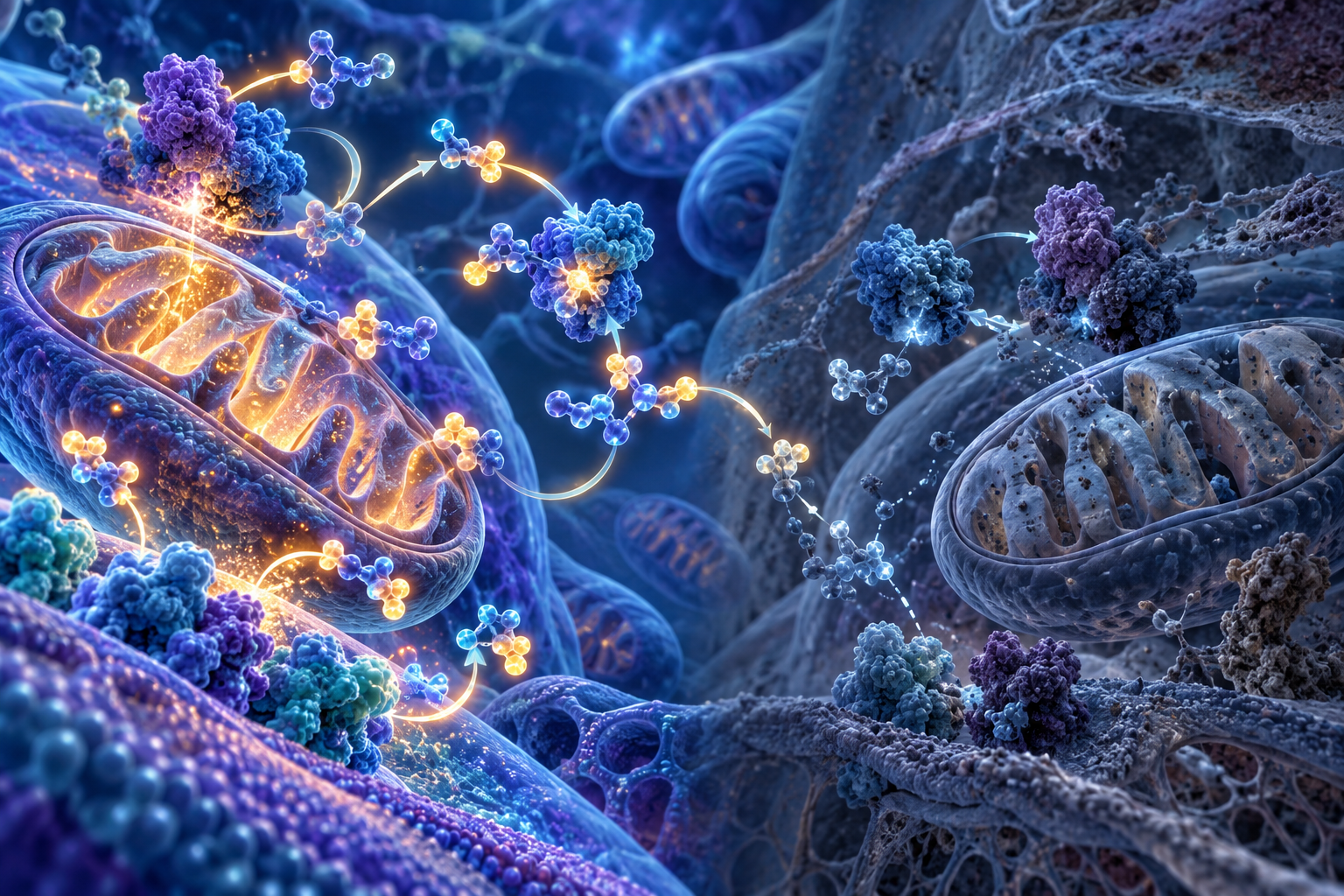
NAD exists in oxidized and reduced forms that shuttle electrons during metabolism. It also serves as a substrate for enzymes including sirtuins, PARPs, and CD38. Those reactions consume NAD+, so cells must continually regenerate it through salvage pathways or build it from dietary precursors.
Niacin is the broad nutritional term covering nicotinic acid and nicotinamide forms that can support NAD production. NR and NMN enter related metabolic routes. The NIH Office of Dietary Supplements describes established niacin requirements, deficiency, food sources, and risks. The existence of a nutrient requirement should not be confused with evidence that taking much more slows aging.
NAD metabolism is compartmentalized. The nucleus, cytosol, and mitochondria may not change in parallel. Blood measurements can show systemic exposure while leaving open what happened inside muscle, liver, brain, or immune cells.
What human trials establish most consistently
Controlled trials of NR show that oral dosing can increase NAD-related metabolites in blood and is generally tolerated over the relatively short durations studied. Trials of NMN have also reported changes in circulating metabolites and selected physiological endpoints.
That is real evidence of bioavailability and target engagement. It is not nothing: many promising compounds fail before reaching that point.
The next layer is less consistent. Studies have examined insulin sensitivity, muscle performance, vascular measures, body composition, fatigue, sleep, and other outcomes. Samples are often small, participants differ, and trials use different doses and endpoints. Positive findings in one subgroup may not reproduce in a broader population.
A supplement can reliably move the biomarker closest to its mechanism yet have little effect on daily function. That can happen because NAD availability was not the limiting factor, the relevant tissue did not receive enough precursor, the trial was too short, or multiple age-related constraints remained unchanged.
Biomarker, surrogate, and outcome are different things
A biomarker is a measurable feature associated with a biological process. A surrogate endpoint is a biomarker validated strongly enough to substitute for a clinical outcome in a specific context. A clinical outcome captures how a person feels, functions, or survives.
Blood NAD-related metabolites are useful pharmacology biomarkers. They confirm that a precursor was absorbed and processed. They are not validated surrogates for longevity.
The distinction prevents a common marketing leap:
- premise: NAD+ participates in important cellular processes;
- observation: NAD-related levels often change with age;
- trial result: a precursor raises a blood marker;
- unsupported conclusion: the supplement reverses aging.
Each arrow requires separate evidence. Pathway correction may be necessary in some settings but insufficient for a meaningful health effect.
Why trial design matters so much
A convincing healthy-aging trial would pre-register a primary outcome, use an adequate sample, compare against placebo, verify adherence, and run long enough to detect a plausible change. It would report all major outcomes and adverse events rather than highlighting only the most favorable subgroup.
Participant selection also matters. A healthy 30-year-old with adequate nutrition has different room for improvement than an older adult with impaired mobility or a person with a defined metabolic disorder. Combining them can hide a benefit—or create the appearance of one that applies only to a narrow group.
Functional endpoints might include walking performance, strength, validated fatigue scales, metabolic control, or disease-specific measures. Epigenetic clocks and omics signatures can support mechanistic work, but a clock shift is not automatically a clinical benefit.
Long-term studies are especially important because chronic pathway manipulation can have effects that a four-week safety trial cannot detect.
Safety is more than the absence of early side effects
Short NR studies often report good tolerability, but short-term safety does not settle years of use. Nicotinic acid at pharmacological doses can cause flushing and, in some contexts, liver, glucose, or uric-acid problems. Different vitamin B3 forms do not share identical effects, so risks should not be copied from one form to another without evidence.
NAD-consuming and NAD-dependent enzymes participate in inflammation, DNA repair, metabolism, and tumor biology. This complexity does not prove that precursors cause cancer or another specific harm. It explains why “natural molecule” is not an adequate long-term safety argument.
Product quality adds another layer. Labels may not match contents, storage can affect stability, and supplement regulation differs between countries. Consumers should check local regulatory status and avoid interpreting a certificate of analysis as proof of clinical benefit.
People using medication, managing cancer, pregnant, breastfeeding, or living with liver, kidney, glucose, or uric-acid disorders should discuss supplements with a qualified clinician. The relevant question is not merely whether a compound is sold legally; it is whether it fits the person’s health context.
A better standard for future claims
Strong evidence would show a reproducible benefit in a defined population, with a meaningful outcome, acceptable adverse events, and clarity about dose and duration. Independent replication matters more than a single company’s sponsored study.
Researchers also need better tissue measurements. Imaging, biopsy studies, isotope tracing, and validated metabolic assays can reveal whether blood changes reflect the compartment that matters. Trials should compare precursors directly where possible rather than treating every molecule in the NAD pathway as interchangeable.
Finally, results need absolute effect sizes. A statistically significant change can still be too small to matter in daily life.
The practical takeaway
NR and NMN are plausible metabolic interventions with evidence that they can alter human NAD-related biomarkers. They are not proven age-reversal therapies, and no human trial has established that taking them extends life.
If you are evaluating a claim, look for the population, duration, comparator, primary endpoint, effect size, and adverse-event data. Give more weight to function than to a pathway graphic and more weight to replicated trials than to a before-and-after blood value.
The science deserves continued testing precisely because NAD biology is important. The honest conclusion today is narrower than the marketing: target engagement is established more clearly than durable health benefit.
Frequently Asked Questions
Do NR and NMN raise NAD+ in humans?
Does a higher blood NAD+ value mean slower aging?
Are NAD+ precursor supplements proven anti-aging treatments?
Sources
- NIH Office of Dietary Supplements — Niacin Fact Sheet for Health Professionals(2026)
- Safety and Metabolism of Long-term Administration of NIAGEN (Nicotinamide Riboside)(2019)
- Chronic nicotinamide riboside supplementation is well-tolerated and elevates NAD+ in healthy adults(2018)
- NAD+ precursors and healthy aging: unresolved questions for human translation(2023)
Stay Updated on Longevity Science
Weekly research digests. No spam, unsubscribe anytime.
Related Articles

AGEs in Your Diet: How Advanced Glycation End Products Accelerate Aging
Advanced glycation end products in food may accelerate aging. Learn which foods are highest in AGEs and how cooking methods affect your aging rate.
9 min read
Anti-Aging Breakfast Ideas: Start Your Day With Longevity-Supporting Foods
Science-backed anti-aging breakfast ideas that support longevity. Learn which morning foods may promote healthy aging through nutrition research.
8 min read
Science-Backed Anti-Aging Foods: What to Eat
Discover the top science-backed anti-aging foods that may slow biological aging, from berries to leafy greens and fatty fish.
9 min read