Vestibular Function and Aging: Balance, Dizziness, and the Inner Ear
Age-related vestibular changes can affect balance, gaze stability, and confidence, but dizziness has many causes. Here is how clinicians separate the signals.
Table of Contents
DISCLAIMER
This article is for informational purposes only and does not constitute medical advice. The statements in this article have not been evaluated by the FDA. The information presented is based on published research and should not be used as a substitute for professional medical guidance. Consult your physician before starting any supplement or health protocol.
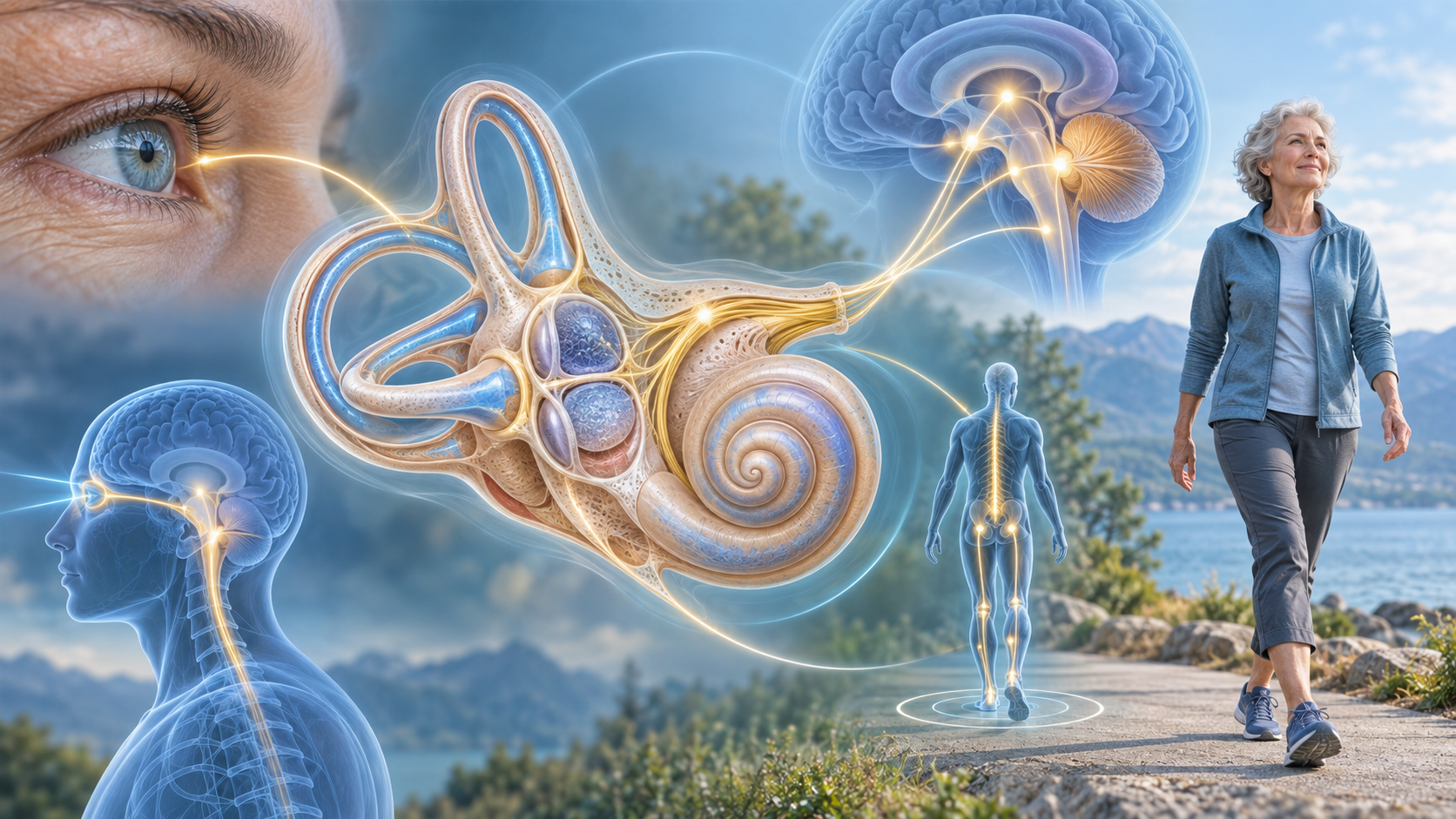
Balance is an agreement between several systems. The inner ear senses head motion and gravity, the eyes report movement relative to the environment, and muscles and joints provide information about body position. The brain reconciles those streams and sends rapid commands to the eyes and limbs. Vestibular function aging can weaken one part of that network, but it rarely acts alone.
That distinction matters because “dizziness” can describe spinning, light-headedness, imbalance, visual blurring, or fear of falling. Those experiences have different causes. Treating every symptom as inevitable inner-ear aging risks missing medication effects, low blood pressure, migraine, stroke, neuropathy, vision problems, or a specific vestibular disorder.
What the vestibular system does
Each inner ear contains semicircular canals that respond mainly to head rotation and otolith organs that respond to linear acceleration and gravity. Hair cells convert movement of fluid and tiny calcium-carbonate particles into neural signals. The vestibular nerves carry those signals to brainstem and cerebellar circuits.
One critical output is the vestibulo-ocular reflex. When the head turns, the eyes move in the opposite direction so an object remains clear. If that reflex is weak, a person may experience oscillopsia—a sense that the visual world bounces during walking. Vestibular pathways also contribute to posture, spatial orientation, and autonomic responses.
Anatomical and physiological studies report age-related changes in hair cells, vestibular nerve fibers, and central processing. Yet the relationship between tissue loss and symptoms is not simple. The brain can compensate for gradual change, and vision or proprioception can temporarily cover a deficit. Problems may become obvious only in darkness, on uneven ground, or during rapid head turns.
Presbyvestibulopathy is a specific clinical concept
The Bárány Society proposed criteria for presbyvestibulopathy, a chronic vestibular syndrome in older adults characterized by unsteadiness, gait disturbance, chronic dizziness, and/or recurrent falls with measured mild bilateral vestibular deficits. It is not diagnosed from age or symptoms alone.
Objective testing can include the video head impulse test, rotational chair testing, or caloric testing. These evaluate different frequencies and parts of the vestibular system. Otolith tests may add information, but thresholds and interpretation depend on technique and clinical context.
The criteria intentionally describe mild bilateral reduction rather than complete vestibular failure. They also require clinicians to consider other diagnoses. A patient may have presbyvestibulopathy plus cataracts, peripheral neuropathy, muscle weakness, or medication-related orthostatic hypotension. The combined burden often explains fall risk better than any single result.
Why symptoms differ so much
Gradual symmetric loss can present as vague imbalance rather than dramatic spinning. In contrast, benign paroxysmal positional vertigo can cause brief attacks triggered by rolling in bed or looking upward. Ménière’s disease, vestibular migraine, neuritis, and central neurological disease produce other patterns. Hearing loss may coexist but does not prove the same mechanism.
Medication review is essential. Sedatives, some antiseizure medicines, blood-pressure drugs, and combinations that increase sleepiness or lower pressure can worsen stability. Polypharmacy can amplify small sensory deficits. Changes should be clinician-guided; abruptly stopping a prescribed drug can be dangerous.
Cardiovascular symptoms can masquerade as vestibular symptoms. Light-headedness after standing, fainting, chest discomfort, or palpitations need a different evaluation than head-motion-induced visual blur. Sudden dizziness with weakness, severe headache, speech change, inability to walk, or double vision requires urgent assessment because posterior-circulation stroke can be difficult to recognize.
How clinicians evaluate balance
A useful history asks what the sensation feels like, what triggers it, how long it lasts, and which symptoms accompany it. Examination may assess eye movements, positional triggers, hearing, sensation in the feet, strength, gait, and blood pressure lying and standing. No consumer balance score replaces this process.
Simple performance tests can quantify function: gait speed, repeated chair stands, turning, or standing with a narrowed base. They are not vestibular-specific. A poor result may reflect arthritis, fear, weakness, neuropathy, or cognition. Their value is identifying functional risk and tracking response, not locating one damaged organ.
Formal vestibular testing is most helpful when tied to a clinical question. A normal result on one test does not exclude all vestibular disease, because different tests stimulate different frequencies and pathways. Similarly, an abnormal laboratory value should be interpreted alongside symptoms and function.
Rehabilitation and compensation
Vestibular rehabilitation uses repeated, graded exercises to improve gaze stability, habituate motion sensitivity, and strengthen balance strategies. Programs may include head movement while focusing on a target, walking with turns, or progressively reducing visual and support cues. The dose should be individualized so it challenges the system without creating unsafe fall exposure.
Strength and power training matter because the best sensory estimate is useful only if the body can act on it. Vision correction, appropriate footwear, hearing care, home hazard reduction, and management of neuropathy or orthostatic hypotension can also improve the overall balance system.
Avoidance can create a vicious circle. A person who stops moving because motion feels uncomfortable loses strength and opportunities for central compensation. On the other hand, forcing provocative maneuvers without diagnosis can increase falls or aggravate a different condition. Supervised progression is the middle path.
What prevention can realistically mean
There is no proven supplement that restores all age-related vestibular hair-cell loss in humans. Research on regeneration and sensory substitution is active, but laboratory promise is not a clinical reversal therapy. The near-term strategy is to identify specific disorders, reduce avoidable contributors, and train remaining systems.
For an older adult with new imbalance, practical next steps include documenting triggers, reviewing recent medication changes, arranging vision and hearing care, and obtaining a clinical fall-risk assessment. Recurrent falls, progressive gait change, or persistent visual bouncing should not be dismissed as age.
The bottom line
Vestibular function can decline with age, reducing the reserve available when vision, sensation, or strength are also challenged. But dizziness and falls are syndromes, not diagnoses. Careful evaluation can distinguish gradual bilateral decline from positional vertigo, cardiovascular problems, neurological disease, and other treatable causes.
The most evidence-aligned response is multifactorial: targeted vestibular rehabilitation when indicated, strength and balance training, safer environments, and management of vision, medication, and cardiovascular contributors. Aging changes the system; it does not eliminate the value of diagnosis or adaptation.
Frequently Asked Questions
Is dizziness a normal part of aging?
Can a balance test identify the exact cause?
Does vestibular rehabilitation help everyone?
Sources
Stay Updated on Longevity Science
Weekly research digests. No spam, unsubscribe anytime.
Related Articles

Ankle Power and Healthy Aging: The Push-Off That Keeps Walking Efficient
Ankle plantar-flexor power supports walking speed and balance recovery. Learn why push-off changes with age and how strength can be trained safely.
9 min read
Arterial Calcification and Vascular Aging: Reading the Risk Signals
Arterial calcification can reveal accumulated vascular risk. Learn what calcium scores mean, why calcification develops, and where testing has limits.
10 min read
Arterial Stiffness and Vascular Age: A Longevity Evidence Guide
Understand arterial stiffness vascular age longevity links, key studies, measurement limits, and evidence-based lifestyle implications for healthy aging.
11 min read