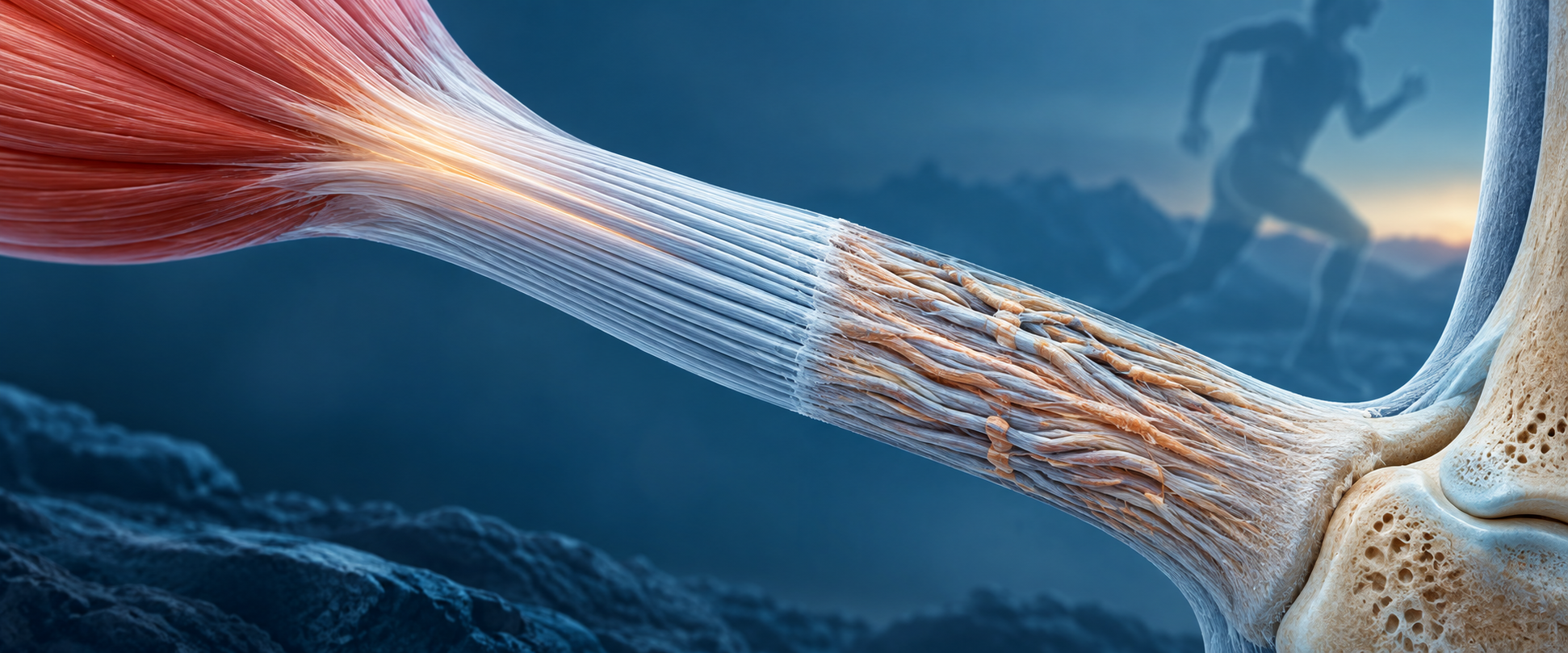
Tendon Stiffness and Aging: What Changes Between Muscle and Bone
Tendons transmit muscle force, but aging changes collagen turnover and mechanical behavior. Learn why both excessive softness and stiffness can matter.
Table of Contents
DISCLAIMER
This article is for informational purposes only and does not constitute medical advice. The statements in this article have not been evaluated by the FDA. The information presented is based on published research and should not be used as a substitute for professional medical guidance. Consult your physician before starting any supplement or health protocol.
Tendons are often described as ropes that attach muscle to bone. The analogy is useful but incomplete. A living tendon is a collagen-rich tissue that stores and releases elastic energy, transmits force, senses load, and remodels in response to use. Tendon stiffness aging research asks how that mechanical link changes when collagen turnover slows, activity patterns shift, and muscles produce less force.
The word “stiffness” can mislead. In mechanics, stiffness is not automatically bad. A tendon that is appropriately stiff can transmit muscle force quickly; a compliant tendon can store energy and protect tissue in other contexts. Excessive stiffness, insufficient stiffness, and poor coordination between muscle and tendon may each create problems. The optimal property depends on the tendon and task.
Structure and mechanics are different measurements
Whole-tendon stiffness describes the relationship between applied force and elongation. Young’s modulus describes material stiffness after accounting for dimensions. A thick tendon can be structurally stiff even if its material is relatively compliant. Ultrasound estimates elongation during contraction, while dynamometry estimates force; small errors in joint angle, moment arm, or probe tracking can affect results.
Researchers also measure cross-sectional area, collagen organization, blood flow, and biochemical markers. Imaging abnormalities do not map perfectly to pain. Some people with tendon thickening or disorganization have no symptoms, while painful tendons may show modest structural change.
Age comparisons are further complicated by activity. A lifelong runner, a sedentary adult, and a person recently immobilized after surgery bring different loading histories. Cross-sectional studies can confuse the effect of chronological age with the effect of reduced movement.
What changes with age
Tendon collagen has a long biological half-life. With age, nonenzymatic glycation can create advanced glycation end-product crosslinks, while cellular density, water content, vascular responses, and matrix turnover may change. These processes can alter how fibers slide and how tissue responds to repeated loading.
Human studies do not show one uniform mechanical direction. Some report lower stiffness or modulus in older tendons; others find little difference or context-dependent increases. The Achilles, patellar, rotator cuff, and hand tendons experience distinct loads and are not interchangeable. Different testing speeds and contraction levels also produce different estimates.
Muscle aging matters because tendon properties are expressed under force. Lower muscle strength can mean lower habitual tendon loading and smaller measured forces. At the same time, reduced tendon stiffness may delay force transmission and contribute to lower rapid power, even when maximal strength appears adequate.
Why the muscle-tendon unit matters
Walking, climbing stairs, catching balance, and jumping depend on timing. Muscle fascicles shorten, tendons stretch, and stored energy returns. An efficient system allows muscle fibers to operate in a favorable range while the tendon manages rapid changes in force.
If muscle capacity declines faster than tendon mechanics adapt, the unit can become mismatched. A sudden return to sport may expose a tendon that has not been prepared for the force a strengthening muscle can produce. Conversely, prolonged unloading can reduce both muscle and tendon capacity.
This helps explain why early training success should not be treated as full tissue adaptation. Neural improvements can make a person stronger within weeks, while tendon remodeling may take longer. Progression should consider total weekly load, speed, range, recovery, and next-day symptoms.
What loading studies show
Progressive resistance training can increase tendon stiffness and improve force transmission in younger and older adults. Studies often use high-intensity isometric or dynamic contractions, but protocols differ and samples are usually small. Improvements in a laboratory measure do not guarantee injury prevention, and one tendon protocol does not fit every condition.
For generally healthy adults, the broad principle is gradual mechanical loading. Heavy slow resistance, isometrics, and eccentric exercise are tools, not competing religions. Selection depends on the tendon, current pain, equipment, goals, and clinical assessment. Plyometrics add fast energy-storage demands and generally belong later in a progression.
Pain monitoring is useful but not infallible. Mild, stable symptoms during a prescribed program may be acceptable in some tendinopathy protocols, whereas escalating pain, swelling, sudden weakness, or loss of function warrants reassessment. Corticosteroid exposure, fluoroquinolone antibiotics, inflammatory disease, diabetes, and previous rupture can change risk.
Collagen supplements and recovery claims
Small trials have explored gelatin, collagen peptides, vitamin C, and exercise-related collagen synthesis. The evidence does not establish that a supplement rebuilds an aging tendon, prevents rupture, or outperforms an adequate diet plus appropriate loading. Studies often use biochemical markers rather than long-term clinical outcomes.
Protein intake supports whole-body tissue maintenance, but tendons do not remodel simply because more amino acids are consumed. The loading signal, total nutrition, sleep, metabolic health, and rehabilitation plan all interact. Marketing that promises to “lubricate” or “reverse” tendon age goes beyond current evidence.
Recovery also includes avoiding abrupt spikes. Weekend sports after a sedentary week, rapid hill-volume increases, or sudden explosive work can exceed current capacity. A training log that tracks session type, intensity, and symptom response is more actionable than an unvalidated tendon-age score.
A practical progression framework
Start by defining function: pain-free walking, stairs, running, overhead work, or sport. Build basic range and slow strength before adding speed. Increase one main variable at a time when possible. Maintain calf, quadriceps, hip, and trunk capacity because joints distribute load across a chain.
Balance and reaction work may reduce the unexpected loads that occur during a trip or misstep. Footwear and surface changes can help, but they should not replace capacity building. Persistent focal pain deserves a diagnosis because arthritis, nerve irritation, muscle injury, or stress fracture can mimic tendon symptoms.
Ultrasound or MRI is not always needed. Imaging is most useful when the result will change management, rupture is suspected, or symptoms do not follow the expected course. Treatment should focus on function and load tolerance rather than chasing a perfectly normal image.
The bottom line
Aging changes tendon cells, collagen chemistry, and habitual loading, but it does not produce one universal pattern of “too stiff” tendons. Mechanical results vary by tissue and method. The clinically important question is whether the muscle-tendon unit can tolerate and transmit the forces required for daily life.
Progressive resistance training can support tendon properties and function, provided loading rises gradually and accounts for medical risk and symptoms. Supplements cannot substitute for that process, and sudden loss of function needs prompt care. Tendon health is adaptation over time, not a single stiffness number.
Frequently Asked Questions
Are older tendons always stiffer?
Can resistance training change tendon properties?
Does tendon pain mean the tendon is torn?
Sources
Stay Updated on Longevity Science
Weekly research digests. No spam, unsubscribe anytime.
Related Articles

Ankle Power and Healthy Aging: The Push-Off That Keeps Walking Efficient
Ankle plantar-flexor power supports walking speed and balance recovery. Learn why push-off changes with age and how strength can be trained safely.
9 min read
Arterial Calcification and Vascular Aging: Reading the Risk Signals
Arterial calcification can reveal accumulated vascular risk. Learn what calcium scores mean, why calcification develops, and where testing has limits.
10 min read
Arterial Stiffness and Vascular Age: A Longevity Evidence Guide
Understand arterial stiffness vascular age longevity links, key studies, measurement limits, and evidence-based lifestyle implications for healthy aging.
11 min read