Muscle Spindles, Proprioception, and Aging: How the Body Tracks Position
Proprioception can change with age, but the effect depends on the joint, task, and test. Learn how muscle spindles contribute to balance and movement.
Table of Contents
DISCLAIMER
This article is for informational purposes only and does not constitute medical advice. The statements in this article have not been evaluated by the FDA. The information presented is based on published research and should not be used as a substitute for professional medical guidance. Consult your physician before starting any supplement or health protocol.
Close your eyes and move one index finger until it meets the other. The ability to estimate where the moving finger is—without watching it—depends partly on proprioception, the nervous system’s representation of body position and movement. Muscle spindles are important sensors in that system, but they are only one link in a much larger chain.
Age-related proprioceptive change is frequently described as universal and severe. The evidence is more nuanced. A 2026 systematic review concluded that average differences between younger and older adults were often limited, while the direction and size of the effect varied with the joint, task, and outcome. That is a useful correction: an older adult is not automatically “losing body awareness,” and a single balance test cannot identify one failing receptor.
What muscle spindles measure
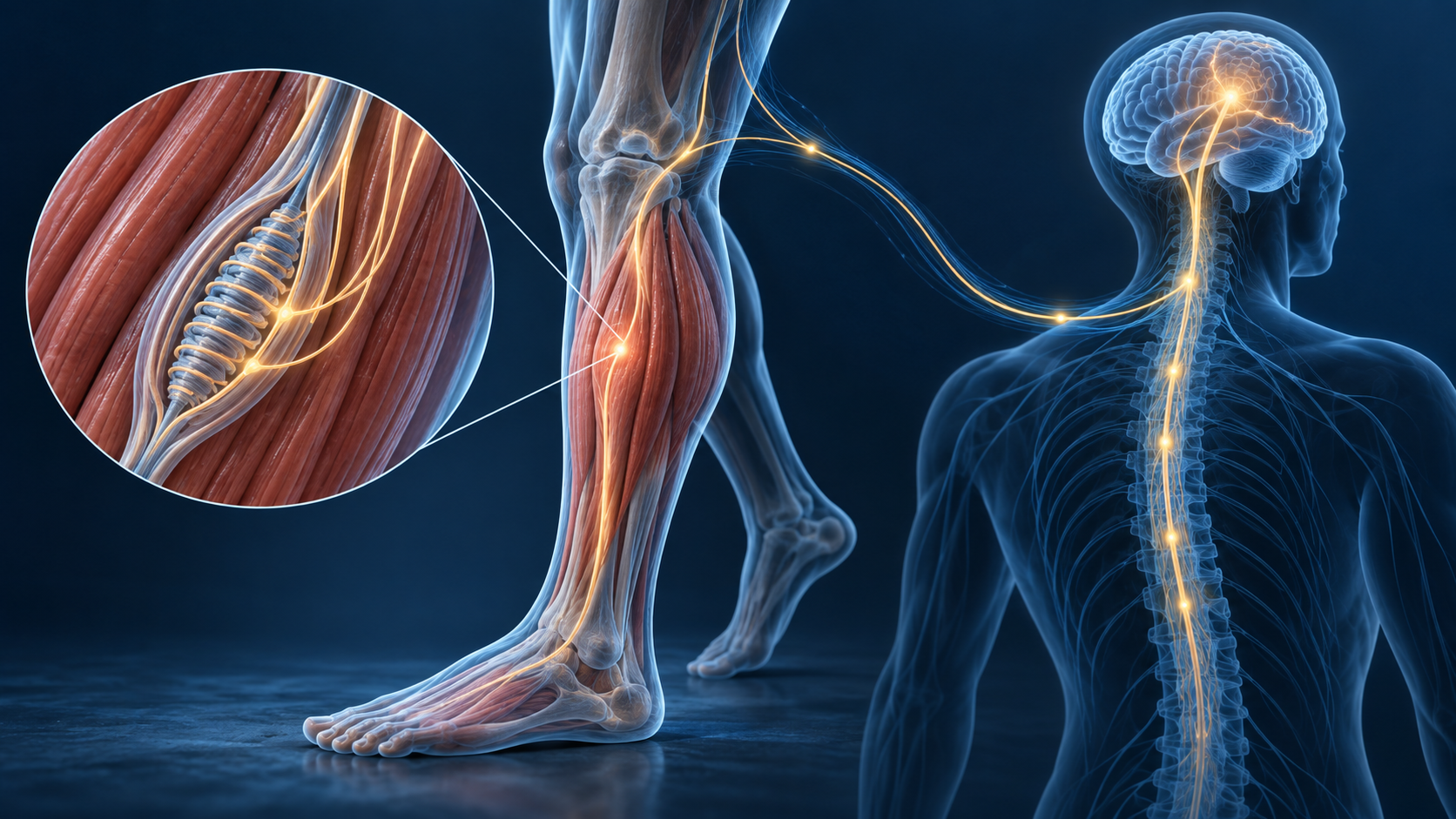
Muscle spindles are specialized structures embedded among ordinary muscle fibers. They respond to muscle length and the speed at which length changes. Sensory fibers carry that information toward the spinal cord and brain, while gamma motor neurons help tune spindle sensitivity as the body moves.
The signal supports stretch reflexes, postural corrections, joint-position estimates, and coordinated movement. Tendon organs, joint receptors, skin stretch, pressure under the feet, vision, and the vestibular system add other information. The brain combines these sources rather than consulting a single biological “position meter.”
This redundancy explains why damage or noise in one channel does not always produce an obvious deficit. It also explains why a laboratory test at the knee may not predict performance at the ankle, shoulder, or finger.
What changes with age
Human studies report altered joint-position sense and movement detection in some older groups, especially during demanding lower-limb tasks. Yet results differ because researchers use different angles, speeds, loads, instructions, and error calculations. Health status matters too: neuropathy, arthritis, stroke, pain, and inactivity can affect performance independently of chronological age.
A 2025 animal study found preferential degeneration among sensory neurons connected to particular muscle-spindle fibers and linked those changes with impaired weight shifting and gait in aged mice. The work provides a plausible biological mechanism, but it does not establish the same cellular sequence or treatment response in humans.
The nervous system may compensate. Older adults can place more weight on vision or consciously slow a movement. Compensation can keep an easy test accurate while making performance more fragile in darkness, on uneven ground, or during a second cognitive task.
Why measurement is difficult
Common tests ask a person to reproduce a joint angle, detect a passive movement, match one limb with the other, or respond to vibration that stimulates spindle pathways. Each test isolates a different component. Angle-reproduction error includes memory and attention. Passive movement detection depends on the equipment’s speed and friction. Standing sway reflects multiple sensory and motor systems.
Even “normal” values require caution. Dominant limb, recent exercise, fatigue, temperature, footwear, and familiarity with the task can change results. Comparing a personal trend under similar conditions is usually more informative than treating one score as a biological-age readout.
Consumer wearables do not directly measure muscle-spindle firing. They can record sway, gait variability, or movement patterns that may reflect sensorimotor function, but those outputs are downstream and nonspecific.
Practical ways to support sensorimotor function
Strength, power, and balance training can improve functional performance even when the microscopic mechanism is uncertain. Progressive resistance work builds the capacity to make a correction. Balance exercises practice the correction itself. Walking on varied but safe surfaces, changing direction, stepping over obstacles, and controlled single-leg work expose the nervous system to useful sensory problems.
Progression should be deliberate. Removing vision, narrowing the base of support, adding head turns, or using an unstable surface all increase difficulty. Combining several at once can add risk without adding useful learning. A stable support and supervision are appropriate when falls, dizziness, neuropathy, or recent injury are present.
Footwear, hearing, vision, medication, and blood-pressure review may matter as much as an exercise drill. New asymmetric numbness, sudden imbalance, weakness, or repeated falls deserves clinical assessment rather than a self-directed “proprioception reset.”
What the evidence does not prove
The evidence does not support a supplement that selectively rejuvenates human muscle spindles. It also does not show that wobble-board performance measures the rate of aging. Improvements on a practiced test can reflect learning and strategy rather than repair of a sensory receptor.
Proprioception is best understood as a distributed function. Receptors detect mechanical change; nerves transmit it; the spinal cord and brain interpret it; muscles produce a response; and attention and environment shape the result. Healthy aging interventions can strengthen several links without claiming to reverse the age of the system.
Bottom line
Muscle spindles help the body estimate length and movement, but age effects on proprioception are smaller and more task-dependent than simple narratives suggest. The practical goal is not to chase one sensory score. It is to preserve adaptable movement through strength, varied balance practice, good vision and foot care, and investigation of medical causes when function changes suddenly.
Frequently Asked Questions
Does proprioception always decline sharply with age?
Can balance training restore muscle spindles?
Is poor balance only a proprioception problem?
Sources
Stay Updated on Longevity Science
Weekly research digests. No spam, unsubscribe anytime.
Related Articles

Ankle Power and Healthy Aging: The Push-Off That Keeps Walking Efficient
Ankle plantar-flexor power supports walking speed and balance recovery. Learn why push-off changes with age and how strength can be trained safely.
9 min read
Arterial Calcification and Vascular Aging: Reading the Risk Signals
Arterial calcification can reveal accumulated vascular risk. Learn what calcium scores mean, why calcification develops, and where testing has limits.
10 min read
Arterial Stiffness and Vascular Age: A Longevity Evidence Guide
Understand arterial stiffness vascular age longevity links, key studies, measurement limits, and evidence-based lifestyle implications for healthy aging.
11 min read