Mitochondrial DNA Heteroplasmy and Aging: A Mixed Population Inside Every Cell
Cells can carry multiple mitochondrial DNA variants at once. Learn how heteroplasmy shifts with age, why thresholds matter, and what current tests cannot prove.
Table of Contents
DISCLAIMER
This article is for informational purposes only and does not constitute medical advice. The statements in this article have not been evaluated by the FDA. The information presented is based on published research and should not be used as a substitute for professional medical guidance. Consult your physician before starting any supplement or health protocol.
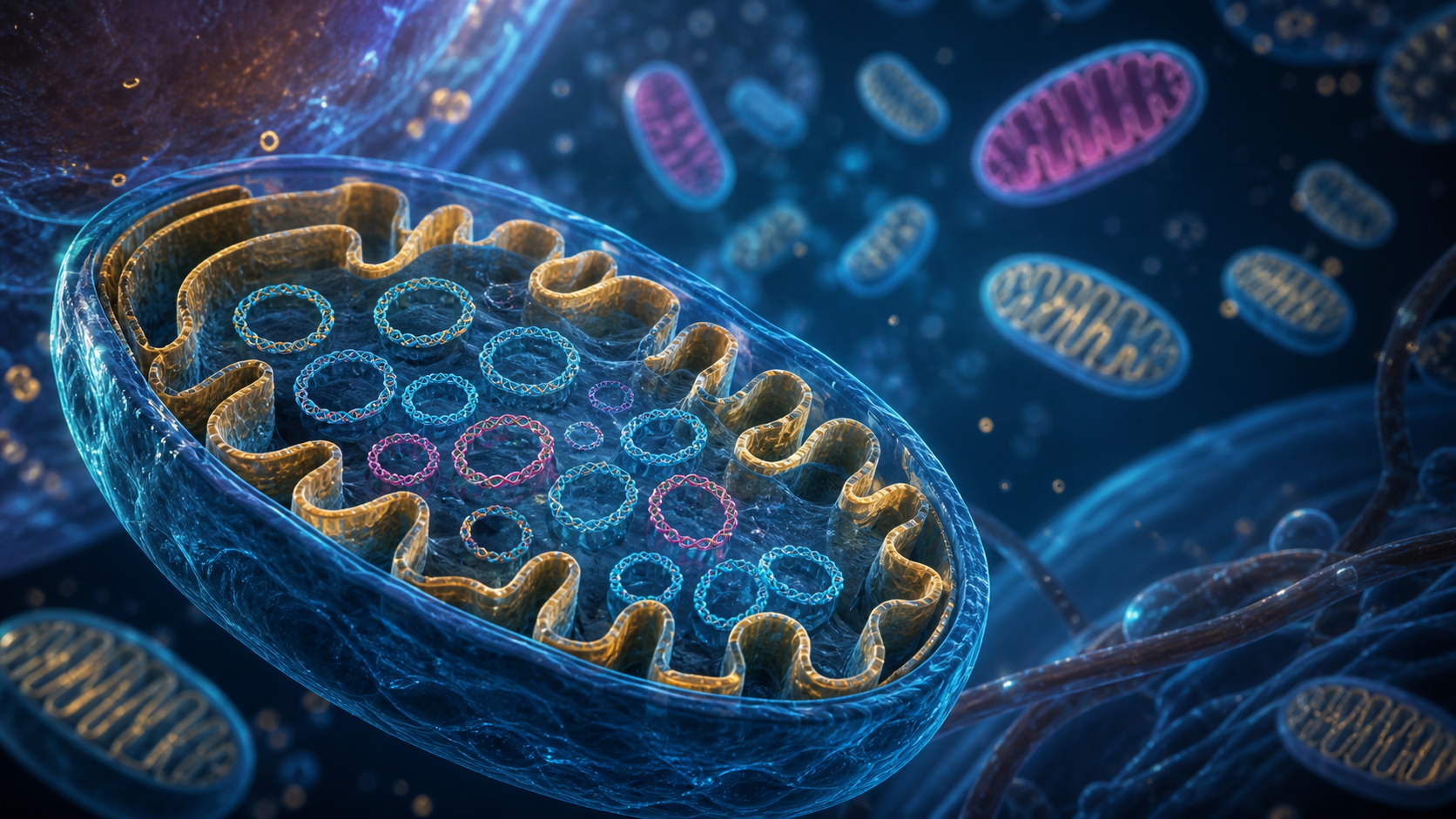
A human cell may contain hundreds or thousands of copies of mitochondrial DNA, distributed among many mitochondria. Those copies are not always identical. A cell can carry a mixture of common and variant sequences—a state known as heteroplasmy.
This makes mitochondrial genetics different from the simplified idea of one gene copy from each parent. The proportion of a variant can differ across tissues, drift during life, and sometimes cross a threshold at which energy production becomes impaired.
Why Mitochondrial DNA Is a Population
Mitochondria continually divide, fuse, exchange contents, and are removed by quality-control processes. Their small circular genome encodes essential components of oxidative phosphorylation, while most mitochondrial proteins are encoded in the nucleus.
When a cell divides, mitochondrial genomes are distributed between daughter cells. Random sampling and selective pressures can cause the proportion of a variant to rise in one lineage and fall in another. This process, sometimes called replicative segregation, helps explain why related cells can diverge.
Most mitochondrial DNA is inherited through the egg. A developmental bottleneck can cause large differences in variant proportion among siblings or tissues. Other variants arise during life through replication errors and damage.
Thresholds and Tissue Differences
A pathogenic variant usually does not behave like an on-off switch at the first copy. Cells often tolerate a proportion of altered genomes because remaining mitochondria and metabolic pathways provide reserve. Dysfunction may appear only when the burden passes a variant- and tissue-specific threshold.
High-energy tissues such as brain, skeletal muscle, heart, retina, and endocrine organs can be especially sensitive to mitochondrial impairment. But the same blood test may not reflect the proportion present in muscle or nervous tissue. Some variants decline in blood with age even while remaining important elsewhere.
Symptoms of mitochondrial disease are consequently diverse and overlapping with many other disorders. Fatigue or exercise intolerance alone does not establish a mitochondrial DNA diagnosis.
How Heteroplasmy Intersects With Aging
Low-level somatic mitochondrial DNA variants can accumulate with age. Certain variants expand clonally within individual cells, producing mosaics of respiratory-chain deficiency in some tissues. Research also examines deletions, copy number, quality control, and interactions with nuclear genes.
The relationship is not simply “more mutations equals older.” Variant identity and location matter, as do cellular selection and compensation. A high proportion of a neutral variant may have little effect, while a lower proportion of a damaging variant in a vulnerable tissue may be important.
Animal models with accelerated mitochondrial mutation have demonstrated that severe mutational burdens can drive aging-like pathology. Translating those models to normal human aging requires care because the rate, spectrum, and distribution of mutations may differ.
What Testing Can and Cannot Tell You
Clinical mitochondrial genetic testing is useful when symptoms, family history, and specialist evaluation support it. Modern sequencing can detect low-level variants, but sensitivity depends on the sample, depth, laboratory methods, and reporting thresholds.
A consumer sequence from saliva or blood is not a complete map of mitochondrial function across the body. Finding a variant of uncertain significance can create anxiety without explaining symptoms. Interpretation should combine genetics with clinical findings, biochemical evidence, and sometimes tissue-specific testing.
Physical activity, sleep, nutrition, and management of chronic disease support general metabolic health, but they should not be marketed as editing mitochondrial genomes. Experimental approaches to shift heteroplasmy are an active research area, not a routine age-reversal service.
Heteroplasmy reveals that aging cells are ecological systems in miniature. What matters is not only which DNA variants exist, but how their proportions, tissues, and quality-control environment change together over time.
Frequently Asked Questions
What does heteroplasmy mean?
Does any mitochondrial DNA mutation cause disease?
Can a supplement remove mutated mitochondrial DNA?
Sources
Stay Updated on Longevity Science
Weekly research digests. No spam, unsubscribe anytime.
Related Articles

Ankle Power and Healthy Aging: The Push-Off That Keeps Walking Efficient
Ankle plantar-flexor power supports walking speed and balance recovery. Learn why push-off changes with age and how strength can be trained safely.
9 min read
Arterial Calcification and Vascular Aging: Reading the Risk Signals
Arterial calcification can reveal accumulated vascular risk. Learn what calcium scores mean, why calcification develops, and where testing has limits.
10 min read
Arterial Stiffness and Vascular Age: A Longevity Evidence Guide
Understand arterial stiffness vascular age longevity links, key studies, measurement limits, and evidence-based lifestyle implications for healthy aging.
11 min read