Immune Clearance of Senescent Cells: How Aging Changes Cellular Cleanup
Immune cells can recognize and remove some senescent cells, but aging may weaken this cleanup. Explore the evidence, limits, and emerging therapeutic ideas.
Table of Contents
DISCLAIMER
This article is for informational purposes only and does not constitute medical advice. The statements in this article have not been evaluated by the FDA. The information presented is based on published research and should not be used as a substitute for professional medical guidance. Consult your physician before starting any supplement or health protocol.
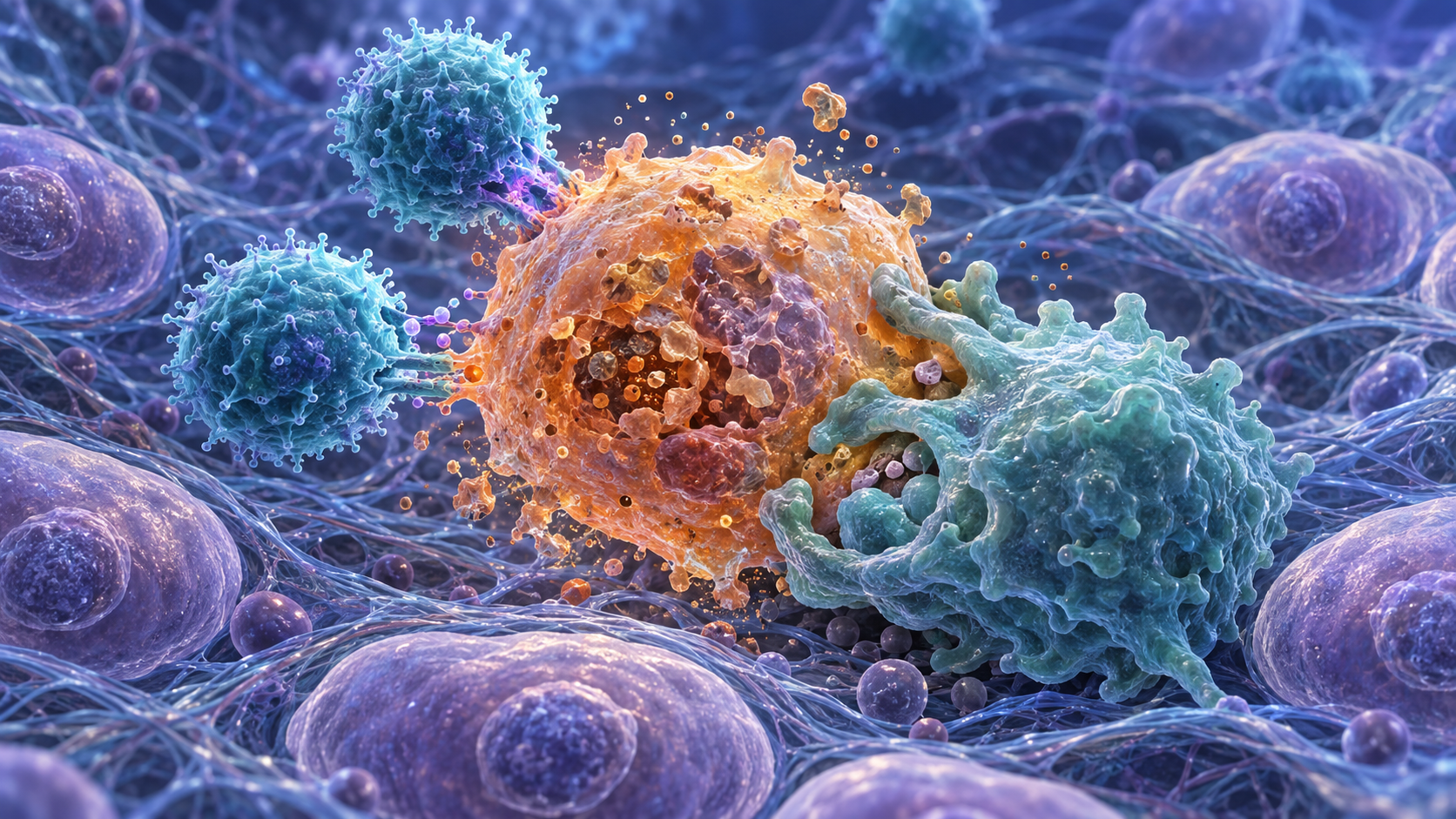
Cellular senescence is often described as a one-way transformation: a stressed cell stops dividing and then accumulates with age. In living tissue, the story is more dynamic. Senescent cells can release signals that recruit macrophages, natural killer cells, T cells, and other immune actors. Immune clearance of senescent cells may remove some of these cells before they persist long enough to disrupt tissue.
The process is neither complete nor universally beneficial. Short-lived senescence can help suppress tumors, coordinate wound repair, and shape development. Problems arise when senescent cells linger, produce inflammatory factors, or alter neighboring cells. Aging may increase their production while simultaneously weakening the surveillance needed to remove them.
What makes a cell senescent
Senescence is a durable stress response, not simply old age at the cellular level. DNA damage, oncogene activation, telomere dysfunction, mitochondrial stress, and some cancer therapies can trigger it. The cell usually exits the division cycle and changes its metabolism, chromatin, surface proteins, and secreted molecules.
Researchers often discuss the senescence-associated secretory phenotype, or SASP. It can include cytokines, chemokines, growth factors, and matrix-remodeling enzymes. The exact mixture depends on cell type and trigger. Some components summon immune cells and support repair; others can sustain inflammation or promote dysfunction when exposure becomes chronic.
No single marker identifies every senescent cell. Studies combine features such as p16 or p21 expression, persistent DNA-damage signals, lysosomal activity, altered morphology, and lack of proliferation. This diversity complicates both measurement and selective targeting.
How immune surveillance works
Senescent cells may display stress ligands that activate natural killer cells or cytotoxic lymphocytes. They can secrete chemokines that recruit immune cells and change “eat me” or inhibitory signals on their surface. Macrophages may engulf targeted cells and clear debris. T cells can recognize antigenic changes in certain contexts.
In a landmark mouse study, Tae-Won Kang and colleagues showed that immune surveillance of senescent premalignant liver cells could limit cancer development. The model demonstrated that senescence and immunity can cooperate: growth arrest contains the cell, while immune removal reduces the chance that it remains a problematic lesion.
Anat Sagiv and colleagues reported that granule exocytosis contributes to natural-killer-cell killing of senescent cells. Their work also illustrated an important principle: senescent cells can express both activating and inhibitory signals, so visibility to the immune system is regulated rather than automatic.
Why clearance may falter with age
Aging changes both sides of the interaction. More cells experience cumulative stress, increasing the supply of senescent states. At the same time, immune cells may show altered trafficking, receptor expression, metabolism, and effector function. Chronic inflammatory signals can distort coordination and make a tissue less capable of resolving a local response.
Some senescent cells may evolve a survival advantage. They can upregulate anti-apoptotic pathways or inhibitory immune checkpoints. Tissue fibrosis and altered extracellular matrix can make physical access harder. Repeated SASP exposure may exhaust or reprogram nearby immune cells.
The 2018 study by Ovadya and colleagues used mouse models to show that impaired immune surveillance accelerated senescent-cell accumulation and age-associated disorders. Animal evidence supports a causal interaction, but it does not establish that a particular immune-boosting strategy will safely reproduce the effect in humans.
The double-edged role of senescence
Eliminating every senescent cell would not necessarily be desirable. During wound healing, transient senescent cells can coordinate remodeling and then disappear. Senescence can prevent a damaged cell from continuing to divide. In the placenta and embryo, related programs participate in normal patterning.
Timing and context therefore matter. A therapy that suppresses senescence during cancer prevention could remove a tumor barrier. A therapy that stimulates cytotoxic immunity broadly could injure healthy tissue. Even selective removal might affect repair if delivered at the wrong moment.
Researchers distinguish senolytics, intended to kill senescent cells, from senomorphics, intended to modify harmful secretions without killing the cell. Immune-based approaches add another possibility: improve recognition or remove inhibitory signals. Each strategy faces the problem of identifying the right cells.
What human evidence can and cannot say
Human tissues show age-associated increases in several senescence markers, and chronic diseases often contain senescent-like cell populations. Yet biopsy sampling is limited, markers overlap with other states, and tissues differ. A blood marker cannot currently count all senescent cells in the body or reveal whether they are helpful, harmful, or being cleared.
Early clinical studies of senescence-targeting drugs are exploring feasibility in specific diseases. These trials should not be generalized into proven lifespan extension. Doses, endpoints, and medical monitoring differ from over-the-counter “senolytic” stacks, whose ingredients may have weak bioavailability or no demonstrated selective effect in human tissue.
Claims that fasting, heat, cold, or a supplement “activates immune cleanup” often leap from a molecular pathway to a clinical promise. Lifestyle patterns can support general metabolic and immune health, but that is not the same as verified clearance of senescent cells.
Practical implications
There is no consumer test or routine that can safely optimize this surveillance pathway. The evidence-based priorities remain broader: vaccination as appropriate, regular physical activity, adequate sleep and nutrition, avoidance of smoking, and management of chronic conditions. These practices support resilience without claiming selective cellular removal.
People receiving chemotherapy, immune therapy, or immunosuppressive treatment should not add purported senolytics or immune stimulants without discussing interactions with their care team. Experimental biology can be especially misleading when commercial products use familiar scientific terms but lack human outcome data.
Limitations and future research
Much of the mechanistic evidence comes from engineered mice or cultured cells. Human senescent cells are diverse, and immune aging varies by tissue, infection history, genetics, and medication. Better markers are needed to track production, persistence, and clearance separately.
Future strategies may combine imaging, single-cell sequencing, and immune profiling. Targeted vaccines, engineered immune cells, or checkpoint modulation are conceivable, but safety will depend on distinguishing harmful chronic senescence from useful temporary programs.
The bottom line
Immune surveillance is an important reason senescent cells do not simply accumulate unchecked from youth onward. Aging may weaken that cleanup while increasing cellular stress, but the biology is context-dependent. The field is promising precisely because it links two hallmarks of aging—and uncertain because manipulating either one can produce tradeoffs.
Frequently Asked Questions
Does the immune system remove all senescent cells?
Can boosting immunity clear senescent cells?
Are senolytic supplements proven to improve healthy lifespan in people?
Sources
Stay Updated on Longevity Science
Weekly research digests. No spam, unsubscribe anytime.
Related Articles

Ankle Power and Healthy Aging: The Push-Off That Keeps Walking Efficient
Ankle plantar-flexor power supports walking speed and balance recovery. Learn why push-off changes with age and how strength can be trained safely.
9 min read
Arterial Calcification and Vascular Aging: Reading the Risk Signals
Arterial calcification can reveal accumulated vascular risk. Learn what calcium scores mean, why calcification develops, and where testing has limits.
10 min read
Arterial Stiffness and Vascular Age: A Longevity Evidence Guide
Understand arterial stiffness vascular age longevity links, key studies, measurement limits, and evidence-based lifestyle implications for healthy aging.
11 min read