Extracellular Vesicles and Aging: What Cell-to-Cell Cargo May Reveal
Extracellular vesicles aging biomarkers may reveal how tissues communicate over time, but measurement and clinical interpretation remain unsettled.
Table of Contents
DISCLAIMER
This article is for informational purposes only and does not constitute medical advice. The statements in this article have not been evaluated by the FDA. The information presented is based on published research and should not be used as a substitute for professional medical guidance. Consult your physician before starting any supplement or health protocol.
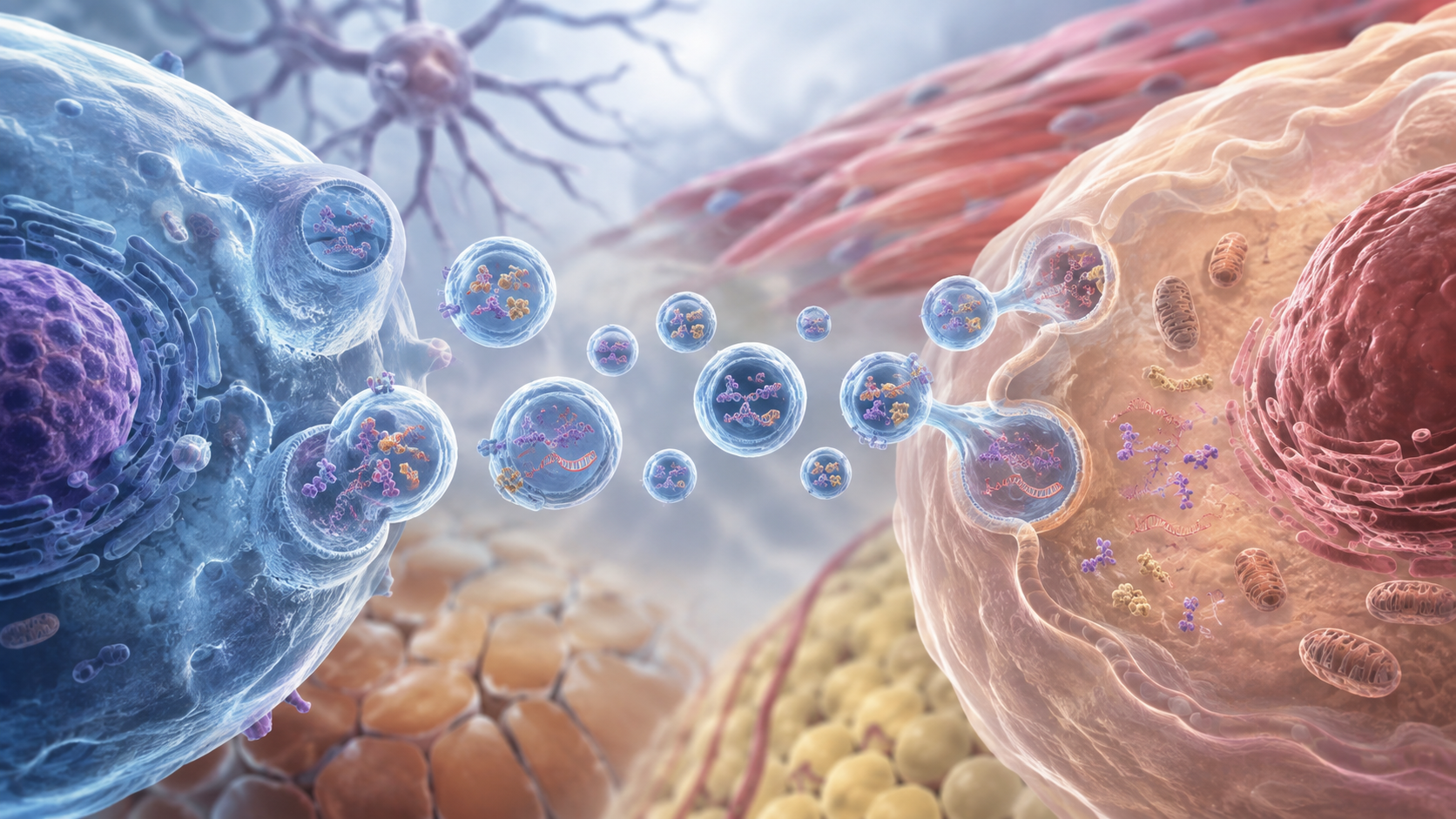
Extracellular vesicles are microscopic parcels released by cells. They carry proteins, lipids and genetic material through blood and tissue, allowing one cell to influence another without direct contact. That makes extracellular vesicles aging biomarkers an appealing idea: instead of measuring only a static blood concentration, researchers may be able to sample messages moving between tissues.
The concept is promising, but it is still a research field rather than a finished clinical product. Vesicles are difficult to isolate consistently, their cargo changes quickly, and a signal associated with age is not automatically a cause of aging.
What extracellular vesicles are
The term covers several membrane-bound particles. Small extracellular vesicles, often described as exosomes when their cellular origin is demonstrated, are typically tens to hundreds of nanometers across. Larger microvesicles bud directly from the cell membrane. Apoptotic bodies form when cells break down.
These categories overlap in size and composition. In practice, many studies responsibly use the broad term “extracellular vesicle” because routine laboratory methods cannot always prove exactly how a particle formed.
Cargo is the message
Vesicles can contain microRNAs, messenger RNA, enzymes, receptors and signaling lipids. A stressed endothelial cell may release a different package than a resting muscle cell. Immune cells can send signals that amplify or dampen inflammation. Senescent cells can alter neighboring tissue through soluble factors and vesicle cargo.
That flexibility is precisely why the particles are interesting—and why they are hard to interpret. A blood sample contains vesicles from many organs. Separating source, destination and biological effect remains a major analytical challenge.
How aging may change the vesicle network
Age-related inflammation, mitochondrial stress, altered nutrient sensing and cellular senescence can all influence vesicle release. Researchers have reported changes in vesicle abundance, membrane markers and RNA cargo with age. Some vesicles may propagate damaging signals; others may support repair.
This is not a simple “more is worse” system. The same molecular family can have different effects depending on dose, tissue and timing. A repair signal after exercise may be beneficial, while persistent inflammatory signaling in chronic disease may not be.
Senescent cells and neighborhood effects
Senescent cells stop dividing but remain metabolically active. Their secretory output can reshape nearby immune cells, fibroblasts and blood vessels. Extracellular vesicles appear to be one component of this broader senescence-associated secretory phenotype.
The implication is important: an aging tissue may change not only because individual cells accumulate damage, but because communication between cells becomes distorted. A vesicle profile could therefore reflect network-level dysfunction that a single conventional biomarker misses.
What key research shows
A 2021 study by Xiao and colleagues in Signal Transduction and Targeted Therapy reported that small vesicles derived from mesenchymal stem cells reduced oxidative-stress-induced senescence in cultured endothelial cells through a microRNA-linked pathway. This supports a mechanism, but cell-culture results do not establish clinical benefit in people.
A 2022 review by Yin and colleagues examined tissue-derived vesicles in osteoarthritis research. It highlighted both diagnostic potential and substantial manufacturing and standardization barriers. A 2024 review by Wang and colleagues similarly described a two-way relationship between bone aging and extracellular vesicle signaling.
Together, these studies suggest that vesicles can carry biologically active information relevant to aging tissues. They do not show that a commercial vesicle panel can accurately forecast lifespan or that vesicle therapy is ready for routine use.
Why measurement remains difficult
Collection tubes, processing delays, centrifugation protocols and storage temperature can change results. Platelets can release particles during handling. Lipoproteins overlap with vesicles in size and can contaminate preparations. Different labs may measure particle count, surface proteins or selected RNA cargo and call each one an “EV biomarker.”
Large reference cohorts are also scarce. Age correlates with medication use, chronic disease, body composition and kidney function, all of which may influence circulating particles. A useful aging marker must add information beyond those ordinary clinical variables.
Practical implications
For readers, the most useful takeaway is caution. Extracellular-vesicle research may eventually improve liquid biopsies, help identify tissue stress or monitor response to an intervention. Today, standard health measures—blood pressure, lipid profile, glucose regulation, fitness, sleep and smoking status—have clearer clinical interpretation.
Be skeptical of services that convert an experimental vesicle measurement into a precise “years younger” score without publishing validation data, repeatability and reference ranges. Ask what particles were measured, how samples were processed, whether the result has been replicated independently and whether it changes a medical decision.
Limitations and future research
The field needs agreed terminology, standardized isolation methods, organ-specific markers and longitudinal studies. Researchers must distinguish a marker that tracks aging from a signal that actively drives it. Therapeutic studies will also need to address dosing, tissue targeting, immune effects and manufacturing consistency.
Multi-omics approaches may help. Combining vesicle cargo with proteomics, routine laboratory data and functional measures could prove more informative than any single particle count. That possibility remains to be tested prospectively.
The bottom line
Extracellular vesicles offer a fascinating view of how aging cells communicate, and their cargo may eventually contribute to useful biomarkers. For now, they are best understood as a rapidly developing research platform—not a validated biological clock or a ready-made anti-aging therapy.
Frequently Asked Questions
Are extracellular vesicles proven biological age tests?
What do extracellular vesicles carry?
Can lifestyle changes alter extracellular vesicles?
Sources
Stay Updated on Longevity Science
Weekly research digests. No spam, unsubscribe anytime.
Related Articles

Ankle Power and Healthy Aging: The Push-Off That Keeps Walking Efficient
Ankle plantar-flexor power supports walking speed and balance recovery. Learn why push-off changes with age and how strength can be trained safely.
9 min read
Arterial Calcification and Vascular Aging: Reading the Risk Signals
Arterial calcification can reveal accumulated vascular risk. Learn what calcium scores mean, why calcification develops, and where testing has limits.
10 min read
Arterial Stiffness and Vascular Age: A Longevity Evidence Guide
Understand arterial stiffness vascular age longevity links, key studies, measurement limits, and evidence-based lifestyle implications for healthy aging.
11 min read