Exercise, Mitophagy, and Aging Muscle: A Quality-Control View
Exercise may tune mitochondrial recycling in aging muscle, but mitophagy is a dynamic process—not a score consumers can reliably optimize at home.
Table of Contents
DISCLAIMER
This article is for informational purposes only and does not constitute medical advice. The statements in this article have not been evaluated by the FDA. The information presented is based on published research and should not be used as a substitute for professional medical guidance. Consult your physician before starting any supplement or health protocol.
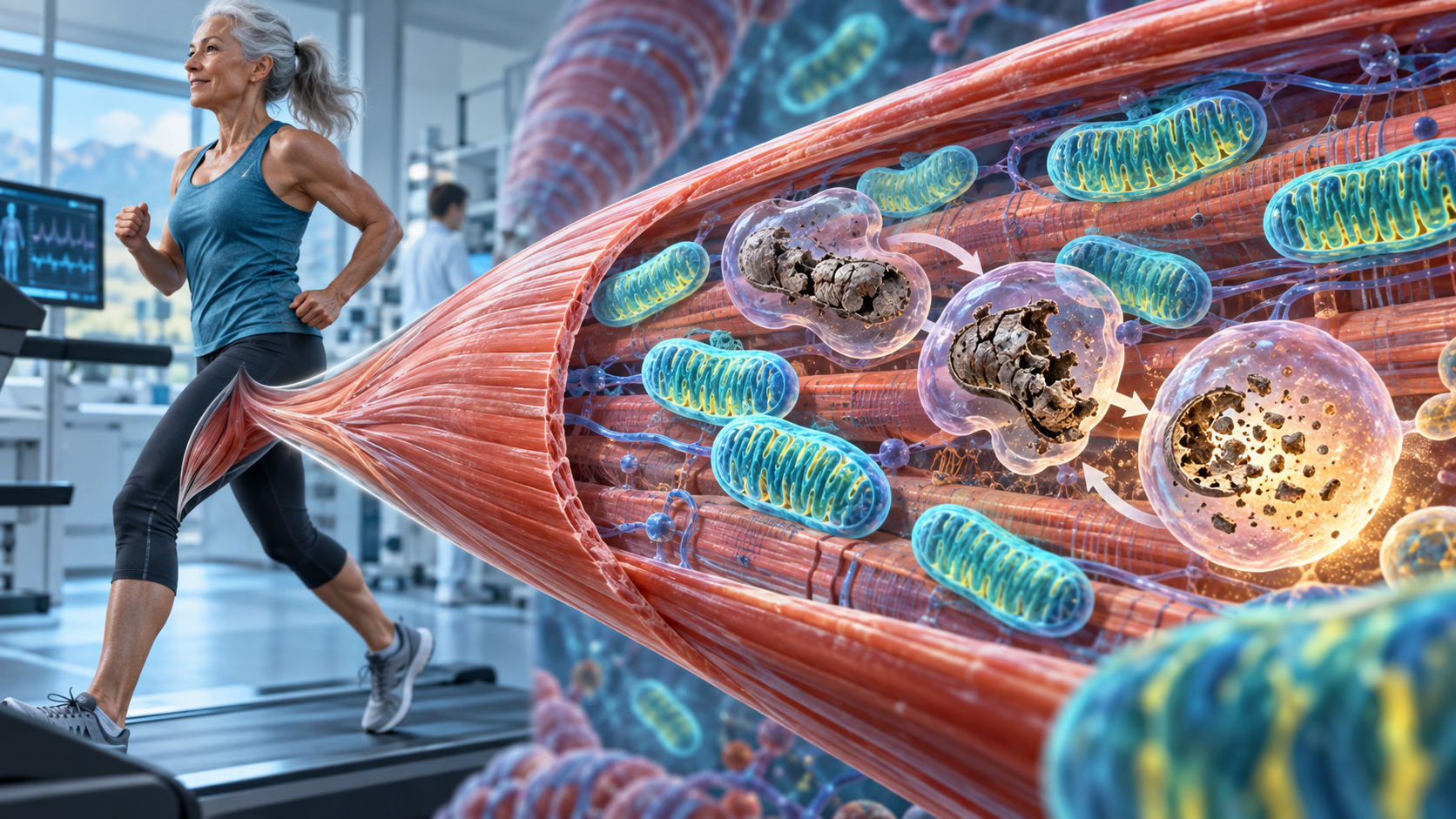
Mitochondria supply much of the energy required for muscle contraction. They also generate signals, manage metabolites, and respond to mechanical and metabolic stress. Because damaged mitochondria can impair a cell, muscle maintains a quality-control system that repairs, reshapes, replaces, or removes them.
Mitophagy is the selective recycling of mitochondria through the autophagy-lysosome system. A 2026 review argues that exercise acts as a context-dependent regulator of this process in aging muscle. That is more useful than the common slogan that exercise simply “boosts mitochondrial cleanup.”
Mitophagy is a flow, not a pile
Scientists distinguish the number of mitophagy-related structures visible at one moment from mitophagic flux, the rate at which material moves through the whole pathway. A traffic jam can put more cars on a road without increasing arrivals. Likewise, accumulated autophagosomes may indicate greater initiation, slower lysosomal completion, or both.
Healthy mitochondrial turnover also requires replacement. Biogenesis produces and expands the mitochondrial network, while fusion, fission, and mitophagy remodel it. Removing damaged components without restoring capacity would not create resilient muscle.
This is why a single protein measurement rarely tells the full story. Markers such as PINK1, Parkin, LC3, or p62 can be informative in experiments, but their interpretation depends on timing, tissue sampling, and whether researchers measure the pathway before and after blocking degradation.
What changes with age
Aging muscle often shows reduced mitochondrial efficiency, altered redox signaling, changes in dynamics, and constraints in lysosomal function. The 2026 review describes the exercise response as delayed, heterogeneous, and nonlinear rather than uniformly switched off.
Different muscle fibers can respond differently. Training status, nutrition, disease, medications, and the interval since the last exercise bout also shape measurements. Two people of the same age may therefore have very different quality-control capacity.
That variability makes mitophagy a poor direct “biological age” score today. A biopsy is invasive, blood does not necessarily represent skeletal muscle, and consumer devices measure external outputs such as heart rate, speed, or power—not organelle turnover.
Why exercise can help the system adapt
Exercise temporarily changes cellular energy demand, calcium signaling, oxygen use, and redox balance. In a recoverable dose, these disturbances trigger adaptation. Damaged components can be removed, antioxidant systems can be recalibrated, and mitochondrial biogenesis can support future work.
Aerobic exercise creates repeated energy demand across many contractions. Resistance exercise adds high mechanical tension and supports the muscle mass and strength needed for independence. Interval patterns create a different pulse of stress than continuous work. The molecular responses overlap but are not identical.
The key word is recoverable. Chronic illness, under-fueling, inadequate sleep, or exercise far beyond current capacity can turn a useful signal into excessive stress. Mitophagy should not be treated as a reason to chase exhaustion.
What the evidence does and does not prove
The new review integrates mechanistic and physiological studies; it is not a large clinical trial showing that one training schedule improves human longevity through mitophagy. Much of the detailed pathway evidence comes from cells, rodents, or muscle biopsies collected under controlled conditions.
Exercise itself has strong human evidence for fitness, strength, metabolic health, and function. The uncertainty concerns how much of each benefit is specifically mediated by mitophagy and how to personalize training through that pathway.
Claims that a fasting window, supplement, or workout “activates mitophagy by 300 percent” deserve scrutiny unless they identify the tissue, method, time point, comparator, and endpoint. Molecular activation is not the same as better mobility or fewer clinical events.
A practical interpretation
Adults can use established activity guidance without waiting for a mitophagy test. A mix of aerobic movement and muscle strengthening, progressed gradually, addresses outcomes that matter now. Older adults also benefit from balance work and from reducing long periods of inactivity.
People with cardiovascular, metabolic, neurological, or orthopedic conditions may need individualized advice. Pain, chest symptoms, fainting, or unusual breathlessness should not be interpreted as evidence that a cellular pathway is “detoxing.”
Recovery supports adaptation. Adequate food, protein, sleep, and spacing between hard sessions are part of the training signal. They do not guarantee a particular mitophagy response, but they help the body complete the repair process that exercise initiates.
Bottom line
Mitophagy is one component of a larger mitochondrial quality-control network. Aging can alter its timing and capacity, while exercise provides a scalable way to challenge and renew muscle systems. The useful message is not to maximize mitophagy at all times. It is to create repeated, tolerable stress followed by recovery so that removal and rebuilding remain coordinated.
For now, strength, endurance, walking capacity, and everyday function are more actionable measures than an inferred mitochondrial-cleanup score.
Frequently Asked Questions
Does more mitophagy always mean healthier muscle?
Can a wearable measure mitophagy?
What exercise is best for mitophagy?
Sources
Stay Updated on Longevity Science
Weekly research digests. No spam, unsubscribe anytime.
Related Articles

Ankle Power and Healthy Aging: The Push-Off That Keeps Walking Efficient
Ankle plantar-flexor power supports walking speed and balance recovery. Learn why push-off changes with age and how strength can be trained safely.
9 min read
Arterial Calcification and Vascular Aging: Reading the Risk Signals
Arterial calcification can reveal accumulated vascular risk. Learn what calcium scores mean, why calcification develops, and where testing has limits.
10 min read
Arterial Stiffness and Vascular Age: A Longevity Evidence Guide
Understand arterial stiffness vascular age longevity links, key studies, measurement limits, and evidence-based lifestyle implications for healthy aging.
11 min read