Endothelial Glycocalyx and Vascular Aging: The Artery's Fragile Shield
The endothelial glycocalyx helps vessels sense flow and limit unwanted adhesion. Learn how aging may change this fragile layer and what evidence can—and cannot—show.
Table of Contents
DISCLAIMER
This article is for informational purposes only and does not constitute medical advice. The statements in this article have not been evaluated by the FDA. The information presented is based on published research and should not be used as a substitute for professional medical guidance. Consult your physician before starting any supplement or health protocol.
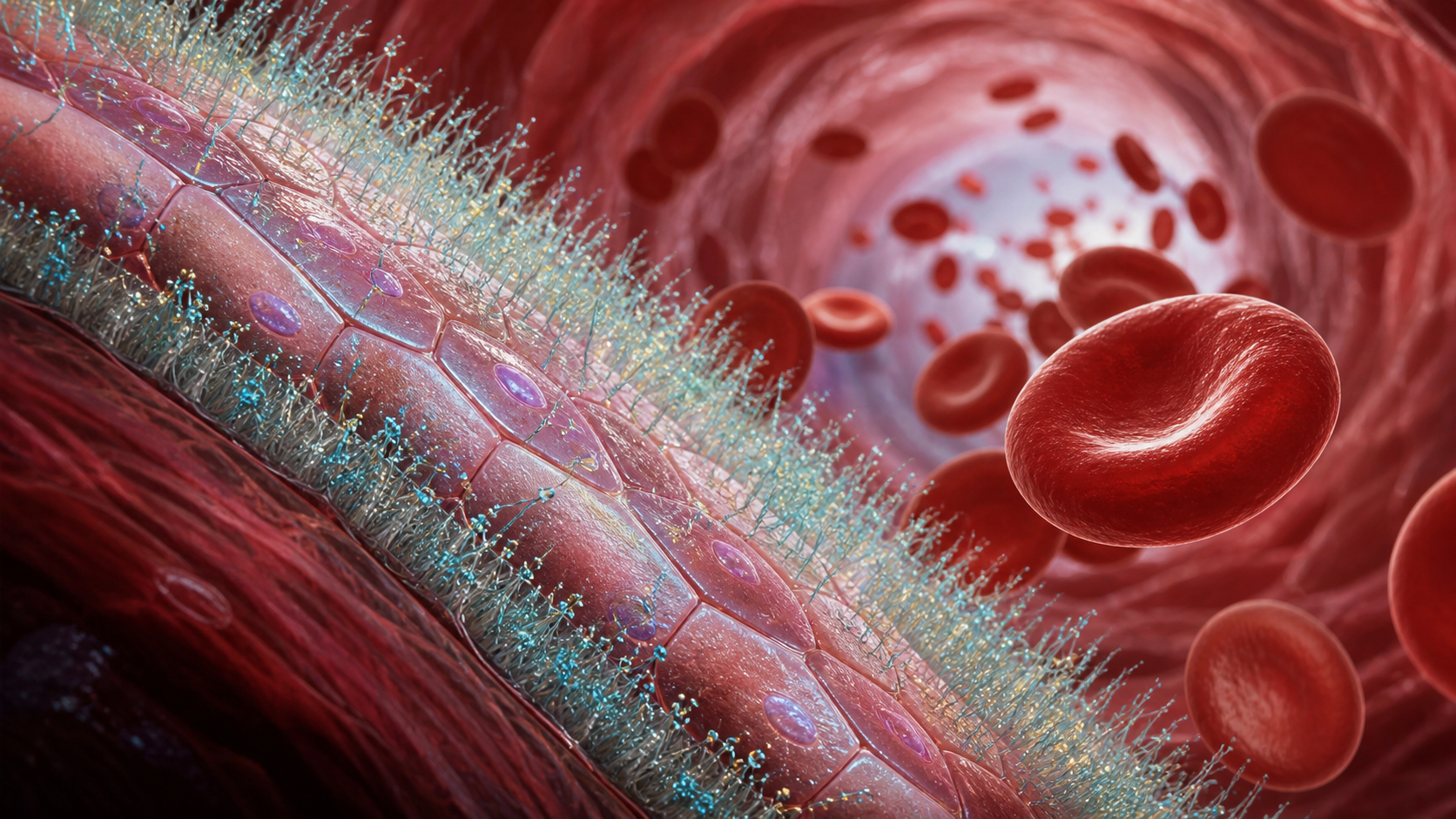
The inside of an artery is not a bare pipe. A thin, hydrated layer of sugars, proteins, and absorbed plasma components covers the endothelial cells that face the bloodstream. This structure, the endothelial glycocalyx, is difficult to preserve and even harder to measure, yet it may help explain how vessels translate blood flow into biological signals.
Interest in the glycocalyx has grown because vascular aging involves more than plaque or blood pressure. Endothelial cells also change how they sense shear stress, regulate permeability, release nitric oxide, and interact with platelets and immune cells. Research suggests that an altered glycocalyx may participate in several of these shifts, but it is not a single cause or a consumer-ready aging score.
What the Glycocalyx Does
The glycocalyx is assembled from membrane-bound proteoglycans and glycoproteins, including syndecans and glypicans, plus long carbohydrate chains such as heparan sulfate and hyaluronan. Soluble proteins from plasma become part of the functional layer. The result behaves less like a rigid coating and more like a responsive, water-rich forest.
One job is mechanosensing. As blood moves along the vessel wall, shear forces bend and compress components of the glycocalyx. These forces can be transmitted to endothelial signaling pathways involved in nitric-oxide production and vascular tone. A healthy response helps a vessel adapt to changing flow.
The layer also contributes to selective permeability. It influences how water, proteins, and other molecules approach the endothelial surface. It can reduce direct contact between circulating cells and adhesion molecules on the vessel wall. When the layer becomes thinner or disorganized, inflammatory cells and platelets may gain easier access to the endothelium.
These functions overlap. Flow sensing influences nitric oxide; nitric oxide influences vessel relaxation and platelet behavior; inflammation can promote enzymatic shedding of glycocalyx components. The system is a network, not a one-way switch.
How Aging May Change the Layer
Human aging studies are technically challenging because the glycocalyx cannot be sampled like cholesterol. Researchers use microscopy in accessible microvessels, blood markers of shed components, experimental vascular preparations, and mathematical estimates of the space that red blood cells do not penetrate. Each method captures a different part of the biology.
Across experimental and clinical research, older age is often associated with poorer endothelial function, more oxidative stress, chronic low-grade inflammation, and reduced nitric-oxide availability. All four may affect glycocalyx maintenance. Reactive oxygen species can alter its components. Inflammatory enzymes can cleave carbohydrate chains or membrane anchors. Metabolic dysfunction may change synthesis and repair.
However, age rarely acts alone. Smoking, high glucose, hypertension, kidney disease, acute infection, and major surgery have all been studied in relation to glycocalyx disruption. An observation in one of these settings cannot automatically be generalized to healthy adults. A circulating fragment may indicate shedding, but its concentration also depends on clearance, tissue source, and timing.
The layer can also change quickly. Meals, exercise, illness, and fluid shifts may alter vascular conditions over hours. That responsiveness is biologically useful, but it complicates claims that one measurement reveals a person’s long-term vascular age.
What the Evidence Means in Practice
There is no routine clinical test that can tell an individual whether the glycocalyx is “young” or “old.” Sublingual imaging systems are used in research and selected clinical settings, but results depend on acquisition quality and analytical assumptions. They should not replace established cardiovascular assessment.
The practical implications remain familiar because the glycocalyx sits inside broader vascular biology. Patterns associated with healthier blood pressure, glucose regulation, lipid levels, physical activity, sleep, and smoking avoidance also support endothelial health generally. That does not prove that a specific habit rebuilds a precise number of micrometers of glycocalyx.
Exercise illustrates the nuance. Regular aerobic activity is associated with better endothelial function in many populations, partly through repeated shear-stress signaling. Yet a single intense bout can temporarily change oxidative and inflammatory markers. Training status, recovery, medication, and disease context matter.
Commercial products sometimes promise glycocalyx “repair” using proprietary blends. Human outcome evidence is not yet strong enough to treat such claims as established healthy-aging practice. A change in a surrogate marker is not the same as fewer heart attacks, preserved mobility, or longer life.
The endothelial glycocalyx is best understood as a fragile interface where blood flow meets living tissue. Its study expands vascular aging beyond the idea of clogged pipes and highlights the importance of barrier integrity, signaling, and inflammation. For now, it is a compelling research target—not a diagnosis, a longevity guarantee, or a shortcut around conventional cardiovascular care.
Frequently Asked Questions
What is the endothelial glycocalyx?
Does glycocalyx damage prove accelerated aging?
Can a supplement rebuild the glycocalyx?
Sources
Stay Updated on Longevity Science
Weekly research digests. No spam, unsubscribe anytime.
Related Articles

Ankle Power and Healthy Aging: The Push-Off That Keeps Walking Efficient
Ankle plantar-flexor power supports walking speed and balance recovery. Learn why push-off changes with age and how strength can be trained safely.
9 min read
Arterial Calcification and Vascular Aging: Reading the Risk Signals
Arterial calcification can reveal accumulated vascular risk. Learn what calcium scores mean, why calcification develops, and where testing has limits.
10 min read
Arterial Stiffness and Vascular Age: A Longevity Evidence Guide
Understand arterial stiffness vascular age longevity links, key studies, measurement limits, and evidence-based lifestyle implications for healthy aging.
11 min read