Baroreflex Sensitivity and Aging: How the Body Buffers Blood Pressure Changes
The arterial baroreflex helps stabilize circulation from beat to beat. Learn how aging can alter cardiovagal sensitivity and why one score is not a diagnosis.
Table of Contents
DISCLAIMER
This article is for informational purposes only and does not constitute medical advice. The statements in this article have not been evaluated by the FDA. The information presented is based on published research and should not be used as a substitute for professional medical guidance. Consult your physician before starting any supplement or health protocol.
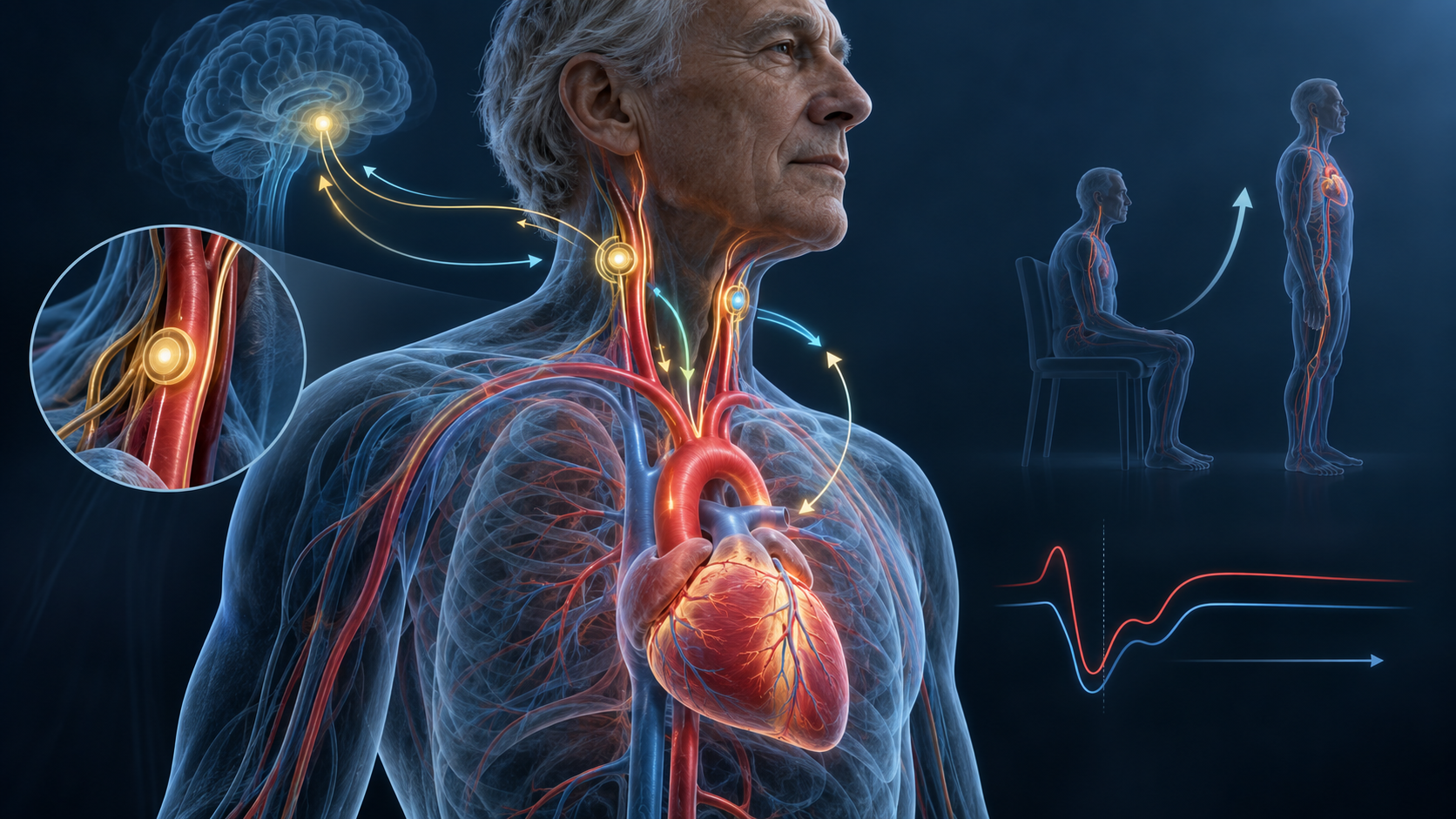
Standing pulls blood toward the legs. A meal redistributes circulation. Exercise and emotion change heart rate and vascular tone. The body handles these shifts partly through the arterial baroreflex, a rapid feedback system that senses stretch in major arteries and adjusts the heart and blood vessels.
Research generally finds lower cardiovagal baroreflex sensitivity with age. That statement is real but incomplete. Different branches of the reflex can change differently, laboratory methods are not interchangeable, and a low value is not a stand-alone diagnosis of “autonomic age.”
How the reflex works
Stretch-sensitive endings near the carotid sinus and aortic arch respond when arterial pressure changes. Signals travel to brainstem circuits that alter parasympathetic and sympathetic output. When pressure rises, the reflex can slow the heart and reduce vascular drive. When pressure falls, it can support heart rate, cardiac output, and vessel constriction.
Researchers often focus on the relationship between blood-pressure changes and the interval between heartbeats. A larger, appropriately directed heart-period response is described as greater cardiovagal baroreflex sensitivity. The vascular sympathetic branch is related but not identical.
The reflex does not set blood pressure by itself. Kidneys, hormones, arterial stiffness, blood volume, medications, temperature, and behavior also matter. During sustained hypertension, the reflex can operate around a higher pressure rather than simply switching off.
Why sensitivity may change with age
Arteries commonly stiffen with age and cardiometabolic disease. For the same pressure change, a stiffer carotid or aortic wall may stretch less, reducing the mechanical input reaching baroreceptors. Changes in central processing, oxidative stress, vagal control, and physical fitness may also contribute.
A widely cited human review concluded that aging is associated with reduced cardiovagal sensitivity. Mechanistic experiments, however, indicate that the decline cannot always be blamed on failure of the outgoing autonomic nerves. The limitation may lie in mechanical transduction, incoming sensory information, central integration, or a combination.
This matters because two people with the same resting blood pressure can have different dynamic responses. It also prevents the common mistake of treating heart-rate variability as a direct substitute. HRV and baroreflex sensitivity overlap in autonomic physiology, but they are not the same measure.
How it is measured
Research methods include drug-induced pressure changes, neck suction or pressure, the Valsalva maneuver, controlled breathing, and sequence or spectral analysis of spontaneous beat-to-beat fluctuations. Results depend on posture, breathing, time of day, medications, recent food, and the calculation chosen.
The most informative tests use synchronized beat-to-beat blood pressure and electrocardiographic or accurate pulse timing. A home cuff that records one value every minute cannot capture the same relationship. Consumer wearables may provide useful heart-rate trends, but most do not directly measure arterial pressure continuously or validate a baroreflex metric for clinical decisions.
Clinical interpretation belongs in context. Dizziness after standing can arise from dehydration, medication, arrhythmia, anemia, vestibular disease, or autonomic failure. A research-grade reflex score cannot replace a history, examination, and appropriate cardiovascular testing.
Associations with health outcomes
Lower sensitivity has been linked with hypertension, cardiovascular risk, and adverse outcomes in several populations. A 2024 study also reported an association between impaired sensitivity and long-term dementia risk in older adults, suggesting that dynamic blood-pressure regulation may add information beyond clinic pressure alone.
That association does not show that raising one reflex score prevents dementia. Vascular stiffness, diabetes, inflammation, activity, sleep, and medication may influence both circulation and cognition. Replication and intervention trials are needed before the metric becomes a prevention target.
The useful interpretation is modest: unstable or poorly buffered circulation may be one part of the pathway connecting vascular health with brain health.
Can lifestyle change the reflex?
Aerobic training and habitual physical activity are associated with better cardiovagal sensitivity in some older cohorts. A 2019 study found that older adults meeting activity guidelines had greater sensitivity at rest and during a Valsalva maneuver than less-active peers, independent of measured aerobic fitness and sedentary time.
Association is not proof that the guideline alone caused the difference. Still, regular walking, cycling, swimming, or other appropriate aerobic exercise already has strong evidence for cardiovascular function. Resistance training, hydration appropriate to medical status, gradual position changes, and management of diabetes or hypertension support the broader system.
People taking blood-pressure drugs should not alter doses to chase a wearable pattern. Recurrent fainting, chest pain, sudden neurological symptoms, or severe postural dizziness requires medical evaluation.
Bottom line
The baroreflex is a fast pressure-buffering network, not a simple anti-aging switch. Cardiovagal sensitivity often declines with age, partly alongside vascular stiffening and changes in autonomic regulation. The measure is scientifically useful, but methods vary and consumer devices do not make it a reliable biological-age score. Protecting vascular health and staying physically active are more defensible goals than optimizing one inferred number.
Frequently Asked Questions
Is baroreflex sensitivity the same as blood pressure?
Can a smartwatch measure baroreflex sensitivity?
Does low sensitivity cause dementia?
Sources
Stay Updated on Longevity Science
Weekly research digests. No spam, unsubscribe anytime.
Related Articles

Ankle Power and Healthy Aging: The Push-Off That Keeps Walking Efficient
Ankle plantar-flexor power supports walking speed and balance recovery. Learn why push-off changes with age and how strength can be trained safely.
9 min read
Arterial Calcification and Vascular Aging: Reading the Risk Signals
Arterial calcification can reveal accumulated vascular risk. Learn what calcium scores mean, why calcification develops, and where testing has limits.
10 min read
Arterial Stiffness and Vascular Age: A Longevity Evidence Guide
Understand arterial stiffness vascular age longevity links, key studies, measurement limits, and evidence-based lifestyle implications for healthy aging.
11 min read