Autophagy and Aging: What Human Evidence Can Actually Tell Us
Autophagy is essential cellular recycling, but higher activity is not automatically better. Here is how researchers measure it and what human studies can support.
Table of Contents
DISCLAIMER
This article is for informational purposes only and does not constitute medical advice. The statements in this article have not been evaluated by the FDA. The information presented is based on published research and should not be used as a substitute for professional medical guidance. Consult your physician before starting any supplement or health protocol.
Autophagy is often described as the cell’s recycling program. That analogy is useful, but it becomes misleading when it turns into the claim that a fast, food, or supplement can simply “switch on cleanup” and reverse aging.
The biology is more demanding. Cells must identify material, wrap it in a membrane, deliver it to a lysosome, break it down, and reuse or dispose of the components. Autophagy and aging are connected because this traffic-and-clearance system helps cells survive stress and maintain quality. The connection does not make maximum autophagy a universal goal.
What autophagy actually does
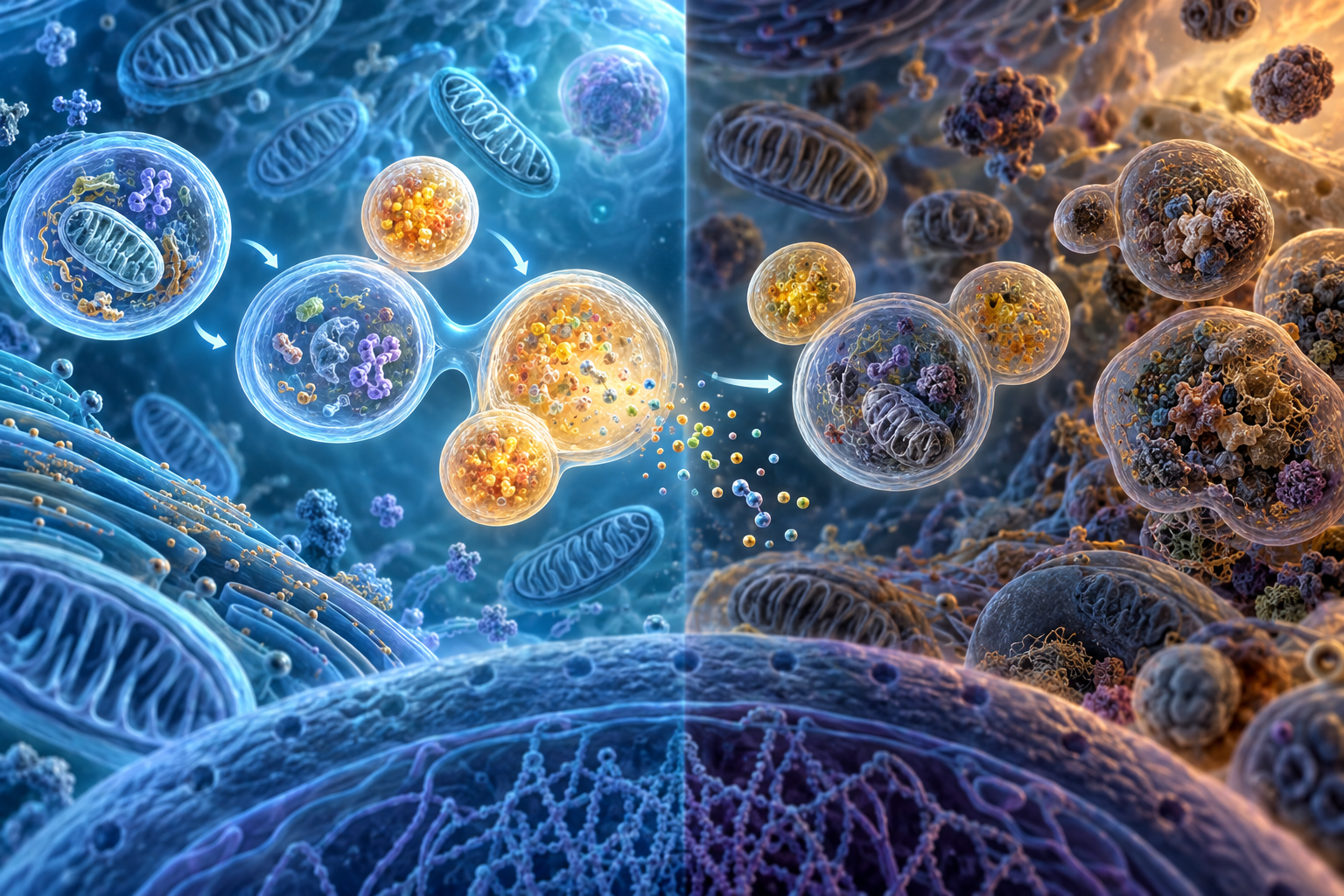
Macroautophagy—the form usually meant by “autophagy”—builds a double-membrane structure around selected cellular material. The resulting autophagosome fuses with a lysosome, whose enzymes degrade the cargo. Related systems include microautophagy and chaperone-mediated autophagy.
Cargo can include damaged proteins, lipid droplets, invading microbes, or whole organelles. Mitophagy is the selective removal of mitochondria. Other selective pathways target parts of the endoplasmic reticulum, ribosomes, or peroxisomes.
This is not indiscriminate demolition. Cells use receptors, tags, and signaling networks to decide what is collected and when. The products—amino acids, fatty acids, sugars, and nucleotides—can return to metabolism.
Yoshinori Ohsumi’s Nobel-recognized work helped identify core autophagy machinery in yeast. Later studies mapped related genes and pathways in mammals. That history established a fundamental process, not a consumer recipe for manipulating it safely.
Why aging can disrupt the recycling chain
The 2023 update to the hallmarks of aging places disabled macroautophagy among interconnected aging mechanisms. With age, cargo recognition, membrane formation, lysosomal acidity, enzyme activity, and organelle transport can all change. The failure point may differ by tissue.
Long-lived neurons face a particular challenge because damaged components cannot be diluted rapidly through cell division. Muscle must coordinate recycling with growth and repair. Liver cells process nutrients and toxins, while immune cells use autophagy during activation and infection.
Inflammation, mitochondrial dysfunction, altered nutrient sensing, and protein-quality problems can increase the amount of material that needs attention while weakening the systems that handle it. A backlog can therefore reflect both more damage and less clearance.
The measurement problem: snapshots are not flux
Researchers often measure proteins such as LC3 and p62/SQSTM1 or count autophagosomes. None of these observations automatically means that the entire pathway is working faster.
Imagine seeing more delivery trucks on a road. Traffic may be moving more goods, or the trucks may be stuck behind a closed warehouse. In the same way, a rise in autophagosomes can mean increased formation or failed breakdown.
Autophagic flux is the movement of cargo through the full pathway. Laboratory studies may compare measurements before and after temporarily blocking lysosomal degradation. The difference helps distinguish increased throughput from accumulation. The major autophagy assay guidelines emphasize using multiple measurements and interpreting them in context.
Human research is harder. Repeated biopsies are invasive, tissues behave differently, and blood does not provide a direct whole-body readout. A change in one circulating molecule should not be marketed as proof that every organ has undergone cellular renewal.
Exercise, food restriction, and the translation gap
Energy shortage and physical activity can alter AMPK, mTOR, insulin, and other pathways that interact with autophagy. Animal studies show that autophagy is important for adaptation to fasting and exercise. These mechanisms help explain why researchers are interested in meal timing and training.
They do not establish an exact human “autophagy hour.” The time course depends on recent meals, glycogen, activity, tissue, health, medication, and the marker being measured. A claim that autophagy begins at a precise fasting duration usually turns a variable biological response into a timer the evidence cannot support.
Regular exercise has far stronger clinical evidence for cardiovascular, metabolic, musculoskeletal, and functional health than any attempt to optimize an unmeasured autophagy peak. That is a reason to train consistently—not a reason to claim every workout rejuvenates cells.
Food restriction also has tradeoffs. Older adults face a meaningful risk of losing muscle and inadequate nutrition. Long or frequent fasts may be inappropriate for people who are pregnant, underweight, frail, using glucose-lowering medication, or managing an eating disorder. Molecular plausibility cannot replace individual safety.
Why a drug target can work in opposite directions
Autophagy may protect healthy cells by removing damaged material. It can also help established cancer cells survive low nutrients and treatment stress. Some infections exploit parts of the pathway, while immune cells require it for normal function.
The direction of intervention therefore depends on disease stage, tissue, dose, and timing. A therapy might aim to restore lysosomal function, increase clearance of a specific toxic substrate, or inhibit autophagy in a defined tumor context. “Boost autophagy everywhere” is not a precise clinical strategy.
The same caution applies to supplements. An ingredient may change an autophagy-related marker in cultured cells at a concentration that people cannot reach safely. Even a human biomarker shift would need to lead to better function or fewer clinical events before it could support a health claim.
How to read an autophagy headline
Ask five questions:
- Was the experiment conducted in isolated cells, animals, or humans?
- Did it measure one marker or full pathway flux?
- Which tissue and cell type were studied?
- Was the outcome molecular, functional, or clinical?
- Were harms, muscle loss, or disease-specific effects measured?
A study can be valuable while answering only the first steps. A mouse experiment may reveal a mechanism. A short human trial may show that an intervention is feasible and changes a pathway. Neither by itself proves slower aging or longer life.
The practical takeaway
Autophagy is indispensable biology, and impaired autophagic control is a serious part of aging research. The credible near-term message is not that people should chase maximum recycling. It is that cellular maintenance depends on a regulated system whose complete operation is difficult to measure in humans.
Use established health behaviors for their demonstrated benefits: adequate activity, sleep, vaccination, nutrition, and control of cardiovascular risk. Treat claims about “activating autophagy” as hypotheses unless they show tissue-relevant flux, meaningful human outcomes, and safety.
The research frontier is becoming more specific—better biomarkers, targeted delivery, and therapies aimed at defined failures. That specificity is exactly what broad detox language leaves out.
Frequently Asked Questions
Does more autophagy always mean healthier cells?
Can a blood test measure whole-body autophagy?
Does fasting reverse aging through autophagy?
Sources
Stay Updated on Longevity Science
Weekly research digests. No spam, unsubscribe anytime.
Related Articles

Ankle Power and Healthy Aging: The Push-Off That Keeps Walking Efficient
Ankle plantar-flexor power supports walking speed and balance recovery. Learn why push-off changes with age and how strength can be trained safely.
9 min read
Arterial Calcification and Vascular Aging: Reading the Risk Signals
Arterial calcification can reveal accumulated vascular risk. Learn what calcium scores mean, why calcification develops, and where testing has limits.
10 min read
Arterial Stiffness and Vascular Age: A Longevity Evidence Guide
Understand arterial stiffness vascular age longevity links, key studies, measurement limits, and evidence-based lifestyle implications for healthy aging.
11 min read