Muscle Stem Cell Rejuvenation: What Could—and Cannot Yet—Reverse Sarcopenia
Satellite-cell research explains part of age-related muscle decline, while clinical rejuvenation remains experimental. Here is the evidence and practical context.
Table of Contents
DISCLAIMER
This article is for informational purposes only and does not constitute medical advice. The statements in this article have not been evaluated by the FDA. The information presented is based on published research and should not be used as a substitute for professional medical guidance. Consult your physician before starting any supplement or health protocol.
The Problem of Muscle Aging
Sarcopenia, the progressive loss of skeletal muscle mass and function with age, is one of the most impactful aspects of aging. Beginning as early as the fourth decade of life, humans may lose 3 to 8 percent of muscle mass per decade, with the rate accelerating after age 60.
This decline has profound consequences. Reduced muscle mass and strength contribute to falls, fractures, loss of independence, metabolic dysfunction, and increased mortality risk. Sarcopenia affects quality of life more directly than many other aging processes, yet it has historically received less research attention than cardiovascular or neurological aging.
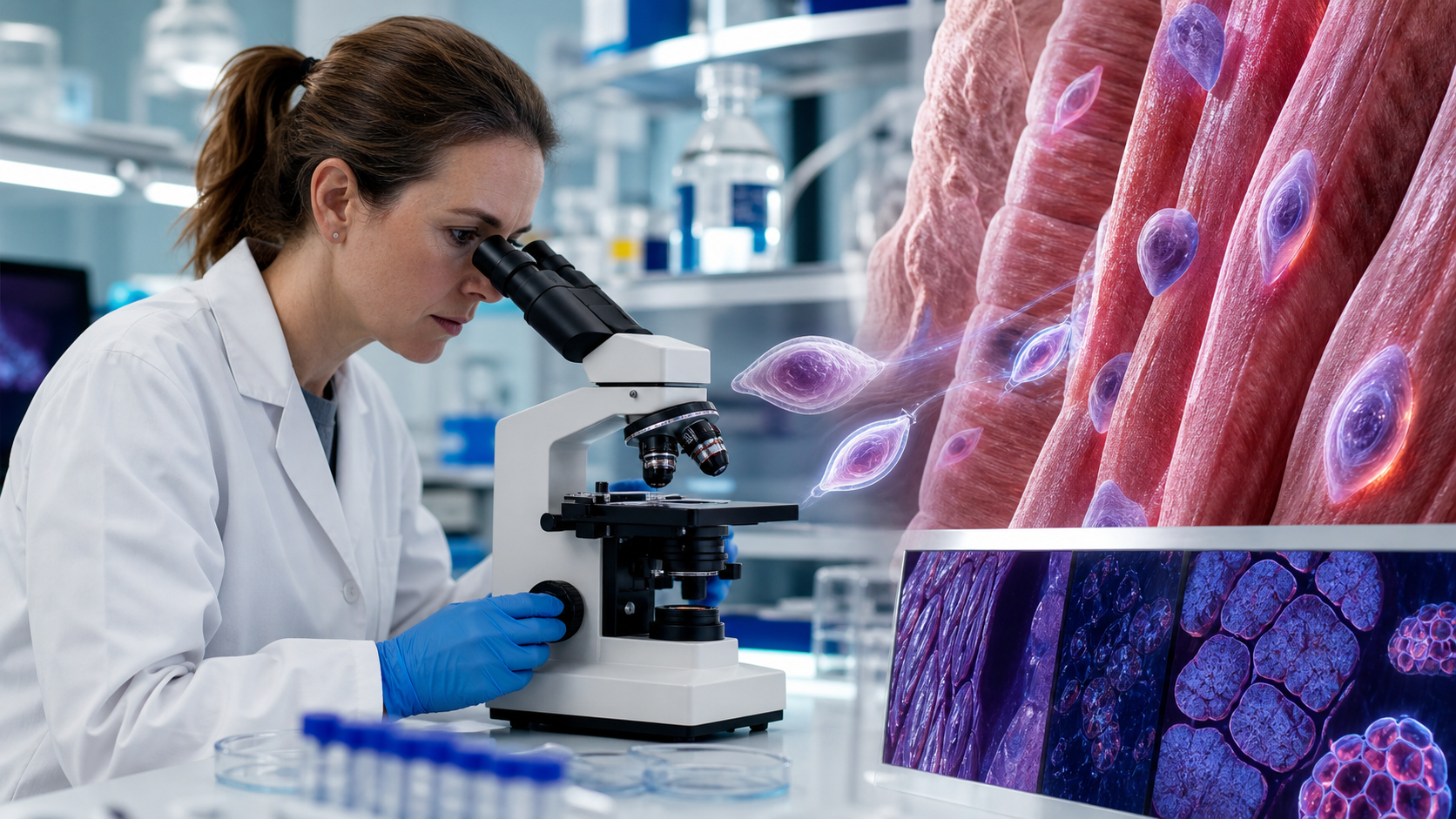
At the cellular level, muscle aging involves multiple interconnected processes. Among the most important is the decline of satellite cells, the resident stem cells responsible for muscle repair and regeneration.
Satellite Cells: The Muscle’s Repair Crew
What Are Satellite Cells?
Satellite cells are a population of undifferentiated muscle progenitor cells that reside between the sarcolemma (muscle cell membrane) and the basal lamina of muscle fibers. In healthy young muscle, these cells exist in a quiescent state, activated only when muscle damage occurs and repair is needed.
When activated by injury or mechanical stress, satellite cells undergo a carefully orchestrated process:
- Activation: Quiescent satellite cells are stimulated by damage signals and growth factors.
- Proliferation: Activated cells divide to produce a pool of myogenic progenitor cells.
- Differentiation: Most daughter cells differentiate into myoblasts that fuse with existing muscle fibers or form new fibers.
- Self-renewal: A subset of daughter cells returns to quiescence, replenishing the satellite cell pool for future repair.
This balance between differentiation and self-renewal is critical for maintaining muscle regenerative capacity throughout life.
Age-Related Satellite Cell Decline
A 2015 review published in Trends in Molecular Medicine detailed how satellite cells are affected by aging:
- Reduced numbers: The absolute number of satellite cells decreases with age in both humans and animal models.
- Impaired quiescence: Aged satellite cells may lose the ability to maintain proper quiescence, leading to premature activation and exhaustion.
- Reduced proliferative capacity: When activated, aged satellite cells divide less efficiently and produce fewer daughter cells.
- Skewed differentiation: Aged satellite cells may increasingly undergo fibrogenic (scar-forming) rather than myogenic (muscle-forming) conversion.
- Diminished self-renewal: The ability of aged satellite cells to replenish their own population is compromised.
The Stem Cell Niche Problem
It Is Not Just the Cells
One of the most important insights from satellite cell aging research is that the decline in stem cell function is not solely due to intrinsic changes in the stem cells themselves. The environment in which satellite cells reside, their niche, undergoes age-related changes that profoundly affect stem cell behavior.
A 2014 study in Nature Medicine demonstrated that aged satellite cells could be functionally rejuvenated when exposed to a young environment. This finding, echoing results from parabiosis experiments, suggested that the aged niche may actively suppress satellite cell function.
Niche Changes With Age
The satellite cell niche undergoes several age-related alterations:
- Increased fibrosis: Aged muscle accumulates fibrous tissue that may physically and biochemically alter the satellite cell environment.
- Altered signaling: Changes in Wnt, Notch, and FGF signaling pathways in the niche may impair satellite cell activation and self-renewal.
- Inflammatory environment: Chronic low-grade inflammation in aged muscle may create a hostile environment for satellite cell function.
- Reduced vascularization: Decreased capillary density in aged muscle may limit nutrient and oxygen delivery to the satellite cell niche.
- Senescent cell accumulation: Senescent cells in aged muscle secrete factors that may impair satellite cell function.
Approaches to Satellite Cell Rejuvenation
NAD+ Restoration
Research has shown that NAD+ levels decline in aged muscle, and this decline may contribute to satellite cell dysfunction. Studies in mice have demonstrated that supplementation with NAD+ precursors like NMN may improve satellite cell function by:
- Restoring mitochondrial function in satellite cells
- Enhancing SIRT1-dependent metabolic regulation
- Improving satellite cell self-renewal capacity
- Reducing DNA damage accumulation
These findings have generated interest in NAD+ supplementation as a potential strategy for maintaining muscle regenerative capacity during aging, though human clinical data specific to satellite cell function remain limited.
Senolytic Approaches
The accumulation of senescent cells in aged muscle may impair satellite cell function through SASP (senescence-associated secretory phenotype) factors. Research suggests that clearing senescent cells from aged muscle tissue using senolytic compounds may improve satellite cell activation and muscle regeneration.
Animal studies have shown that senolytic treatment may:
- Reduce fibrosis in aged muscle
- Improve satellite cell proliferation
- Enhance muscle regeneration after injury
- Restore some aspects of youthful muscle function
Notch Pathway Modulation
The Notch signaling pathway is critical for satellite cell activation and self-renewal. Research has shown that Notch signaling is reduced in aged satellite cells, contributing to impaired regenerative capacity.
Studies exploring Notch pathway activation in aged muscle have shown improvements in satellite cell function and muscle regeneration. However, systemic Notch activation carries risks, as aberrant Notch signaling is associated with certain cancers. Targeted approaches to restore Notch signaling specifically in satellite cells are being investigated.
Wnt Pathway Balance
The Wnt signaling pathway plays complex roles in satellite cell biology. While some Wnt signaling is necessary for myogenic differentiation, excessive Wnt activation in aged muscle may drive satellite cells toward fibrogenic rather than myogenic fate.
Research suggests that restoring the balance between canonical and non-canonical Wnt signaling may help redirect aged satellite cells toward muscle formation rather than scar tissue production. Compounds that modulate Wnt signaling are being explored in preclinical studies.
Exercise as Satellite Cell Medicine
Resistance Training Effects
Resistance training is the most well-established intervention for maintaining satellite cell function during aging. Research has consistently shown that resistance exercise:
- Activates quiescent satellite cells, promoting muscle repair and growth
- Increases satellite cell numbers in trained muscles
- Improves satellite cell proliferative capacity
- Enhances myogenic differentiation
A 2015 review in Development emphasized that mechanical loading through exercise remains one of the most potent stimuli for satellite cell activation, potentially counteracting some aspects of age-related decline.
Age Is Not a Barrier
Studies of older adults engaged in resistance training have demonstrated that satellite cells retain significant responsiveness to exercise stimuli even in advanced age. While the magnitude of response may be reduced compared to younger individuals, meaningful improvements in satellite cell number and function have been observed in exercising older adults.
This finding has important practical implications: the satellite cell population in aged muscle is not irreversibly damaged but rather exists in a state of suppression that can be partially relieved through appropriate mechanical stimulation.
Aerobic Exercise Contributions
While resistance training has the most direct effects on satellite cells, aerobic exercise may also contribute to muscle stem cell health through:
- Improved vascularization of the satellite cell niche
- Reduced systemic inflammation
- Enhanced mitochondrial function
- Improved metabolic health of the muscle environment
Evidence Hierarchy and Scientific Disagreement
Cell and mouse studies show that an aged satellite cell can respond differently when its signaling environment is changed. Transplantation, pathway manipulation, and young-circulation experiments help identify mechanisms, but they do not show that a clinic can safely rejuvenate an older person’s muscles. Human studies are strongest for the benefits of progressive resistance exercise and adequate nutrition; evidence for cell transplantation, systemic growth factors, senolytics, NAD+ products, or partial reprogramming remains preliminary.
The field also illustrates why early excitement requires replication. GDF11 was initially reported to improve regeneration in old mice, while later studies questioned assay specificity, circulating levels, and whether higher GDF11 was consistently beneficial. Likewise, satellite-cell number alone does not explain all sarcopenia: motor-neuron loss, inflammation, hormones, vascular supply, mitochondrial function, protein intake, and inactivity all influence strength and mass.
Practical Decision Criteria
For current care, prioritize interventions with human outcome data: progressive resistance training adapted to ability, sufficient dietary protein when medically appropriate, fall-risk assessment, and evaluation of reversible causes of weakness. Experimental products should be judged by randomized human trials that measure strength, mobility, adverse events, and durability—not only a molecular marker or a mouse image. Unregulated stem-cell injections marketed for “rejuvenation” should not be treated as equivalent to a clinical trial.
Emerging Therapeutic Strategies
Satellite Cell Transplantation
Researchers are exploring whether transplanted young or rejuvenated satellite cells can engraft in aged muscle and restore regenerative capacity. While early animal studies have shown promise, significant challenges remain:
- Ensuring sufficient engraftment and survival of transplanted cells
- Achieving functional integration with existing muscle tissue
- Scaling the approach for clinical use
- Demonstrating long-term safety and efficacy
Growth Factor Delivery
Targeted delivery of growth factors that support satellite cell function is being investigated as a less invasive alternative to cell transplantation. Approaches include:
- Local injection of specific growth factors into aged muscle
- Biomaterial-based sustained release systems
- Gene therapy to increase endogenous growth factor production
Epigenetic Reprogramming
Partial epigenetic reprogramming approaches, similar to those being explored for other aging tissues, may have applications for satellite cell rejuvenation. Research suggests that carefully controlled expression of reprogramming factors may restore youthful gene expression patterns in aged satellite cells without losing their muscle identity.
Practical Implications
While therapeutic satellite cell rejuvenation remains largely experimental, current research offers several actionable insights:
- Resistance training is the most accessible and evidence-based approach to supporting satellite cell health during aging. Engaging in regular resistance exercise, ideally 2 to 3 sessions per week, may help maintain muscle regenerative capacity.
- Adequate protein intake provides the raw materials for muscle protein synthesis and may support satellite cell-mediated repair. Research suggests older adults may benefit from higher protein intake than currently recommended.
- Avoiding prolonged inactivity is critical, as extended periods without mechanical loading may accelerate satellite cell decline. Even brief periods of immobilization can significantly reduce satellite cell numbers.
- Sleep optimization matters because growth hormone release during deep sleep may support muscle repair and satellite cell function.
The field of muscle stem cell rejuvenation is advancing rapidly, with new therapeutic candidates entering preclinical and early clinical evaluation. While we await more definitive evidence, the combination of regular exercise, adequate nutrition, and healthy lifestyle practices remains the most reliable approach to maintaining muscle health and function during aging.
Frequently Asked Questions
What are muscle stem cells and why do they matter for aging?
Can exercise rejuvenate muscle stem cells?
What interventions are being studied for muscle stem cell rejuvenation?
Sources
- Muscle stem cell aging: regulation and rejuvenation(2015)
- Rejuvenation of aged muscle stem cells(2014)
- Satellite cell self-renewal and skeletal muscle regeneration(2015)
- The aged niche disrupts muscle stem cell quiescence(2012)
- Rejuvenation of the muscle stem cell population restores strength to injured aged muscles(2014)
- Restoring systemic GDF11 levels reverses age-related dysfunction in mouse skeletal muscle(2014)
Stay Updated on Longevity Science
Weekly research digests. No spam, unsubscribe anytime.
Related Articles

Age Reversal Clinical Trials to Watch in 2026
A comprehensive guide to the most important age reversal clinical trials in 2026, from senolytics to epigenetic reprogramming and beyond.
14 min read
Biological vs Chronological Age: What Really Matters
Understand the crucial difference between biological and chronological age, how biological age is measured, and why it may be a better predictor of health outcomes.
9 min read
Cellular Rejuvenation: Latest Research Findings in 2026
Explore the latest cellular rejuvenation research in 2026, from partial reprogramming to senolytics and mitochondrial restoration strategies.
13 min read