Epigenetic Noise and Aging: A Promising Theory, Not a Proven Cause
Epigenetic information loss may contribute to aging, but most causal evidence comes from models. Here is what is known, disputed, and still experimental.
Table of Contents
DISCLAIMER
This article is for informational purposes only and does not constitute medical advice. The statements in this article have not been evaluated by the FDA. The information presented is based on published research and should not be used as a substitute for professional medical guidance. Consult your physician before starting any supplement or health protocol.
The Information Theory of Aging
Among the many theories proposed to explain why we age, one has gained considerable traction in recent years: the idea that aging is fundamentally a loss of information. Not genetic information encoded in our DNA sequence, which remains remarkably stable throughout life, but epigenetic information, the instructions that tell each cell which genes to turn on and off.
This concept, championed by Dr. David Sinclair of Harvard Medical School and supported by a landmark 2023 study published in Cell, suggests that the accumulation of epigenetic noise, the progressive scrambling of gene regulation patterns, may be a root cause of aging rather than merely a consequence.
If this theory is correct, it reframes aging not as inevitable decay but as a potentially reversible loss of cellular identity information.
Understanding Epigenetic Information
The Epigenome as Software
Every cell in the human body contains essentially the same DNA sequence, roughly 20,000 protein-coding genes. Yet a liver cell is vastly different from a neuron, which is different from a skin cell. The distinction lies in which genes are active in each cell type, and this is controlled by the epigenome.
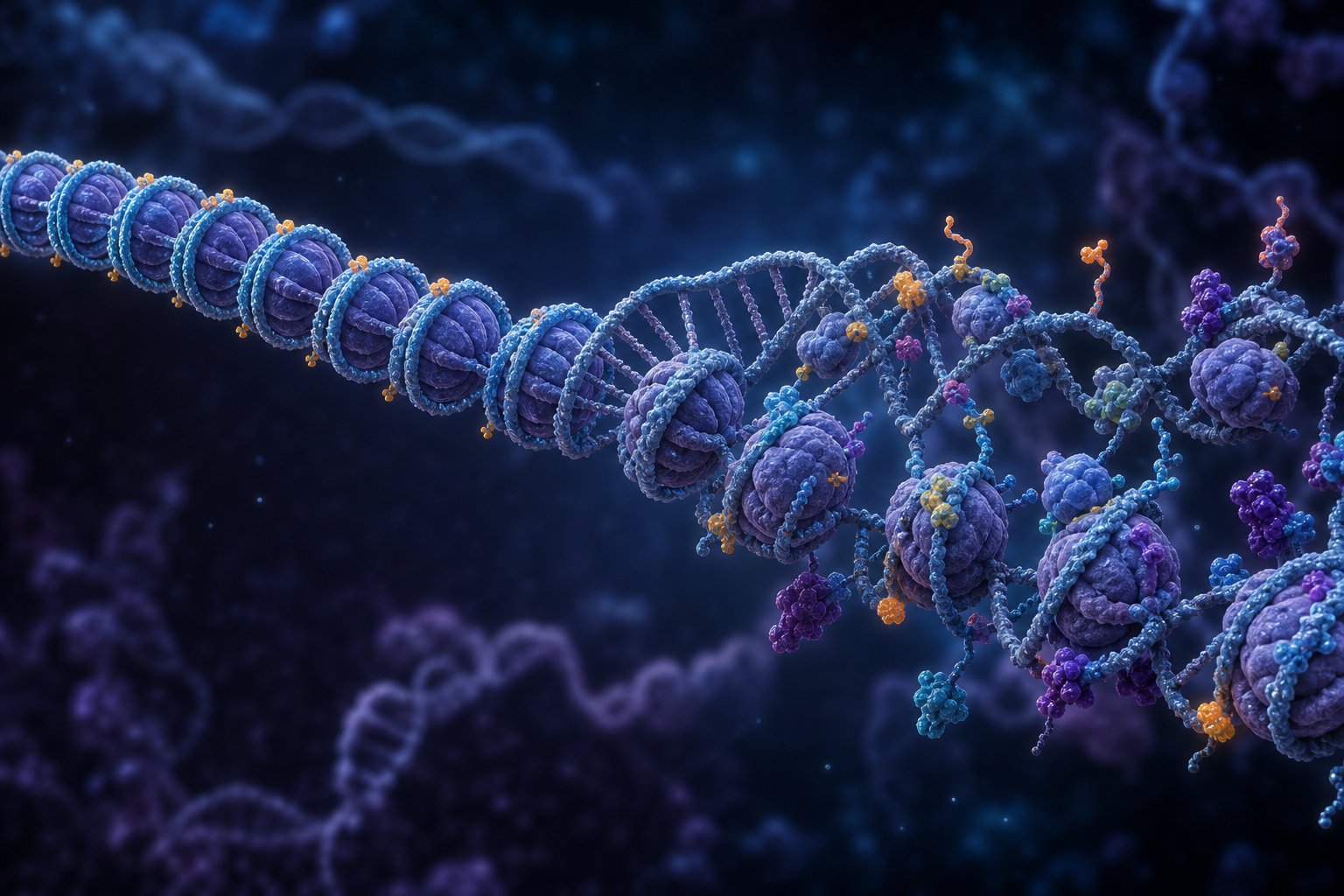
The epigenome consists of chemical modifications to DNA and the histone proteins around which DNA is wrapped. These modifications include:
- DNA methylation: Methyl groups attached to cytosine bases in DNA, typically at CpG sites. Methylation generally silences gene expression.
- Histone modifications: Chemical tags (acetylation, methylation, phosphorylation) on histone tails that influence chromatin structure and gene accessibility.
- Chromatin remodeling: The physical arrangement of DNA-histone complexes that determines which regions are accessible for transcription.
Together, these modifications form a complex regulatory code that defines cellular identity. A skin cell is a skin cell because the appropriate genes for skin function are accessible while genes for other cell types are silenced.
The Noise Analogy
Epigenetic noise can be understood through an analogy with digital media. Imagine a high-resolution photograph stored on a computer. If small random errors are introduced into the file, the image may still be recognizable but slightly degraded. As more errors accumulate, the image becomes increasingly blurred and distorted until the original content is no longer discernible.
Similarly, the epigenome of a young cell carries clear, precise instructions for that cell type. Over time, random perturbations, many caused by DNA damage responses, gradually blur these instructions. The cell begins to lose its identity, expressing genes it should not while silencing genes it needs.
Evidence for Epigenetic Noise as a Cause of Aging
The ICE Mouse Study
The 2023 Cell study from Sinclair’s laboratory provided some of the strongest evidence that epigenetic noise can directly cause aging. The researchers created a mouse model called ICE (Inducible Changes to the Epigenome) in which they could deliberately introduce epigenetic noise without causing DNA mutations.
When epigenetic noise was induced in young mice, the animals developed features resembling accelerated aging:
- Tissue deterioration similar to aged mice
- Increased biological age as measured by epigenetic clocks
- Cognitive decline and reduced physical function
- Changes in gene expression patterns matching natural aging
Crucially, these aging-like changes occurred without any increase in DNA mutations, supporting the hypothesis that epigenetic information loss alone is sufficient to drive aging phenotypes.
Epigenetic Drift Studies
A 2014 review in Aging Cell detailed the phenomenon of epigenetic drift, the progressive divergence of epigenetic patterns from their youthful state. Key observations include:
- Twin studies: Identical twins, who start life with nearly identical epigenomes, show increasingly divergent epigenetic patterns as they age. This epigenetic drift occurs even in twins raised in similar environments.
- Tissue-specific changes: Different tissues show distinct patterns of epigenetic drift, but the overall trend toward increased noise is universal.
- Cross-species conservation: Epigenetic drift occurs across mammalian species, suggesting it represents a fundamental feature of aging biology.
Epigenetic Clocks as Evidence
The remarkable accuracy of epigenetic clocks, algorithms that predict biological age from DNA methylation patterns, provides indirect evidence for the importance of epigenetic changes in aging. The fact that age can be predicted with high accuracy from epigenetic marks alone suggests that these marks change in systematic, predictable ways during aging.
Moreover, interventions that slow biological aging (as measured by epigenetic clocks) tend to also improve functional outcomes, supporting the idea that epigenetic changes are not merely markers but drivers of aging.
Sources of Epigenetic Noise
DNA Damage Responses
Research suggests that the primary source of epigenetic noise may be the cellular response to DNA damage. When DNA breaks occur, chromatin remodeling enzymes are recruited to the damage site to facilitate repair. These enzymes, including sirtuins and other chromatin modifiers, must temporarily abandon their normal posts maintaining epigenetic marks elsewhere in the genome.
While the DNA is usually repaired accurately, the chromatin modifiers may not return precisely to their original locations. Over time, with thousands of DNA damage events occurring daily in each cell, these small relocalization errors accumulate, gradually blurring the epigenetic landscape.
Replicative Erosion
Each time a cell divides, its epigenetic marks must be faithfully copied to daughter cells. This process is not perfectly accurate, with small errors introduced during each replication cycle. In tissues with high cell turnover, this replicative erosion of epigenetic fidelity may contribute significantly to noise accumulation.
Environmental Exposures
External factors may accelerate epigenetic noise accumulation:
- Oxidative stress from environmental toxins, radiation, or metabolic byproducts increases DNA damage frequency, triggering more chromatin remodeling events.
- Chronic inflammation may alter epigenetic programming through inflammatory signaling pathways.
- Metabolic stress can affect the availability of substrates for epigenetic modifications, such as SAM (S-adenosylmethionine) for DNA methylation.
Consequences of Epigenetic Noise
Loss of Cell Identity
As epigenetic noise accumulates, cells may begin to lose their specialized identity. A liver cell might begin expressing genes normally restricted to other cell types, while failing to adequately express liver-specific genes. This loss of cellular identity may manifest as:
- Reduced tissue function as cells perform their specialized roles less effectively
- Increased susceptibility to transformation, as aberrant gene expression may promote uncontrolled growth
- Altered cellular responses to signals and stressors
Activation of Transposable Elements
Research has shown that epigenetic noise may lead to the derepression of transposable elements, segments of DNA that can mobilize and insert themselves elsewhere in the genome. Normally, these elements are silenced by epigenetic marks. When silencing is lost, transposable element activation may:
- Cause further genomic instability
- Trigger inflammatory responses through cytoplasmic DNA sensing pathways
- Contribute to the chronic inflammation observed in aging
Senescence Promotion
Epigenetic noise may contribute to cellular senescence by deregulating cell cycle control genes and activating stress response pathways. Senescent cells, in turn, secrete factors that may promote further epigenetic noise in neighboring cells, creating a potential feedback loop.
Reversing Epigenetic Noise
Yamanaka Factor Reprogramming
The most dramatic demonstration that epigenetic noise can be reversed comes from partial reprogramming studies. Brief, controlled expression of Yamanaka factors (Oct4, Sox2, Klf4, and c-Myc) has been shown to restore youthful epigenetic patterns in aged cells without fully reverting them to a pluripotent state.
The ICE mouse study demonstrated that partial reprogramming could reverse the aging-like changes caused by induced epigenetic noise, restoring tissue function and reducing biological age as measured by epigenetic clocks.
Sirtuin Activation
Sirtuins are enzymes that remove acetyl groups from histones and other proteins, playing important roles in maintaining epigenetic integrity. Research suggests that boosting sirtuin activity, through NAD+ supplementation or other activators, may help cells better maintain their epigenetic marks and potentially slow the accumulation of noise.
Lifestyle Interventions
Studies suggest that certain lifestyle factors may influence the rate of epigenetic noise accumulation:
- Exercise has been associated with slower epigenetic aging and potentially better maintenance of epigenetic patterns.
- Caloric restriction and fasting may reduce DNA damage frequency and support epigenetic maintenance through sirtuin activation.
- Antioxidant-rich diets may reduce oxidative DNA damage, potentially slowing the primary source of epigenetic noise.
- Stress management may influence epigenetic aging rates, as chronic psychological stress has been associated with accelerated epigenetic drift.
What the Evidence Can—and Cannot—Support
Evidence is strongest at the mechanistic and animal-model levels. The 2023 ICE mouse experiments showed that engineered DNA breaks, designed to avoid changing sequence, were followed by epigenetic disruption and aging-like phenotypes. Partial reprogramming reversed some measured changes in that model. This is a carefully constructed causal experiment in mice, not proof that naturally occurring human aging has one dominant cause.
Human studies provide associations. Epigenetic clocks correlate with chronological age and, in some cohorts, with disease or mortality risk. A clock moving backward after an intervention does not by itself demonstrate restored tissue function or longer life. Different clocks measure different methylation patterns and can disagree, while changes in blood-cell composition can affect a reading.
Competing explanations remain viable. DNA damage, mitochondrial dysfunction, altered nutrient sensing, inflammation, and stem-cell exhaustion may create epigenetic noise, result from it, or participate in feedback loops. The expanded hallmarks framework therefore classifies epigenetic alteration as one connected hallmark rather than a settled master cause.
Practical Decision Criteria
No partial-reprogramming therapy is approved as a general anti-aging treatment. A credible future claim should show tissue-specific delivery, durable functional benefit, independent replication, and careful monitoring for loss of cell identity or tumor formation. Consumers should distinguish those endpoints from marketing built around a single commercial biological-age test.
Implications for Anti-Aging Medicine
A Unifying Framework
The epigenetic noise theory offers a potentially unifying framework for understanding diverse aspects of aging. Many hallmarks of aging, including mitochondrial dysfunction, cellular senescence, stem cell exhaustion, and altered intercellular communication, could be downstream consequences of progressive epigenetic information loss.
If correct, this framework suggests that targeting epigenetic noise directly could address multiple aging processes simultaneously, rather than requiring separate interventions for each hallmark.
Therapeutic Horizons
Several therapeutic strategies are being developed based on the epigenetic noise theory:
- Partial reprogramming therapies: Companies are developing approaches to safely deliver reprogramming factors to aged tissues.
- Epigenetic editing: CRISPR-based tools are being adapted to precisely modify epigenetic marks without altering DNA sequence.
- Sirtuin-enhancing compounds: NAD+ precursors and direct sirtuin activators may help maintain epigenetic fidelity.
- DNA damage reduction: Strategies to reduce the frequency of DNA damage events may slow the primary driver of epigenetic noise.
Remaining Questions
Despite the compelling evidence, important questions remain:
- Is epigenetic noise a primary cause of aging or one of several equally important drivers?
- Can epigenetic noise be reversed safely in humans without cancer risk?
- What is the minimum level of reprogramming needed to achieve meaningful rejuvenation?
- How durable are the effects of epigenetic noise reversal?
The answers to these questions will determine whether the information theory of aging translates into practical anti-aging therapies. Research is progressing rapidly, but the gap between laboratory demonstrations and safe, effective human treatments remains significant.
Frequently Asked Questions
What is epigenetic noise in the context of aging?
Can epigenetic noise be reversed?
How does epigenetic noise differ from genetic mutations?
Sources
- Loss of epigenetic information as a cause of mammalian aging(2023)
- The role of epigenetic mechanisms in the regulation of gene expression in the aging cell(2014)
- Epigenetic drift as a cause of aging(2014)
- Hallmarks of aging: An expanding universe(2023)
- Partial reprogramming induces a steady decline in epigenetic age before loss of somatic identity(2022)
- DNA methylation age of human tissues and cell types(2013)
Stay Updated on Longevity Science
Weekly research digests. No spam, unsubscribe anytime.
Related Articles

Age Reversal Clinical Trials to Watch in 2026
A comprehensive guide to the most important age reversal clinical trials in 2026, from senolytics to epigenetic reprogramming and beyond.
14 min read
Biological vs Chronological Age: What Really Matters
Understand the crucial difference between biological and chronological age, how biological age is measured, and why it may be a better predictor of health outcomes.
9 min read
Cellular Rejuvenation: Latest Research Findings in 2026
Explore the latest cellular rejuvenation research in 2026, from partial reprogramming to senolytics and mitochondrial restoration strategies.
13 min read