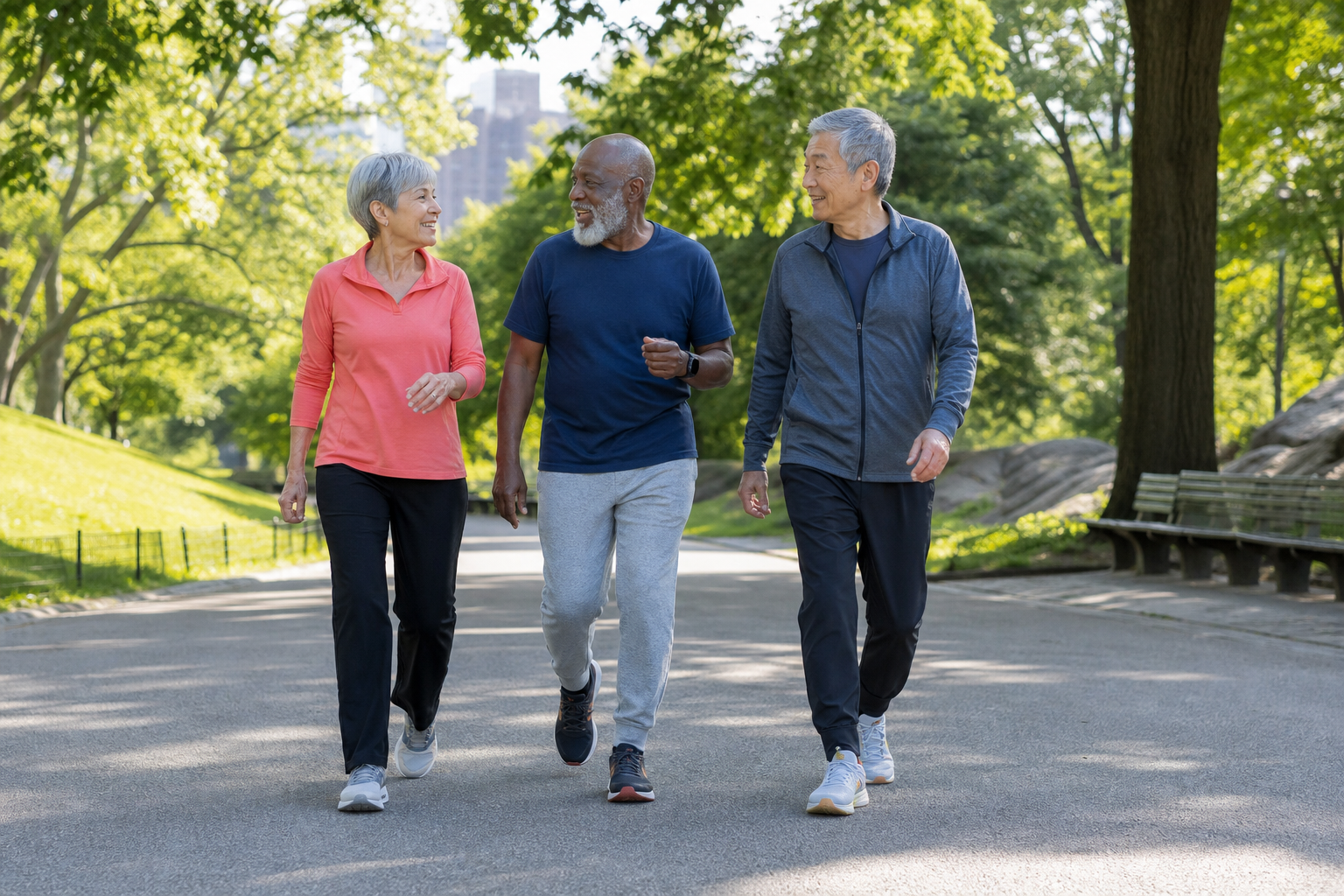
Walking Cadence and Healthy Aging: What Steps per Minute Can Tell You
Walking cadence describes step rhythm, not a universal fitness score. Learn how to use it alongside pace, effort, symptoms, and mobility goals as you age.
Table of Contents
DISCLAIMER
This article is for informational purposes only and does not constitute medical advice. The statements in this article have not been evaluated by the FDA. The information presented is based on published research and should not be used as a substitute for professional medical guidance. Consult your physician before starting any supplement or health protocol.
A step counter tells you how much walking accumulated. Cadence tells you something different: the rhythm of those steps, usually expressed as steps per minute. Two people can record the same daily total while one strolls intermittently and the other completes a sustained brisk walk.
That makes cadence useful, but easy to oversimplify. A watch may display a precise number that looks like a grade. It is not. Cadence is one measurement shaped by leg length, terrain, gait pattern, fitness, assistive devices, and the purpose of the walk.
Cadence, Speed, and Effort Are Related but Different
Walking speed depends on cadence multiplied by step length. A person can move faster by taking more steps per minute, lengthening each step, or doing some of both. Aging, pain, weakness, balance confidence, joint range, and neurological conditions can change either part of the equation.
Effort adds another dimension. The same cadence can be easy on a flat indoor track and demanding on a slope, in heat, or while carrying groceries. A shorter person may take more steps per minute than a taller person at the same speed. Someone using a cane or recovering from illness may reach moderate effort at a cadence that looks low compared with a generic target.
Researchers have studied cadence thresholds as practical indicators of walking intensity. Around 100 steps per minute is often discussed as a rough marker of moderate intensity for many adults. It is a heuristic derived from groups, not a diagnosis or prescription for every individual.
Use the Talk Test Beside the Number
Public-health guidance commonly defines moderate aerobic activity by relative effort. Breathing and heart rate rise, but conversation remains possible; singing would be difficult. The talk test captures context that a cadence value misses.
During a familiar walk, compare cadence with perceived effort and the talk test. If 92 steps per minute feels purposeful and raises breathing to a moderate level, that information is more useful than forcing 100. If 105 feels easy, a mild hill or longer continuous interval may add challenge without turning the walk into a race.
Wearables estimate cadence with movement sensors, and accuracy can vary with slow gait, pushing a cart, arm position, or device placement. Counting steps for 30 seconds and doubling the result provides a simple spot check. Look for repeatable patterns rather than obsessing over single-minute fluctuations.
Progress Walking Without Distorting Gait
Start with a pace that feels stable and natural. Add short purposeful intervals—perhaps one to three minutes slightly brisker—between easier walking. Over time, increase the number or length of the brisk intervals. Warm up and cool down, especially when joints feel stiff or cardiovascular fitness is limited.
Do not increase cadence by shuffling. Foot clearance, posture, and control still matter. Think about smooth, slightly quicker steps rather than reaching far forward with the heel. Overstriding may feel fast while increasing braking forces and instability.
Strength and balance work support walking quality. Calf raises, sit-to-stands, step-ups, and hip exercises can improve the capacity behind each step. A physical therapist can help when cadence is unusually low, sides differ, feet catch the floor, or faster walking makes coordination deteriorate.
Track a Personal Range, Not a Universal Score
A practical record might include daily steps, minutes of purposeful walking, typical cadence during a known route, and effort from 1 to 10. Add symptoms and terrain when relevant. This creates a personal baseline that can show whether the same route is becoming easier or whether illness, pain, or fatigue changed the pattern.
Sudden gait changes deserve attention. New weakness, dizziness, chest pressure, severe breathlessness, repeated stumbling, or a sharp decline in usual walking ability should not be treated as a motivation problem.
For healthy aging, cadence is most useful as feedback. It can help distinguish an easy stroll from a purposeful bout and make progression visible. The goal is not to satisfy a watch. It is to preserve the capacity to walk safely, confidently, and energetically through real life.
Frequently Asked Questions
Is 100 steps per minute required for a brisk walk?
Is cadence the same as daily step count?
Should I increase cadence if walking causes pain or breathlessness?
Sources
Stay Updated on Longevity Science
Weekly research digests. No spam, unsubscribe anytime.
Related Articles

Circadian Amplitude and Healthy Aging: Why Strong Daily Rhythms Matter
Explore circadian amplitude healthy aging research and learn why stronger daily light, sleep, activity, and meal rhythms may support long-term resilience.
10 min read
Alcohol and Aging: What the Latest Research Says
A review of the latest research on alcohol's effects on aging, biological age, disease risk, and longevity, including evolving views on moderate drinking.
9 min read
Blue Light and Aging: How Screen Time May Be Accelerating Your Biological Clock
Examine the evidence linking blue light exposure to accelerated aging through circadian disruption, retinal damage, and metabolic effects. Practical mitigation tips.
11 min read