The Vestibular System and Healthy Aging: Why Balance Depends on More Than Muscle
Balance depends on the inner ear, vision, sensation, and the brain—not strength alone. Learn how vestibular aging affects stability and what evidence supports.
Table of Contents
DISCLAIMER
This article is for informational purposes only and does not constitute medical advice. The statements in this article have not been evaluated by the FDA. The information presented is based on published research and should not be used as a substitute for professional medical guidance. Consult your physician before starting any supplement or health protocol.
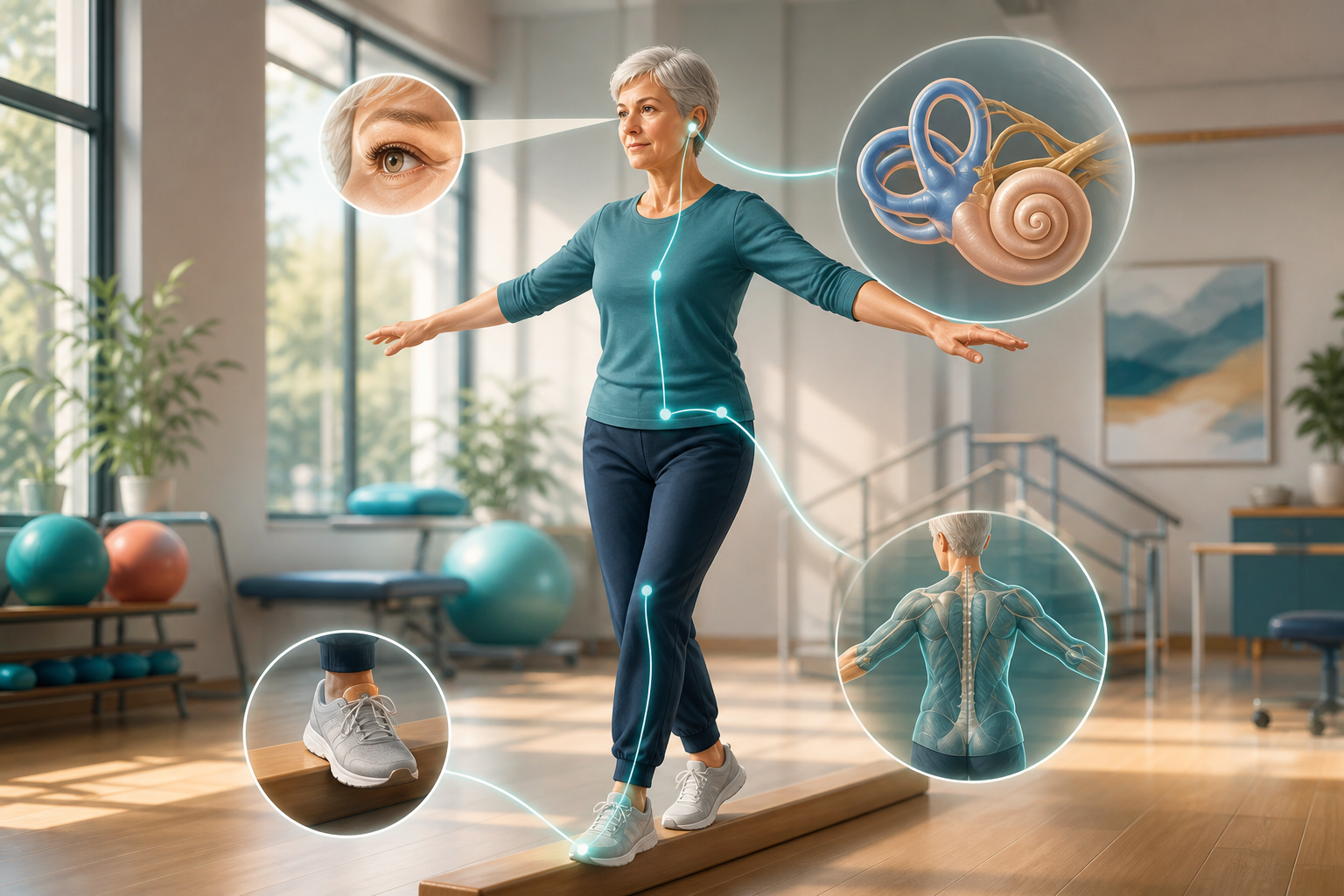
Standing still is not a passive act. The brain continuously compares signals from the inner ears, eyes, feet, joints, and muscles, then makes tiny corrections before the body visibly sways. Healthy balance is a multisystem prediction problem, not simply a test of leg strength.
That distinction matters with age. A person can have strong legs and still feel unstable in darkness, on uneven ground, or while turning the head. Another person may have reduced strength but compensate well because sensory information remains reliable. Understanding the vestibular system helps explain why balance problems vary—and why effective training often uses more than one kind of exercise.
What the Vestibular System Actually Does
Each inner ear contains semicircular canals that detect head rotation and otolith organs that respond to linear acceleration and gravity. Together, they tell the brain how the head is moving even when the eyes are closed.
One important reflex, the vestibulo-ocular reflex, stabilizes vision during head movement. It lets a street sign remain readable while you walk. Vestibular signals also influence posture through pathways that adjust the trunk and limbs.
The brain does not trust this system in isolation. It combines vestibular input with vision and somatosensation—the pressure and position signals from the feet, muscles, and joints. On a firm, well-lit floor, all three sources usually agree. On soft ground in dim light, the brain must depend more heavily on vestibular information.
How Vestibular Function Can Change With Age
Research describes age-related changes in hair cells, vestibular nerve fibers, central processing, and reflex performance. These changes do not affect everyone equally, and a laboratory decline does not automatically produce symptoms. The brain can recalibrate and use other senses to compensate.
Compensation becomes harder when several systems decline together. Reduced contrast vision, peripheral neuropathy, slower reaction time, medication effects, hearing loss, and deconditioning can narrow the margin for error. A minor trip that would once trigger a fast step may become a fall.
This is also why “dizziness” is too broad to be a diagnosis. People use the word for spinning, lightheadedness, rocking, faintness, visual motion sensitivity, or simple unsteadiness. Inner-ear disorders are one possible cause among cardiovascular, neurological, metabolic, medication-related, and psychological causes.
Clues That Balance Is Relying on Compensation
Some patterns can suggest that the brain is leaning heavily on vision or firm-surface sensation:
- instability becomes worse in darkness or when closing the eyes;
- walking on grass, sand, or thick carpet feels unusually difficult;
- busy stores or scrolling scenes create disorientation;
- quick head turns blur vision or make walking drift;
- turning, bending, or getting out of bed triggers brief spinning.
These patterns are not self-diagnostic. Brief position-triggered spinning may reflect benign paroxysmal positional vertigo, while persistent imbalance has many other causes. Hearing changes, ear fullness, headache, numbness, double vision, fainting, or new neurological symptoms change the clinical picture.
What Training Can Improve
Balance training works best when it practices the demands that daily life creates. A simple program may include progressively narrower stances, controlled weight shifts, stepping in different directions, and safe practice on varied surfaces. Strength and power training improve the ability to recover once balance is challenged.
Vestibular rehabilitation adds targeted elements. Gaze-stabilization exercises pair head movement with a visual target. Habituation exercises gradually reduce sensitivity to specific movements. Sensory-integration tasks teach the brain to select useful information when vision or the support surface is unreliable.
The correct dose depends on the problem. Randomly provoking severe dizziness is not a shortcut to adaptation, and some positional disorders respond better to a specific repositioning maneuver than to general exercise. A vestibular physical therapist can identify which deficits are trainable and design safe progression.
Walking remains important, but ordinary walking on predictable surfaces may not challenge every missing capacity. Multicomponent programs that combine strength, gait, reaction, and balance practice have stronger fall-prevention logic than relying on one exercise or supplement.
A Practical, Low-Risk Starting Framework
For a generally stable adult, balance practice can begin near a sturdy counter with another person nearby if needed. The goal is controlled challenge, not repeated loss of control.
Start with tasks such as standing with the feet closer together, slow marching, deliberate side steps, and sit-to-stand practice. Progress one variable at a time: hand support, stance width, head movement, surface, or visual conditions. Avoid closing the eyes or using unstable surfaces without an appropriate safety setup.
Reviewing footwear, vision correction, home lighting, and medications can matter as much as adding another drill. Hydration and blood-pressure changes also deserve attention when symptoms occur after standing.
Balance should be treated as a functional vital sign. Difficulty rising from a chair, repeated near-falls, new fear of walking outside, or a growing need to touch walls are useful signals to seek assessment early.
The Healthy-Aging Perspective
The vestibular system illustrates a broader principle of aging: function emerges from coordination. Muscle, sensation, attention, vision, and the inner ear share the work. Improving one component can create more reserve, but no single component explains every outcome.
The encouraging part is that the nervous system retains adaptive capacity. Targeted practice can improve gaze stability, sensory selection, stepping strategy, confidence, and participation, even when it cannot restore every age-related change.
Persistent imbalance is not a character flaw and should not be accepted as an inevitable price of getting older. The useful question is not merely “Are the legs strong?” It is “Which information or response fails when the environment becomes difficult?” That question leads to safer, more specific action.
Frequently Asked Questions
Is worsening balance a normal part of aging?
Can strength training fix vestibular loss?
When should dizziness receive medical attention?
Sources
Stay Updated on Longevity Science
Weekly research digests. No spam, unsubscribe anytime.
Related Articles

Circadian Amplitude and Healthy Aging: Why Strong Daily Rhythms Matter
Explore circadian amplitude healthy aging research and learn why stronger daily light, sleep, activity, and meal rhythms may support long-term resilience.
10 min read
Alcohol and Aging: What the Latest Research Says
A review of the latest research on alcohol's effects on aging, biological age, disease risk, and longevity, including evolving views on moderate drinking.
9 min read
Blue Light and Aging: How Screen Time May Be Accelerating Your Biological Clock
Examine the evidence linking blue light exposure to accelerated aging through circadian disruption, retinal damage, and metabolic effects. Practical mitigation tips.
11 min read