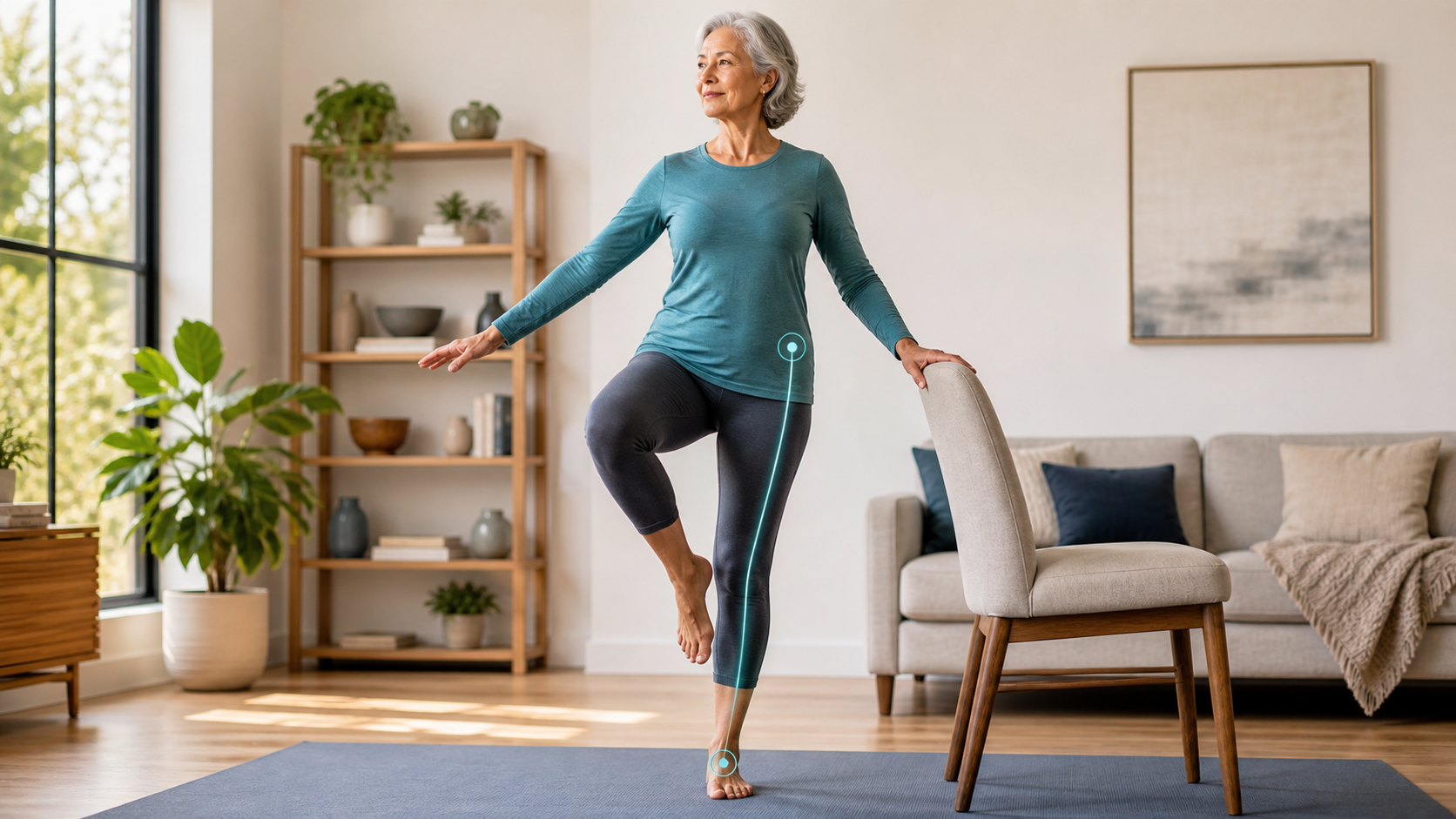
Single-Leg Balance for Healthy Aging: A Safe Practice Guide
Single-leg balance reflects several body systems working together. Learn what the test can and cannot show, plus a safe progression for everyday practice.
Table of Contents
DISCLAIMER
This article is for informational purposes only and does not constitute medical advice. The statements in this article have not been evaluated by the FDA. The information presented is based on published research and should not be used as a substitute for professional medical guidance. Consult your physician before starting any supplement or health protocol.
Standing on one leg looks simple because the corrections are small. Under the surface, the brain is integrating vision, inner-ear signals, sensation from the feet, ankle and hip strength, reaction speed, and confidence.
That makes single-leg balance useful as a functional snapshot, but not a stand-alone prediction of biological age or lifespan. The most valuable use is practical: identify a challenge, train it safely, and notice meaningful change over time.
What the Test Can Show
A one-leg stand can expose side-to-side differences and difficulty controlling the ankle or hip. Performance varies with footwear, surface, fatigue, pain, lighting, and whether a hand is near support. Comparing scores from different setups can be misleading.
Use the same safe conditions if you track progress. Stand beside a sturdy counter with another person nearby if needed. Stop the timer when the lifted foot touches down, the standing foot moves, or the hand takes support.
Why Balance Matters
Balance supports walking, stairs, turning, dressing, and recovering from a trip. Falls rarely have one cause. Vision, medicines, blood-pressure changes, home hazards, neuropathy, and muscle weakness can interact.
For that reason, balance training works best inside a broader plan that includes leg strength, gait, appropriate footwear, vision care, and medication review when indicated.
Start With a Supported Progression
Begin with feet together while lightly touching a counter. Progress to a semi-tandem stance, heel-to-toe stance, and then a supported single-leg stance. Use only enough fingertip contact to remain secure.
Try several short holds per side. Quality matters more than a long, wobbly attempt. Keep the standing knee soft, pelvis level, and gaze on a fixed point. Breathe normally.
Make the task harder by reducing hand support, increasing hold time, or adding slow head turns—but change only one variable at a time. Do not practice on unstable cushions until basic floor balance is comfortable and the environment is protected.
Add Strength and Real-World Movement
Calf raises, sit-to-stands, step-ups, and hip-strengthening exercises give balance corrections more physical capacity. Tai chi and structured multicomponent programs can train controlled weight shifts and stepping reactions.
Real life also requires dynamic balance. Practice deliberate turns, obstacle clearance, and controlled backward steps with professional supervision when risk is elevated.
When to Get Assessed
Contact a clinician or physical therapist after a fall, recurrent near-falls, new dizziness, numb feet, sudden weakness, or a large unexplained side difference. A brief home test should never replace evaluation of neurological, vestibular, cardiovascular, or medication-related causes.
The goal is not to win a balance score. It is to make everyday movement more adaptable, confident, and safe.
Frequently Asked Questions
Is standing on one leg a longevity test?
How often should balance be practiced?
Should I practice with my eyes closed?
Sources
Stay Updated on Longevity Science
Weekly research digests. No spam, unsubscribe anytime.
Related Articles
Circadian Amplitude and Healthy Aging: Why Strong Daily Rhythms Matter
Explore circadian amplitude healthy aging research and learn why stronger daily light, sleep, activity, and meal rhythms may support long-term resilience.
10 min read
Alcohol and Aging: What the Latest Research Says
A review of the latest research on alcohol's effects on aging, biological age, disease risk, and longevity, including evolving views on moderate drinking.
9 min read
Blue Light and Aging: How Screen Time May Be Accelerating Your Biological Clock
Examine the evidence linking blue light exposure to accelerated aging through circadian disruption, retinal damage, and metabolic effects. Practical mitigation tips.
11 min read