Creatine for Healthy Aging: Muscle, Brain, and Longevity Evidence
Creatine may support strength and cognition in some older adults. Review healthy-aging evidence, limitations, safety, and practical research questions.
Table of Contents
DISCLAIMER
This article is for informational purposes only and does not constitute medical advice. The statements in this article have not been evaluated by the FDA. The information presented is based on published research and should not be used as a substitute for professional medical guidance. Consult your physician before starting any supplement or health protocol.
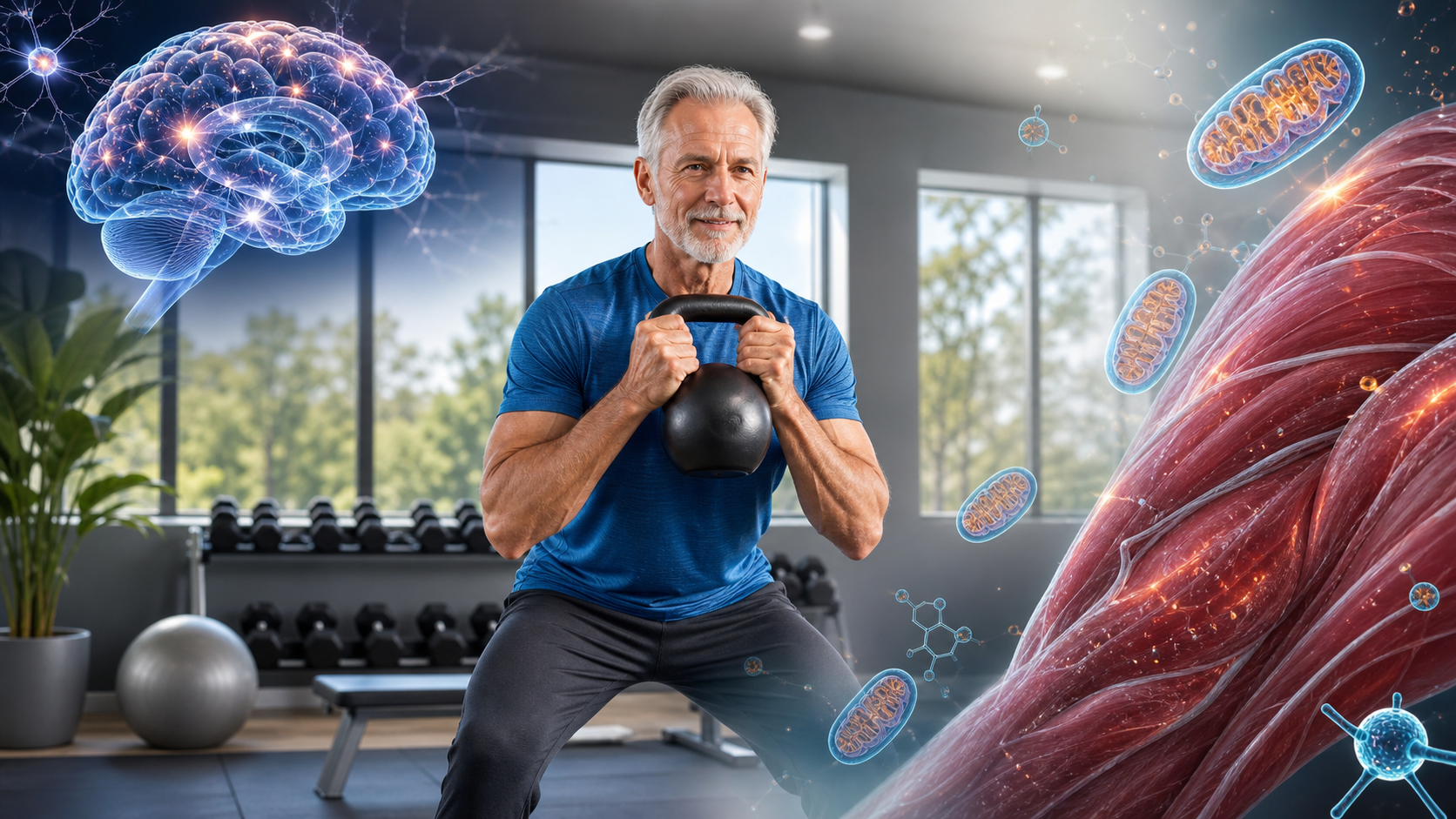
Creatine is usually pictured beside a shaker bottle in a gym. That image is too narrow. The compound helps recycle cellular energy in muscle and other high-demand tissues, including the brain. As loss of strength and cognitive resilience become central concerns with age, researchers have asked whether creatine for healthy aging, muscle, and cognition deserves a place beyond sports nutrition.
The strongest evidence concerns creatine combined with resistance training. Some meta-analyses find greater gains in lean mass and strength among older adults using creatine than among those training with placebo. Cognitive evidence is intriguing but less settled. No study shows that creatine extends human lifespan or reverses aging.
What Does Creatine Do in the Body?
Creatine is synthesized mainly from amino acids in the liver and kidneys and obtained from foods, particularly meat and fish. Most is stored in skeletal muscle as free creatine and phosphocreatine.
During a brief, intense demand for energy, phosphocreatine donates a phosphate group to help regenerate adenosine triphosphate, or ATP. This phosphagen system supports repeated muscular effort before slower energy pathways fully respond. Increasing muscle creatine stores can therefore improve the capacity to perform high-quality work across repeated sets.
That training effect matters more than a simplistic claim that creatine “builds muscle.” If a person can complete slightly more work, recover between efforts, and progress consistently, the training stimulus may accumulate. Creatine also draws water into muscle cells, so early scale or lean-mass changes do not represent new contractile tissue alone.
The brain uses the same creatine kinase system to buffer energy. Neural tissue has high and variable energy demands, which provides a rationale for studying cognition, sleep deprivation, depression, and neurological disease. A rationale, however, is only the start of evidence.
What Does Research Show for Older Muscle?
Aging is commonly accompanied by declining muscle mass, power, and neuromuscular function. Resistance training remains the most effective broadly applicable intervention. Protein intake, total energy, vitamin status, illness, and medication can influence the response.
Meta-analyses of trials in older adults suggest that creatine used during resistance training may add modest improvements in lean tissue and strength compared with training alone. Effects vary by study duration, sex, baseline diet, training program, and adherence. Some trials find clear benefits; others find little difference.
Power and functional performance deserve special attention. Rising from a chair, preventing a fall, and climbing stairs depend on force produced quickly, not only muscle size. Trials have examined sit-to-stand performance and other functional outcomes, but the evidence is less uniform than laboratory strength measures.
Creatine without training is less convincing as a strategy against sarcopenia. Supplementation may influence cell hydration and energy availability, but muscle adapts most strongly to mechanical loading. The combination is the relevant research model.
Could Creatine Support Cognition?
Systematic reviews of healthy adults report possible benefits in memory or reasoning, especially in people with lower dietary creatine intake, under sleep deprivation, or during cognitively demanding conditions. Vegetarians often have lower baseline muscle creatine stores, though brain uptake does not mirror muscle perfectly.
Older adults are of interest because brain energy metabolism, sleep, vascular health, and neurodegenerative risk change with age. Small studies have produced encouraging signals, but methods and outcomes differ. A benefit on one memory task does not establish prevention of dementia or broad cognitive rejuvenation.
The blood-brain barrier and local brain synthesis complicate the picture. Muscle creatine levels rise reliably with supplementation; brain concentrations may change less and more slowly. Researchers are testing different durations and populations to clarify who might respond.
For now, creatine should not be marketed as a cognitive-health therapy. New memory problems require medical assessment because medications, sleep disorders, depression, hearing loss, metabolic disease, and neurological conditions can contribute.
Does Creatine Affect Biological Aging or Lifespan?
Creatine may influence aging-relevant domains without changing the underlying rate of aging. Greater strength can support independence, activity, glucose disposal, and fall resistance. Better training capacity may help people maintain those advantages. If cognition benefits in some contexts, that could support function as well.
Those are meaningful outcomes, but they are not evidence of lifespan extension. Human longevity trials would require many years and careful control of exercise, diet, disease, and adherence. Biomarker studies are not a substitute for clinical outcomes, and no validated epigenetic-age claim currently follows from creatine use.
Animal and cellular research explores antioxidant effects, mitochondrial function, and energy stress. Translation into healthy human aging remains uncertain.
Safety and Practical Considerations
Creatine monohydrate is the most studied form. Research reviews generally find it well tolerated in healthy adults. Water retention can increase body mass, and gastrointestinal discomfort may occur, particularly when large amounts are taken at once.
Serum creatinine may rise because creatine breaks down into creatinine. This can complicate interpretation of a common kidney-function marker without necessarily indicating kidney injury. Clinicians can consider the full context and alternative markers when appropriate.
People with kidney disease, pregnancy, complex chronic illness, or medication concerns should consult a healthcare provider before using creatine. Product quality also matters; independent testing can reduce contamination and labeling risk.
Supplementation cannot compensate for inadequate training, protein, calories, sleep, or rehabilitation. A practical healthy-aging program begins with an individualized resistance-training plan and evaluation of barriers such as pain, balance, and cardiovascular limitations.
Limitations and Future Research
Many trials are short and enroll relatively healthy volunteers. Women and the oldest adults have not always been adequately represented. Lean mass is often estimated rather than directly measured, and cognitive trials use varied tests.
Future research should examine functional independence, falls, hospitalization recovery, brain creatine uptake, and longer-term safety in diverse older populations. Trials should also identify whether diet, sex, genotype, or baseline creatine status predicts response.
The Bottom Line
Creatine may be a useful adjunct to resistance training for strength and lean mass in some older adults, while cognitive benefits remain promising but uncertain. It is not a longevity shortcut. Anyone considering supplementation, especially with kidney disease or multiple medications, should consult a healthcare provider.
Frequently Asked Questions
Does creatine prevent age-related muscle loss?
Can creatine improve memory in older adults?
Is creatine safe for older adults?
Sources
- International Society of Sports Nutrition position stand: safety and efficacy of creatine supplementation(2017)
- Effect of creatine supplementation during resistance training on lean tissue mass and muscular strength in older adults(2014)
- Effects of creatine supplementation on cognitive function of healthy individuals: a systematic review(2018)
Stay Updated on Longevity Science
Weekly research digests. No spam, unsubscribe anytime.
Related Articles

Circadian Amplitude and Healthy Aging: Why Strong Daily Rhythms Matter
Explore circadian amplitude healthy aging research and learn why stronger daily light, sleep, activity, and meal rhythms may support long-term resilience.
10 min read
Alcohol and Aging: What the Latest Research Says
A review of the latest research on alcohol's effects on aging, biological age, disease risk, and longevity, including evolving views on moderate drinking.
9 min read
Blue Light and Aging: How Screen Time May Be Accelerating Your Biological Clock
Examine the evidence linking blue light exposure to accelerated aging through circadian disruption, retinal damage, and metabolic effects. Practical mitigation tips.
11 min read