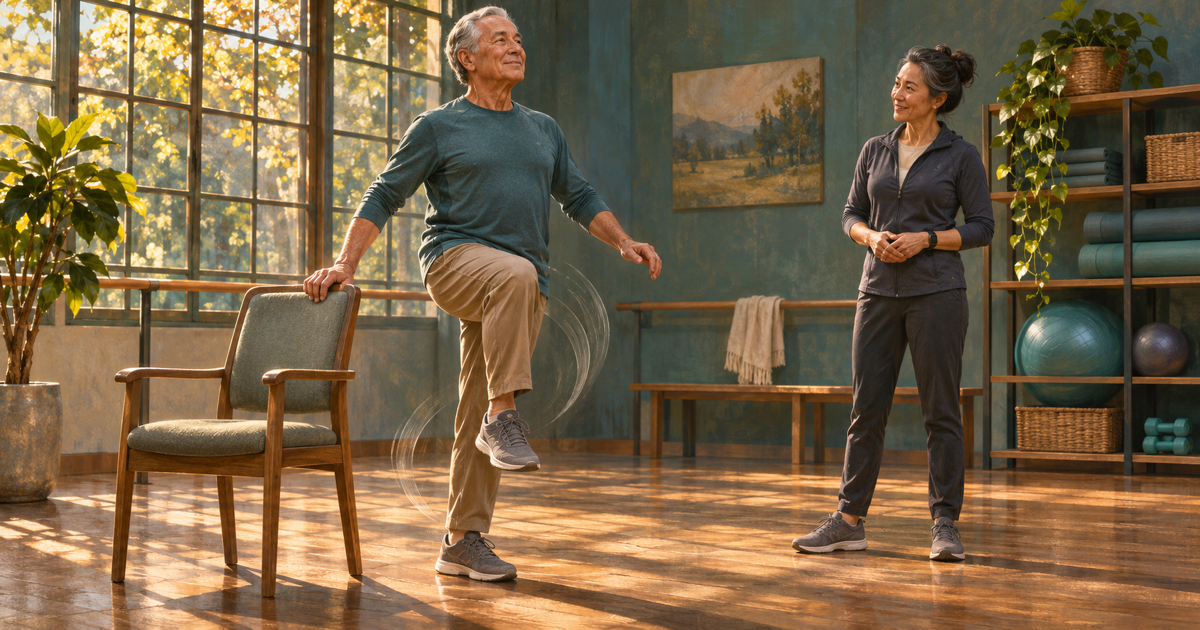
Balance Training May Reduce Falls, but It Does Not Eliminate Risk
Structured balance exercise may reduce falls in older adults. Study design helps explain why fewer falls do not automatically mean fewer fractures or longer life.
Table of Contents
DISCLAIMER
This article is for informational purposes only and does not constitute medical advice. The statements in this article have not been evaluated by the FDA. The information presented is based on published research and should not be used as a substitute for professional medical guidance. Consult your physician before starting any supplement or health protocol.
Fewer falls may be a meaningful outcome on their own
Research suggests that exercise designed around balance and everyday movement may reduce falls among older adults living independently. That finding supports a specific claim about physical function and injury prevention. It does not establish that balance training reverses biological aging, prevents every fracture, or extends life. The useful question is whether a particular program may help a particular person remain mobile with fewer falls.
The distinction matters because a fall is an event people experience, rather than a laboratory marker whose importance must be inferred. A program might be worthwhile without changing an epigenetic clock or a blood test. Equally, an improvement on a balance test should not automatically be presented as proof that falls outside the clinic have become less likely. Those are different outcomes, and a convincing study needs to identify which one it measured.
The US Preventive Services Task Force’s 2024 recommendation supports exercise interventions for community-dwelling adults aged 65 or older who have increased fall risk. Its assessment describes a moderate net benefit with moderate certainty. That is a clinically relevant endorsement with a defined population, rather than a promise that any exercise class will protect anyone who attends.
For readers assessing healthy-aging claims, this is a useful standard: look for a clearly described intervention, a relevant comparison group, and an outcome that matters in daily life. A claim about fewer falls may be supported even when a claim about rejuvenation is not. Keeping that boundary visible may make the practical benefit easier to understand without exaggerating its reach.
Balance practice may target a specific movement problem
The proposed rationale for balance training is task-specific. Moving from sitting to standing, transferring body weight, turning, and placing a foot accurately may challenge control in ways that repeated straight-line walking does not. The 2022 world guidelines on falls prevention emphasize balance-challenging and functional exercises, with examples including stepping and rising from a chair. They also emphasize individual adaptation and progression.
These examples help explain why a fall-prevention intervention may look different from a general fitness session. The intended challenge may involve controlling movement during a transition, rather than simply completing more repetitions or becoming breathless. A person might be able to walk a familiar route yet find a turn in a confined space difficult. That example illustrates the proposed training target; it is not a diagnostic test.
A plausible mechanism is that repeated practice may improve the coordination needed to manage these movements. However, an intervention that reduces falls does not, by itself, reveal exactly which adaptation produced the result. Changes in strength, confidence, movement strategy, or participation could contribute. A study would need additional measurements and an appropriate analysis to distinguish these possibilities rather than assigning the whole benefit to one mechanism.
The practical implication may be to examine what a program actually teaches. The label ‘balance’ provides less information than a description of the movements, how difficulty is adjusted, and what support is available. A dramatic demonstration of unsupported standing may be less informative than a clear explanation of how an instructor adapts a task for someone who uses a walking aid or struggles to rise from a chair.
A lower fall rate is different from fewer people falling
A major Cochrane review published in 2019 included 108 randomized studies involving 23,407 participants. In the analysis of overall fall rate, exercise was associated with a 23% relative reduction compared with control interventions. Balance and functional exercise showed a similar pattern. The review rated the overall fall-rate finding as high-certainty evidence, while describing greater uncertainty for several injury outcomes.
The word ‘rate’ is essential. A study may count every fall, including several experienced by the same participant. Another outcome may count how many people fell at least once. A program could reduce repeated falls among a smaller group without producing an equally large reduction in the number of people who ever fall. Neither measure is inherently misleading, but substituting one for the other changes the meaning.
Consider a hypothetical comparison, separate from the review’s data. Suppose two groups each contain 100 people. In one group, 20 people fall twice; in the other, 20 people fall once. The second group has half as many falls, yet the same proportion of people has fallen. A headline saying that half as many people fell would be wrong. Reporting the event count alongside the participant count may prevent that error.
Relative reductions also require a baseline. A 20% relative reduction would correspond to two fewer events when the starting count is 10, but 20 fewer when it is 100, assuming comparable follow-up. Those arithmetic examples are not forecasts for an individual. They show why the same relative result may have different practical implications in populations with different starting risks.
The Cochrane authors also described limitations in reporting fractures, hospitalizations, medical attention, and adverse events. Fewer falls may be encouraging without proving an equally certain reduction in hip fractures or hospital admissions. Those outcomes need their own evidence, rather than being treated as automatic consequences of a favorable fall-rate result.
One tai ji quan study tested a defined program
A 2018 randomized study led by Fuzhong Li provides a concrete example of why program details matter. Researchers enrolled 670 community-dwelling adults aged 70 or older in Oregon who had a recent fall or impaired mobility. Participants were assigned to therapeutic tai ji quan, a multimodal exercise program, or stretching. This was a comparison among organized interventions, rather than a simple comparison between activity and inactivity.
Over 24 weeks, researchers recorded 152 falls in the therapeutic tai ji quan group, 218 in the multimodal group, and 363 in the stretching group. The analysis estimated a 58% lower fall rate for therapeutic tai ji quan compared with stretching, and a 31% lower rate compared with multimodal exercise. These findings suggest a benefit for the tested intervention under the study’s conditions.
They do not establish that every tai chi class would reproduce that result. The intervention was therapeutically tailored, and the study used organized classes over a defined period. An online video, a recreational park session, and a structured clinical program may differ in instruction, progression, attendance, and participant selection. Treating them as interchangeable would extend the finding beyond what was tested.
The comparison group also matters. ‘Lower than stretching’ and ‘lower than another exercise program’ answer different questions. A large advantage over one comparator should not be assumed to apply against every alternative. Readers may learn more from the actual comparison than from an isolated percentage detached from the program that produced it.
The participants’ average age was approximately 78, and most were white. Those features may limit how confidently the result can be generalized to other populations. Random assignment strengthens a causal interpretation within a study; it does not make the enrolled sample representative of every older adult. The appropriate conclusion remains specific to the intervention, participants, and follow-up examined.
How study design may change the interpretation
A useful reading checklist begins with the main outcome: did investigators count real-world falls, assess performance on a movement test, or ask participants how confident they felt? Each may provide useful information, but they address different questions. Confidence could improve without a demonstrated change in injuries. A movement test could improve without enough follow-up to establish whether falls became less frequent.
Next, examine how falls were recorded. A report based on recollection at the end of a long interval may differ from one that gathers information repeatedly. This is a methodological concern rather than an accusation that participants report inaccurately. If one group receives more frequent contact, investigators also need to consider whether opportunities to report events differ between groups.
Blinding presents another challenge. Participants usually know whether they are attending an exercise class, and instructors know what they are teaching. That awareness may influence expectations or behavior. Outcome assessment can sometimes be organized independently, but calling a study randomized does not resolve every source of bias. The Cochrane review specifically noted common concerns around blinding and other study limitations.
Follow-up length changes the question as well. A benefit measured during an organized program may not establish how long it persists after classes end. A result over several months should not be converted into a claim of permanent protection. To support that claim, researchers would need longer observation and information about what participants continued doing after the intervention.
The 2024 evidence summary prepared for the US Preventive Services Task Force found that exercise showed the most consistent statistically significant benefit across multiple fall-related outcomes. That synthesis supports considering structured exercise while preserving uncertainty about the best approach for each individual. A pooled result may support a category of interventions without identifying one universally superior class.
A useful program may need to fit the person and the setting
The world guidelines favor appropriately trained providers who can adapt exercise to functional ability and medical conditions. That recommendation may be particularly relevant when someone needs support during standing or transitions. Progression should not be interpreted as removing assistance as quickly as possible. The purpose of adjustment is to create a manageable challenge within an appropriate setting, rather than to make a task look impressive.
For someone comparing services, concrete questions may be more useful than promises of transformation. How does the provider assess the starting point? How are tasks modified when a participant struggles? What happens after an absence or a change in mobility? These questions do not prescribe an exercise routine. They help reveal whether a service resembles an adaptable intervention or offers the same sequence to everyone.
Access is part of the intervention’s practical meaning. Transport, cost, language, and the suitability of the venue may determine whether attendance is realistic. A program that performs well under study conditions may offer less benefit if people cannot reach it or continue participating. The USPSTF explicitly connects the pathway to benefit with interventions being available, accessible, and provided equitably.
Exercise may also address only part of a person’s fall risk. The CDC’s overview of older-adult falls identifies contributors including balance difficulties, lower-body weakness, some medications, vision problems, and environmental hazards. That framing suggests why a class should not be expected to resolve every cause. A loose rug and a medication-related episode of dizziness are different problems, even if either could precede a fall.
The USPSTF therefore distinguishes exercise from multifactorial interventions, which begin with assessment and target identified risks. It recommends individualizing the decision to offer the latter. This distinction may help avoid two extremes: assuming a class is sufficient for everyone, or assuming everyone needs the same extensive package of services. The relevant assessment may depend on prior falls, other conditions, and personal circumstances.
A sensible outcome discussion may include both events and daily function: whether falls recur, whether everyday movement feels manageable, and whether participation is sustainable. These observations are not interchangeable with a formal study endpoint, but they may help a clinician and participant judge whether an approach fits. The defensible promise remains limited: structured balance and functional exercise may reduce falls for some older adults; it does not remove all risk or demonstrate biological rejuvenation.
Frequently asked questions
Does balance training prevent every fall?
No. Research suggests that structured programs may reduce fall rates, but falls can occur during participation and may have several contributing causes.
Is tai chi the same as the program tested in Oregon?
Not necessarily. The favorable result concerned a therapeutically tailored tai ji quan intervention; other classes may differ in content, instruction, and progression.
Do fewer falls prove that people live longer?
No. A lower fall rate may be valuable, but it does not establish longer survival, fewer fractures, or reversal of biological aging.
This article summarises published research and is not medical advice. Consult your healthcare provider before changing your routine.
Frequently Asked Questions
Does balance training prevent every fall?
Is tai chi the same as the program tested in Oregon?
Do fewer falls prove that people live longer?
Sources
- Cochrane: Exercise for preventing falls in older people living in the community(2026)
- Li et al.: Therapeutic tai ji quan versus multimodal exercise and stretching(2026)
- World guidelines for falls prevention and management for older adults(2026)
- USPSTF: 2024 falls prevention recommendation(2026)
- USPSTF: Falls prevention evidence summary(2026)
- CDC: Facts About Older Adult Falls(2026)
Stay Updated on Longevity Science
Weekly research digests. No spam, unsubscribe anytime.
Related Articles
Circadian Amplitude and Healthy Aging: Why Strong Daily Rhythms Matter
Explore circadian amplitude healthy aging research and learn why stronger daily light, sleep, activity, and meal rhythms may support long-term resilience.
10 min read
Alcohol and Aging: What the Latest Research Says
A review of the latest research on alcohol's effects on aging, biological age, disease risk, and longevity, including evolving views on moderate drinking.
9 min read
Breathwork Practices That May Support Healthy Aging
Explore how breathwork techniques like box breathing, Wim Hof, and pranayama may influence stress, inflammation, and biological aging markers.
12 min read