Calorie Restriction May Shift Blood Markers, but Longer Life Is Unproven
The CALERIE trial suggests eating less may improve some metabolic measures, but clock changes cannot establish longer life, and bone loss complicates the findings.
Table of Contents
DISCLAIMER
This article is for informational purposes only and does not constitute medical advice. The statements in this article have not been evaluated by the FDA. The information presented is based on published research and should not be used as a substitute for professional medical guidance. Consult your physician before starting any supplement or health protocol.
What CALERIE may establish about eating less
Calorie restriction may alter several measures associated with later-life health, but the CALERIE trial does not establish that it extends human life. That distinction matters because a favorable laboratory result may be meaningful without proving that people will live longer, avoid disability, or remain independent. For healthy-aging readers, the central question may be whether the measured benefits justify the intervention’s burdens and possible harms.
In the trial’s main analysis, investigators compared 143 participants assigned to calorie restriction with 75 assigned to continue eating freely for two years. Participants were generally healthy adults without obesity, approximately 21–50 years old. The intervention targeted a 25% reduction from estimated energy requirements, while the achieved average reduction was approximately 12%. These figures describe an experimental intervention; they should not be read as a personal intake recommendation. The original trial report suggests that sustained restriction was feasible for some carefully selected volunteers.
The comparison may offer stronger causal information than a survey of people who voluntarily eat less. Random assignment may reduce the possibility that initial differences in health or motivation explain the results. Nevertheless, participants knew their assignments, and the intervention included substantial behavioral support. The experiment may therefore estimate the effect of an organized dietary program rather than the isolated effect of subtracting calories from an otherwise identical life.
Its scope also deserves attention. A study in relatively young, healthy volunteers may help investigate prevention before chronic disease develops. It may say much less about an older person with reduced appetite, established osteoporosis, or difficulty maintaining weight. Interpreting the result as a universal instruction to eat less would require a substantial extrapolation beyond the people actually studied.
Metabolic improvements may matter without proving longer life
A later CALERIE analysis suggests that restriction may improve several conventional cardiovascular and metabolic risk measures. Investigators reported favorable changes in LDL cholesterol, blood pressure, an insulin-sensitivity index, and C-reactive protein relative to controls. Participants assigned to restriction also lost about 10% of their initial weight on average. These findings may support a plausible preventive benefit, particularly when considered as a pattern rather than as one isolated laboratory result. The cardiometabolic analysis reported exploratory outcomes rather than a trial of cardiovascular events.
Risk factors and clinical outcomes answer different questions. A lower cholesterol measurement may strengthen the case for a cardiovascular mechanism, but this experiment did not demonstrate fewer heart attacks. Better insulin sensitivity may suggest improved glucose regulation, but it does not by itself establish that diabetes was prevented. Neither finding supplies a direct estimate of additional years of life.
The authors’ sensitivity analysis suggests that the metabolic findings may not be explained entirely by the amount of weight lost. That is an interesting clue, but statistical adjustment cannot fully separate calorie intake, changing body composition, and other behavioral changes. A cleaner test of a calorie-specific mechanism might compare interventions producing similar weight changes through different routes, with comparable contact and nutritional support.
For readers, the useful distinction may be between a credible intermediate benefit and an unmeasured ultimate benefit. Rejecting a lifespan claim does not make improvements in established risk measures irrelevant. Equally, recognizing those improvements does not require calling the intervention rejuvenation. The strongest interpretation may remain tied to the outcomes measured, the population enrolled, and the two-year observation period.
Absolute benefit may also depend on starting risk. Someone whose measurements already sit within healthy ranges may have less room for a clinically important improvement than someone with a diagnosed metabolic condition. CALERIE cannot provide a personalized calculation of that tradeoff. A small average laboratory change may be scientifically informative while leaving an individual’s treatment decision unresolved.
One molecular clock may respond while others do not
A 2023 post hoc analysis used stored blood samples to examine DNA methylation, chemical marks on DNA that may reflect aspects of physiology. Researchers reported an approximately 2–3% slowing on DunedinPACE, an algorithm intended to estimate the pace of aging. They did not find significant intervention effects on the PC PhenoAge and PC GrimAge measures. The molecular analysis therefore suggests a selective response rather than agreement across every clock examined.
A pace estimate and an age estimate may capture different features of the same sample. Their disagreement may reflect differences in construction, sensitivity, or the processes they track. It does not automatically invalidate the positive result, but it limits the claim that the intervention broadly reversed biological age. The clock findings may be best treated as a hypothesis-generating molecular signal within a randomized experiment.
Most importantly, a 2–3% change in a clock output should not be translated into a corresponding percentage increase in lifespan. That translation would require assumptions about whether an intervention-induced clock change predicts later disease and mortality. The trial did not establish that relationship. A clock may be useful for studying a response without yet being a validated substitute for a clinical outcome.
Consider the distinction through a hypothetical example. If two dietary programs produced the same clock improvement but one also caused more fractures, the clock alone would not identify the preferable program. The decision would depend on the full pattern of outcomes. This illustrates why a molecular result may contribute to an assessment while remaining insufficient to settle it.
For a clock to become a dependable decision tool, future work would ideally show that its changes anticipate patient-important benefits across multiple interventions. Repeated measurements, independent laboratories, and prespecified analyses could strengthen confidence. Until then, purchasing a commercial clock test after changing one’s diet may produce a number whose personal clinical meaning remains uncertain.
Bone and body composition may complicate the benefit
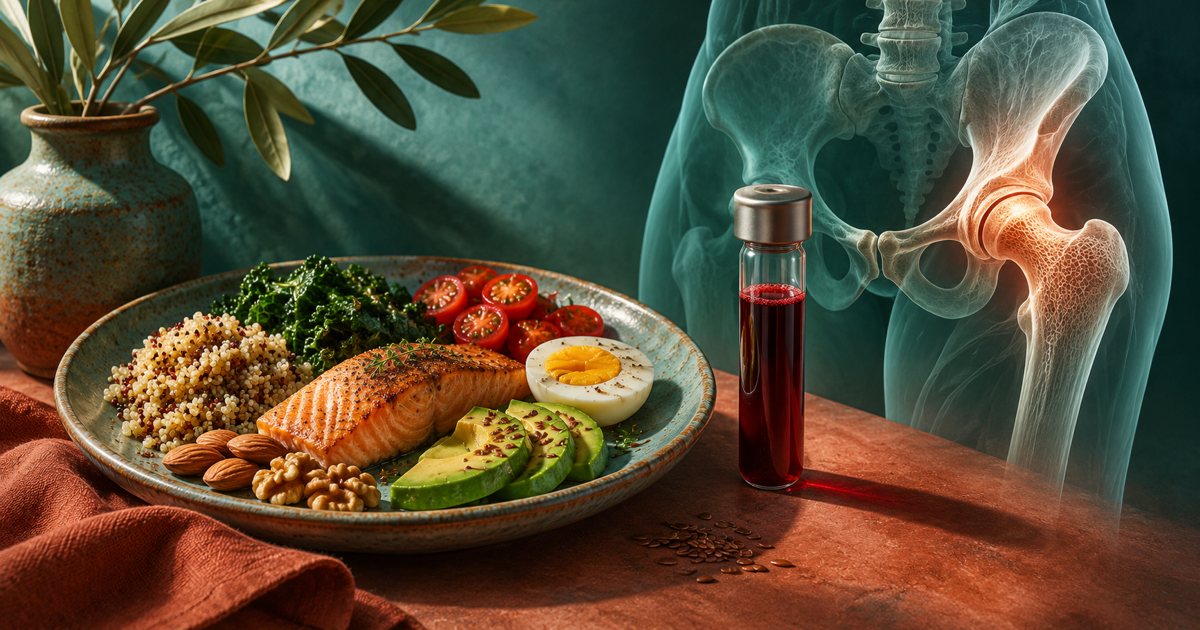
The skeletal findings suggest a concrete reason to resist a simple ‘less food means better health’ interpretation. In a CALERIE analysis, the restriction group experienced greater reductions in bone mineral density at the lumbar spine, total hip, and femoral neck than controls. The same report described losses of both fat and fat-free mass. The bone study suggests that favorable metabolic changes may coexist with measurable skeletal costs.
At the total hip, the reported average change over two years was approximately −0.017 grams per square centimeter in the restriction group, compared with approximately +0.001 in controls. These measurements do not establish that participants subsequently experienced more fractures. They do, however, identify a safety signal that a discussion centered only on cholesterol or molecular clocks could overlook.
Possible explanations may include reduced mechanical loading as body weight falls and changes in signals involved in bone turnover. Those mechanisms should be distinguished from proof of a single causal pathway. The trial’s observed density changes may justify further investigation even when the relative contributions of weight loss, nutrition, and hormonal adaptation remain uncertain.
A separate body-composition analysis suggests that much of the weight reduction came from fat, with a smaller reduction in fat-free mass. That distinction may improve interpretation of the scale reading: weight loss was not exclusively fat loss. Fat-free mass measurements also should not be equated directly with muscle strength, walking ability, or the capacity to recover after illness.
For healthy-aging research, this creates a demanding standard. A strategy intended to improve later-life health would ideally preserve physical reserve while reducing disease risk. Favorable blood tests may be less persuasive if accompanied by losses that could matter for mobility or resilience. CALERIE does not settle that long-term balance, particularly for people who already have limited skeletal or nutritional reserve.
The bone findings also caution against assuming that a nutritionally planned intervention must be free of structural tradeoffs. Adequate attention to nutrients and an observed change in bone density may coexist. Future trials could investigate whether different dietary designs or accompanying activity programs modify that balance, but such possibilities should not be presented as demonstrated solutions to the CALERIE finding.
Tolerability may depend on the people and support involved
Calorie restriction is sometimes portrayed as inevitably making people miserable. A CALERIE report suggests a more qualified picture: participants assigned to restriction reported some improvements in mood and perceived general health, without an overall deterioration in the measured health-related quality-of-life outcomes. The questionnaire study may therefore challenge an assumption that sustained restriction necessarily worsens well-being in selected healthy adults.
That finding has boundaries. Self-reported mood and health may reflect multiple aspects of participation, including weight changes, expectations, and contact with staff. Because participants knew which program they were following, questionnaire results may be especially sensitive to those influences. The results do not imply that everyone who restricts food will feel better or that restrictive eating is psychologically appropriate for every reader.
Feasibility also includes more than completing a study visit. A program may require planning meals, attending appointments, managing hunger, and maintaining motivation. These demands may be acceptable to a volunteer who actively sought a nutrition trial but harder to accommodate in other circumstances. An intervention’s practical value may depend partly on whether similar support is accessible outside a research center.
The gap between targeted and achieved restriction may be informative here. It suggests that even motivated participants receiving support did not, on average, sustain the full experimental target. That observation should not become an argument for greater personal discipline. It may instead help researchers design interventions that are more realistic and assess outcomes at the level of change people actually maintain.
Questions about acceptability may also differ across life stages. An older adult concerned about unintentional weight loss faces a different problem from a younger volunteer seeking planned weight reduction. The trial’s reassuring questionnaire averages cannot resolve that difference. A discussion with a clinician or registered dietitian may help connect an individual’s nutritional status and health priorities with the much narrower trial findings.
What stronger follow-up would need to show
A more decisive healthy-aging trial would ideally follow participants long enough to measure outcomes they can experience: diagnosed disease, fractures, physical function, and survival. It would also examine whether any benefits persist after the intensive support ends. Two-year changes may establish that a physiological response is possible while leaving its durability and eventual clinical value uncertain.
Prespecification would strengthen the molecular component. Researchers could identify a limited set of clock outcomes before analyzing samples and explain how they will handle multiple comparisons. Independent replication could then test whether the same signal appears in another population. These steps may help distinguish a reproducible response from a finding that depends heavily on one dataset or analytical choice.
A useful design would also separate questions that public discussion often combines. Does an intervention reduce energy intake? Does it change body composition? Does it improve a validated disease-risk measure? Does it preserve strength and bone? Does it ultimately improve health or survival? A positive answer at one step may justify investigating the next, but it should not substitute for answering it.
Different comparison groups could clarify mechanisms. Equal staff contact might help isolate the contribution of dietary changes from the effect of support. Comparisons with similar weight loss could investigate whether energy restriction has effects beyond weight change. Including participants with different baseline risks could reveal whether the balance of benefit and harm varies in clinically useful ways.
For a reader assessing a new headline, three details may offer an efficient check: who participated, what changed, and what was never measured. A study of younger adults may not answer a question about frailty. A methylation algorithm may not answer a question about survival. A favorable average may not describe every participant. Those distinctions can preserve the useful information without enlarging the claim.
As of this November 7, 2026 explainer, the CALERIE findings discussed here may support calorie restriction as an informative human experiment in metabolic and molecular adaptation. They do not establish a universally beneficial eating prescription or a proven way to extend life. The unresolved issue may be whether favorable signals can translate into durable clinical benefits while preserving bone, function, and nutritional adequacy.
Frequently asked questions
Did CALERIE prove that eating less extends human life?
No. The trial suggests changes in several intermediate measures, but its two-year findings do not establish longer survival.
Does the clock result mean participants became younger?
Not necessarily. One pace-of-aging measure responded, while two age-estimating measures did not show significant effects; this may indicate a limited molecular response.
Should an older adult copy the trial’s calorie target?
The findings do not support a universal target. Bone, weight, appetite, and medical history may change the balance, making individualized nutritional assessment more appropriate.
This article summarises published research and is not medical advice. Consult your healthcare provider before changing your routine.
Frequently Asked Questions
Did CALERIE prove that eating less extends human life?
Does the clock result mean participants became younger?
Should an older adult copy the trial's calorie target?
Sources
- Ravussin et al. — A 2-Year Randomized Controlled Trial of Human Caloric Restriction(2026)
- Kraus et al. — Two Years of Calorie Restriction and Cardiometabolic Risk Factors(2026)
- Waziry et al. — Effect of long-term caloric restriction on DNA methylation measures of biological aging(2026)
- Villareal et al. — Two-Year Caloric Restriction, Bone Metabolism, and Bone Mineral Density(2026)
- Das et al. — Body-composition changes in the CALERIE-2 study(2026)
- Martin et al. — Calorie Restriction, Mood, and Quality of Life in CALERIE 2(2026)
Stay Updated on Longevity Science
Weekly research digests. No spam, unsubscribe anytime.
Related Articles

Science-Backed Anti-Aging Foods: What to Eat
Discover the top science-backed anti-aging foods that may slow biological aging, from berries to leafy greens and fatty fish.
9 min read
Anti-Inflammatory Diet and Aging: Research-Backed Strategies
Explore the science behind anti-inflammatory diets and their role in mitigating inflammaging, promoting healthspan, and supporting longevity.
12 min read
Astaxanthin May Support Skin and Eye Health, But Longevity Claims Outrun?
Astaxanthin is a carotenoid with antioxidant and anti-inflammatory activity. Trials suggest modest skin and eye benefits, but human longevity data remain thin.
8 min read